

- Joined
- Nov 21, 2019
- Messages
- 6,792
- Reaction score
- 124,314
- Points
- 11
- Age
- 55
- Location
- Орёл
- 💎VM
- 432,340.00
- New country
- 🌐Единия
- Enneatype
- 5 (?)
- Gender
- Male
- Ashram resident
- Yes
If neo-Slavism and various forms of neo-paganism are often merely inventions of self-proclaimed “experts in the Russian Vedas,” then with the Scandinavian Gods, everything is different.
There are no “experts” there who suddenly burst onto the internet shouting that they had their own Vedas, their own runes, that everything was their own, and that the whole world did nothing but borrow everything from them...
What is more, they have nothing to do with Russia or the Russian Federation. And it is mutual. Especially considering the fact that Russians have hated the Scandinavian Gods since ancient times, and that they were destroyed in every possible way throughout history.
Of course, long ago, before the time when Russians enslaved you, we had our own history, and the Scandinavian Gods had a place in it.
First and foremost, the word “Scandinavian” contains the Sanskrit root “skanda.”
There is even a Skanda Purana.
“Skanda Purana” — a sacred Hindu text in Sanskrit, the largest in volume among the eighteen principal Puranas (called “mahapuranas”).
First and foremost, it is important to understand that this is partly about very powerful northern magic.
Not black or white
Simply Knowledge.
Often, the knowledge of Nature and the Cosmos.
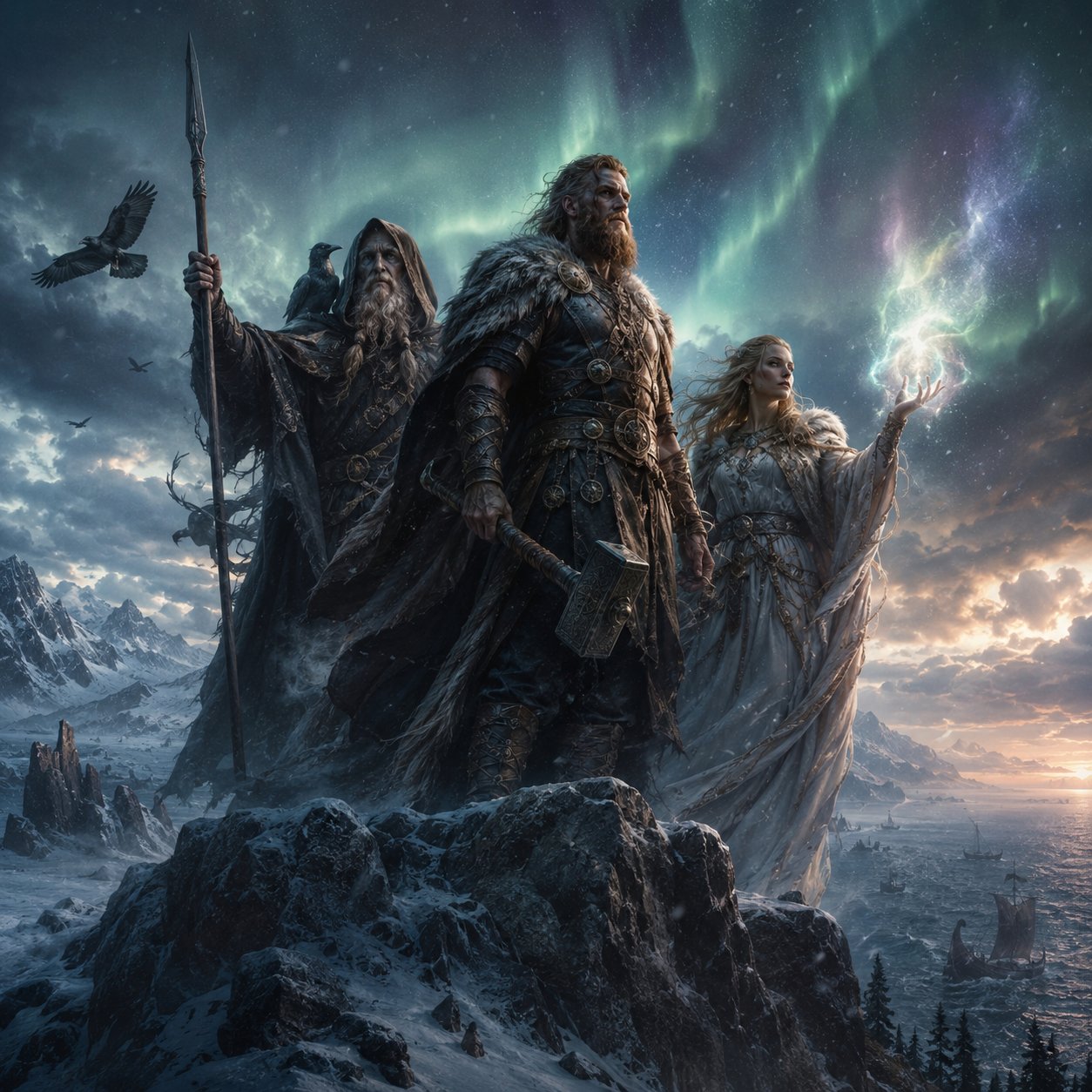
Who were they?
I increasingly think of the Scandinavian gods not as distant fantastic beings, but as bearers of a different degree of development.
In ancient stories, they possess qualities that today we would call superpowers.
They can see what is hidden.
Change their form.
Travel between worlds.
Affect consciousness.
Wield magic.
Understand the language of signs.
Predict events.
Control the forces of nature.
But most interestingly, many of these abilities do not appear in the northern tradition as something fundamentally inaccessible to humans.
A human can study runes.
A human can practice magic.
A human can seek knowledge.
A human can undergo initiation.
A human can change themselves.
And then a very interesting thought arises.
What if the northern gods are not quite “gods” in the sense familiar to us?
What if they are the memory of beings who attained an incredible level of knowledge and inner strength?
I am not presenting this as a historically proven fact.
But the northern tradition itself leaves a remarkable amount of room for such an idea.
Odin—not a king, but a seeker
This is especially clear in the image of Odin.
Odin is immensely powerful.
But knowledge is not given to him for free.
He constantly seeks it.
To gain wisdom, he gives up an eye.
To comprehend the runes, he undergoes a terrifying initiation—he hangs pierced by a spear from the World Tree for nine nights.
This is not at all the image of an omniscient God who knows everything from the outset.
On the contrary.
Before us is one who becomes wiser through experience.
Through sacrifice.
Through pain.
Through inner transformation.
That is why Odin is one of the most unusual characters in world mythology for me.
He is great not because he received everything ready-made.
He is great because he never stops seeking.
In this sense, Odin is remarkably close to the human path.
The mystery of the gods’ youth
There is another detail that is rarely noticed.
The Scandinavian gods do not possess absolute eternal youth.
In the myths, their youth is connected with Idunn’s apples.
When Idunn and her apples disappear, the gods begin to grow old.
This plot is incredibly interesting in itself.
It turns out that their immortality—if we use that word at all—is not an unconditional property of their nature.
It is sustained.
They require something that allows them to preserve their youth.
And this alone sharply distinguishes the northern gods from the idea of absolute and eternal celestial beings.
They are not incorporeal spirits outside of time.
They are remarkably material.
They eat.
Drink.
Travel.
Grow old.
Wound one another.
Yet at the same time, they possess knowledge and abilities that far surpass those of humans.
That is precisely why I like the expression:
gods of the North.
Not simply gods.
The gods of the North.
Because one can feel the northern land itself in them.
The northern tradition has not disappeared
More than a thousand years have passed.
The ancient settlements have disappeared.
The wooden houses rotted away long ago.
The pagan sanctuaries fell silent.
But the world of the northern gods has not disappeared completely.
It left behind stones.
Runes.
Amulets.
Jewelry.
Burials.
Images.
Poetry.
Thousands of runic inscriptions have survived in Scandinavia alone.
The names of people who lived more than a thousand years ago are carved into the stones.
Someone set up a stone in memory of his father.
Someone—in memory of his brother.
Someone died on a campaign.
Someone crossed the sea.
And when you look at these inscriptions, you understand especially clearly: this is not an invented world.
These people really existed.
They really lived in the North.
They really believed in their gods.
The names of these gods rang out over the sea long before Scandinavian myths were written down in books.
Thor’s hammer, something you can hold in your hand
Archaeologists find numerous hammer-shaped amulets.
Today we call it Mjölnir—the hammer of Thor.
People of the Viking Age wore such pendants.
This is no longer a literary image.
Not a line copied by a monk many centuries later.
It is a thing.
An object.
Metal once touched by a human hand.
One of the amulets found in Denmark proved particularly interesting: it bears a runic inscription explicitly indicating that it is a hammer.
And here mythology suddenly becomes almost tangible.
Thor ceases to be merely a character from an ancient tale.
Before us appears a person from a thousand years ago who wore his sign on their chest.
Why?
As protection?
As a symbol of strength?
As a sign of belonging to their faith?
We cannot know for certain.
But the object itself remains.
And that is already a bridge between us and the ancient North.
The Eddas—a voice carried across the centuries
Texts have also survived to our time.
Above all, the Poetic and Prose Eddas.
It is thanks to them that we know most of the stories about Odin, Thor, Loki, Freyja, Baldr, Yggdrasil, and Ragnarök.
But there is an important detail here.
The surviving manuscripts were written down in the Christian era.
By that time, the ancient faith was fading.
Therefore, the Eddas cannot be read completely literally, as though we were looking at a transcript of a conversation with a person from the ninth century.
And yet researchers compare these stories with earlier skaldic poetry, archaeological images, and runes—and discover that many of the motifs are indeed considerably older than the manuscripts themselves.
In other words, the world of the Eddas was not invented in the thirteenth century.
It came from the past.
From oral memory.
From songs.
From rituals.
From generation to generation.
And perhaps every storyteller changed something.
Forgot something.
Added something.
But a core survived through the centuries.
A world made up of many worlds
The northern tradition is astonishing in its view of the structure of the Universe.
There is Asgard.
There is Midgard—the world of humans.
There is Jötunheim.
There is Hel.
There are other worlds.
And all of this is connected by the great tree Yggdrasil.
Today we perceive this as mythological cosmology.
But if, for a moment, we abandon the habit of considering ancient people naive, an interesting question arises.
What exactly were they trying to describe?
Other dimensions?
Other states of consciousness?
Different levels of reality?
Or simply a spiritual map of the Universe expressed in language they could understand?
We do not know.
But the idea of many worlds is itself remarkably modern.
A human does not live in a void.
They occupy only one of the levels of an immense universe.
And transitions between worlds are possible.
Runes as knowledge
In the modern world, runes are often turned into fortune-telling cards.
But for a northern person, they were something more.
A rune is a sign.
A sound.
Meaning.
Power.
In the myth, Odin does not simply receive an alphabet.
He uncovers secret knowledge.
That is why the runic tradition was connected not only with writing, but also with magic, protection, divination, and influencing events.
And again, the familiar motif arises.
Knowledge exists.
But it must be obtained.
It requires inner maturity.
Sometimes—a sacrifice.
The North, in general, very rarely promises a person an easy path.
Were the gods human?
History does not allow us to say:
“Odin was a real person who lived at such-and-such a time and place.”
We have no such evidence.
And it would be wrong to present a beautiful hypothesis as an established fact.
But there is another fact.
The ancient northerners perceived their gods as a real part of the cosmos.
They addressed them.
Wore their symbols.
Created images.
Composed songs.
Passed down stories.
And at the same time, the gods in these stories behave nothing like absolute immortal beings.
They are much closer to humans.
That is precisely why I find it interesting to view them as the image of a human who has crossed a certain boundary of humanity.
A human who acquired knowledge.
A human who mastered the forces of nature.
A human who learned to see more than others.
Perhaps this is how the ancient North understood divinity.
Not as the opposite of humanity.
But as the highest possibility of human development.
And once again, the North
When you read Scandinavian myths for a long time, you gradually begin to feel that the main character in them is not even Odin.
Not Thor.
Not Loki.
The main character here is the North itself.
The cold sea.
The gray sky.
Mountains.
Wind.
Fire inside a longhouse.
A ship disappearing beyond the horizon.
A warrior who knows he may not return.
A person raising their head to the night sky and trying to understand what lies beyond their small life.
And beside them are their gods.
Not perfect.
Not serene.
Not omnipotent.
But great.
As harsh as the land that gave birth to them.
They know that Ragnarök will come one day.
They know that even Asgard is not eternal.
But until that day arrives, Odin continues to seek knowledge.
Thor continues to protect the world of humans.
Freyja guards her magic.
Heimdall stands at the border between worlds.
And Yggdrasil still holds the vast Universe on its branches.
That is probably why, after a thousand years, the gods of the North have not disappeared.
We still speak their names.
And somewhere on the cold land of Scandinavia, rune-covered stones still stand.
And the wind passes over them just as it did a thousand years ago.
There are no “experts” there who suddenly burst onto the internet shouting that they had their own Vedas, their own runes, that everything was their own, and that the whole world did nothing but borrow everything from them...
What is more, they have nothing to do with Russia or the Russian Federation. And it is mutual. Especially considering the fact that Russians have hated the Scandinavian Gods since ancient times, and that they were destroyed in every possible way throughout history.
Of course, long ago, before the time when Russians enslaved you, we had our own history, and the Scandinavian Gods had a place in it.
First and foremost, the word “Scandinavian” contains the Sanskrit root “skanda.”
There is even a Skanda Purana.
“Skanda Purana” — a sacred Hindu text in Sanskrit, the largest in volume among the eighteen principal Puranas (called “mahapuranas”).
First and foremost, it is important to understand that this is partly about very powerful northern magic.
Not black or white
Simply Knowledge.
Often, the knowledge of Nature and the Cosmos.
Who were they?
I increasingly think of the Scandinavian gods not as distant fantastic beings, but as bearers of a different degree of development.
In ancient stories, they possess qualities that today we would call superpowers.
They can see what is hidden.
Change their form.
Travel between worlds.
Affect consciousness.
Wield magic.
Understand the language of signs.
Predict events.
Control the forces of nature.
But most interestingly, many of these abilities do not appear in the northern tradition as something fundamentally inaccessible to humans.
A human can study runes.
A human can practice magic.
A human can seek knowledge.
A human can undergo initiation.
A human can change themselves.
And then a very interesting thought arises.
What if the northern gods are not quite “gods” in the sense familiar to us?
What if they are the memory of beings who attained an incredible level of knowledge and inner strength?
I am not presenting this as a historically proven fact.
But the northern tradition itself leaves a remarkable amount of room for such an idea.
Odin—not a king, but a seeker
This is especially clear in the image of Odin.
Odin is immensely powerful.
But knowledge is not given to him for free.
He constantly seeks it.
To gain wisdom, he gives up an eye.
To comprehend the runes, he undergoes a terrifying initiation—he hangs pierced by a spear from the World Tree for nine nights.
This is not at all the image of an omniscient God who knows everything from the outset.
On the contrary.
Before us is one who becomes wiser through experience.
Through sacrifice.
Through pain.
Through inner transformation.
That is why Odin is one of the most unusual characters in world mythology for me.
He is great not because he received everything ready-made.
He is great because he never stops seeking.
In this sense, Odin is remarkably close to the human path.
The mystery of the gods’ youth
There is another detail that is rarely noticed.
The Scandinavian gods do not possess absolute eternal youth.
In the myths, their youth is connected with Idunn’s apples.
When Idunn and her apples disappear, the gods begin to grow old.
This plot is incredibly interesting in itself.
It turns out that their immortality—if we use that word at all—is not an unconditional property of their nature.
It is sustained.
They require something that allows them to preserve their youth.
And this alone sharply distinguishes the northern gods from the idea of absolute and eternal celestial beings.
They are not incorporeal spirits outside of time.
They are remarkably material.
They eat.
Drink.
Travel.
Grow old.
Wound one another.
Yet at the same time, they possess knowledge and abilities that far surpass those of humans.
That is precisely why I like the expression:
gods of the North.
Not simply gods.
The gods of the North.
Because one can feel the northern land itself in them.
The northern tradition has not disappeared
More than a thousand years have passed.
The ancient settlements have disappeared.
The wooden houses rotted away long ago.
The pagan sanctuaries fell silent.
But the world of the northern gods has not disappeared completely.
It left behind stones.
Runes.
Amulets.
Jewelry.
Burials.
Images.
Poetry.
Thousands of runic inscriptions have survived in Scandinavia alone.
The names of people who lived more than a thousand years ago are carved into the stones.
Someone set up a stone in memory of his father.
Someone—in memory of his brother.
Someone died on a campaign.
Someone crossed the sea.
And when you look at these inscriptions, you understand especially clearly: this is not an invented world.
These people really existed.
They really lived in the North.
They really believed in their gods.
The names of these gods rang out over the sea long before Scandinavian myths were written down in books.
Thor’s hammer, something you can hold in your hand
Archaeologists find numerous hammer-shaped amulets.
Today we call it Mjölnir—the hammer of Thor.
People of the Viking Age wore such pendants.
This is no longer a literary image.
Not a line copied by a monk many centuries later.
It is a thing.
An object.
Metal once touched by a human hand.
One of the amulets found in Denmark proved particularly interesting: it bears a runic inscription explicitly indicating that it is a hammer.
And here mythology suddenly becomes almost tangible.
Thor ceases to be merely a character from an ancient tale.
Before us appears a person from a thousand years ago who wore his sign on their chest.
Why?
As protection?
As a symbol of strength?
As a sign of belonging to their faith?
We cannot know for certain.
But the object itself remains.
And that is already a bridge between us and the ancient North.
The Eddas—a voice carried across the centuries
Texts have also survived to our time.
Above all, the Poetic and Prose Eddas.
It is thanks to them that we know most of the stories about Odin, Thor, Loki, Freyja, Baldr, Yggdrasil, and Ragnarök.
But there is an important detail here.
The surviving manuscripts were written down in the Christian era.
By that time, the ancient faith was fading.
Therefore, the Eddas cannot be read completely literally, as though we were looking at a transcript of a conversation with a person from the ninth century.
And yet researchers compare these stories with earlier skaldic poetry, archaeological images, and runes—and discover that many of the motifs are indeed considerably older than the manuscripts themselves.
In other words, the world of the Eddas was not invented in the thirteenth century.
It came from the past.
From oral memory.
From songs.
From rituals.
From generation to generation.
And perhaps every storyteller changed something.
Forgot something.
Added something.
But a core survived through the centuries.
A world made up of many worlds
The northern tradition is astonishing in its view of the structure of the Universe.
There is Asgard.
There is Midgard—the world of humans.
There is Jötunheim.
There is Hel.
There are other worlds.
And all of this is connected by the great tree Yggdrasil.
Today we perceive this as mythological cosmology.
But if, for a moment, we abandon the habit of considering ancient people naive, an interesting question arises.
What exactly were they trying to describe?
Other dimensions?
Other states of consciousness?
Different levels of reality?
Or simply a spiritual map of the Universe expressed in language they could understand?
We do not know.
But the idea of many worlds is itself remarkably modern.
A human does not live in a void.
They occupy only one of the levels of an immense universe.
And transitions between worlds are possible.
Runes as knowledge
In the modern world, runes are often turned into fortune-telling cards.
But for a northern person, they were something more.
A rune is a sign.
A sound.
Meaning.
Power.
In the myth, Odin does not simply receive an alphabet.
He uncovers secret knowledge.
That is why the runic tradition was connected not only with writing, but also with magic, protection, divination, and influencing events.
And again, the familiar motif arises.
Knowledge exists.
But it must be obtained.
It requires inner maturity.
Sometimes—a sacrifice.
The North, in general, very rarely promises a person an easy path.
Were the gods human?
History does not allow us to say:
“Odin was a real person who lived at such-and-such a time and place.”
We have no such evidence.
And it would be wrong to present a beautiful hypothesis as an established fact.
But there is another fact.
The ancient northerners perceived their gods as a real part of the cosmos.
They addressed them.
Wore their symbols.
Created images.
Composed songs.
Passed down stories.
And at the same time, the gods in these stories behave nothing like absolute immortal beings.
They are much closer to humans.
That is precisely why I find it interesting to view them as the image of a human who has crossed a certain boundary of humanity.
A human who acquired knowledge.
A human who mastered the forces of nature.
A human who learned to see more than others.
Perhaps this is how the ancient North understood divinity.
Not as the opposite of humanity.
But as the highest possibility of human development.
And once again, the North
When you read Scandinavian myths for a long time, you gradually begin to feel that the main character in them is not even Odin.
Not Thor.
Not Loki.
The main character here is the North itself.
The cold sea.
The gray sky.
Mountains.
Wind.
Fire inside a longhouse.
A ship disappearing beyond the horizon.
A warrior who knows he may not return.
A person raising their head to the night sky and trying to understand what lies beyond their small life.
And beside them are their gods.
Not perfect.
Not serene.
Not omnipotent.
But great.
As harsh as the land that gave birth to them.
They know that Ragnarök will come one day.
They know that even Asgard is not eternal.
But until that day arrives, Odin continues to seek knowledge.
Thor continues to protect the world of humans.
Freyja guards her magic.
Heimdall stands at the border between worlds.
And Yggdrasil still holds the vast Universe on its branches.
That is probably why, after a thousand years, the gods of the North have not disappeared.
We still speak their names.
And somewhere on the cold land of Scandinavia, rune-covered stones still stand.
And the wind passes over them just as it did a thousand years ago.