

I want to collect here practices that can be done independently, in ordinary surroundings. I’ll start with an unusual approach to sensitivity: through the memory of touch. It requires neither an assistant nor any objects.
I am publishing these practices exclusively for our Mahapurna School.
Practice 1. “Touch Without Touching”
Robert Bruce’s NEW system includes a method called tactile imaging—tactile imagination. Instead of a vivid image, you are invited to reproduce the sensation of movement over a small area of the body. In his system, this is the foundation for working with the “energy body.” Below is a short version for an introduction, based on Chapter 4 of the book New Energy Ways V2.
How to Try It
1. Sit comfortably and place your right hand palm down. Relax your fingers and breathe freely.
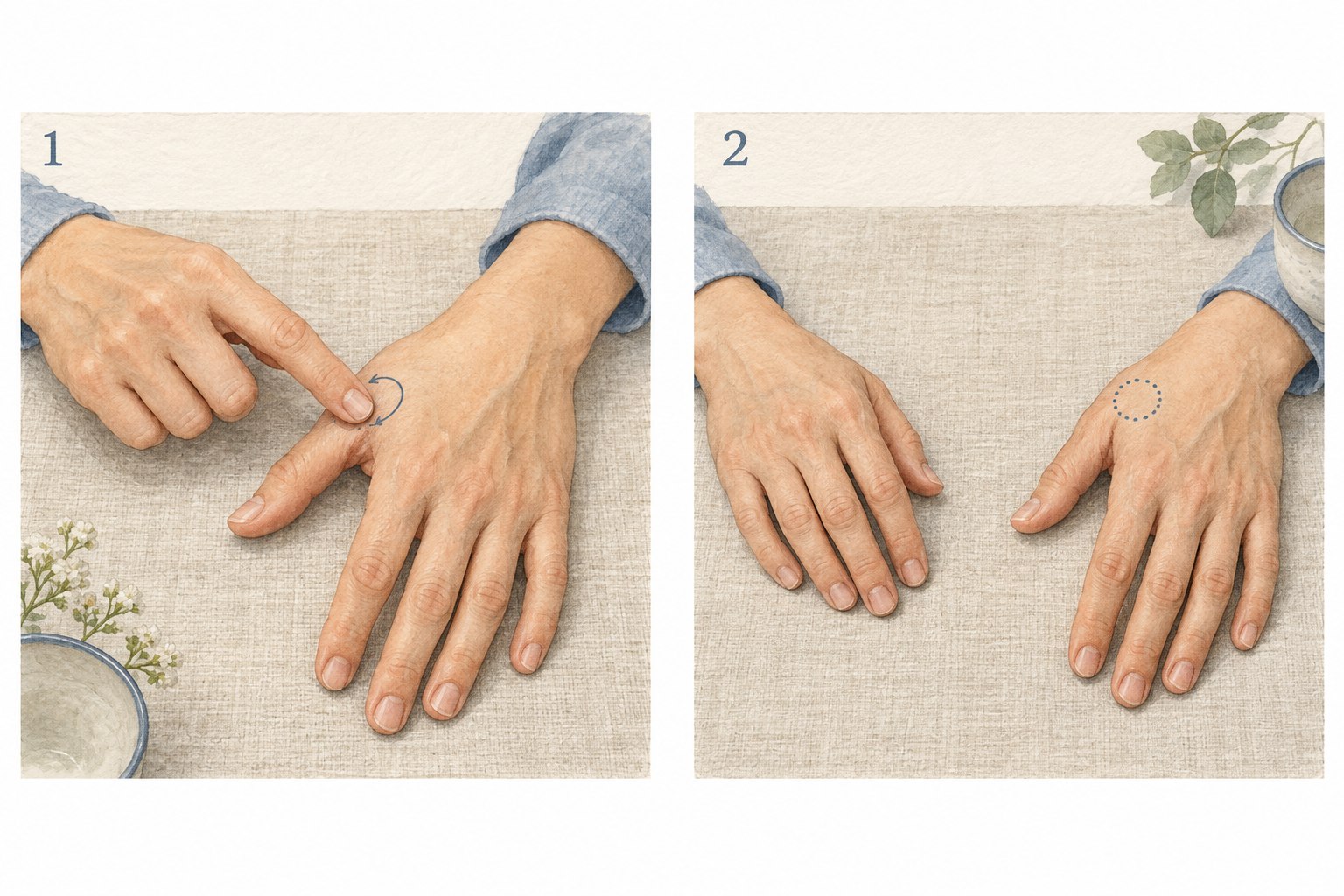
2. With the pad of your left index finger, gently trace a small circle on the back of the joint at the base of your right thumb. The diameter should be approximately 1–1.5 cm. Follow the touch with your attention several times. Do not press or rub the skin.
3. Remove your left hand. Close your eyes and try to continue the same circle using only your attention, recalling the movement of the touch. It is not necessary to visualize it in front of your eyes. Keep your right hand still.
4. If the sensation is lost, trace it once more with your finger and continue without it. For an introduction, I suggest 20–30 seconds, followed by a short pause. This is my version of a brief approach, not a duration set by the author.
5. Repeat with the other hand. At the end, relax your hands and shift your attention to the sounds around you. Two or three minutes in total is enough for the first time; if you feel uncomfortable, stop sooner.
What to pay attention to
You can write down literally a couple of lines: whether you managed to follow the trajectory without touching, which hand felt easier, and how the actual touch differed from its reproduction. If nothing clear came of it, that is also a perfectly normal note. There is no need to decide in advance what exactly you "should" feel.
What interests me about this idea is that the word "imagination" usually immediately brings pictures to mind. Here, however, you are asked to recall a touch, just as you recall the movement of your hand in a familiar task. Perhaps this entry point will be more understandable to some people than visualizations of light and complex symbols.
This is an exercise in attention and tactile imagination, not a test of extrasensory abilities. Tingling or warmth on their own do not prove the perception of "energy." To begin with, I would focus on something simpler: whether you can calmly guide your attention along the chosen area without tensing your hand.
Source: Robert Bruce
I am publishing these practices exclusively for our Mahapurna School.
Practice 1. “Touch Without Touching”
Robert Bruce’s NEW system includes a method called tactile imaging—tactile imagination. Instead of a vivid image, you are invited to reproduce the sensation of movement over a small area of the body. In his system, this is the foundation for working with the “energy body.” Below is a short version for an introduction, based on Chapter 4 of the book New Energy Ways V2.
How to Try It
1. Sit comfortably and place your right hand palm down. Relax your fingers and breathe freely.
2. With the pad of your left index finger, gently trace a small circle on the back of the joint at the base of your right thumb. The diameter should be approximately 1–1.5 cm. Follow the touch with your attention several times. Do not press or rub the skin.
3. Remove your left hand. Close your eyes and try to continue the same circle using only your attention, recalling the movement of the touch. It is not necessary to visualize it in front of your eyes. Keep your right hand still.
4. If the sensation is lost, trace it once more with your finger and continue without it. For an introduction, I suggest 20–30 seconds, followed by a short pause. This is my version of a brief approach, not a duration set by the author.
5. Repeat with the other hand. At the end, relax your hands and shift your attention to the sounds around you. Two or three minutes in total is enough for the first time; if you feel uncomfortable, stop sooner.
What to pay attention to
You can write down literally a couple of lines: whether you managed to follow the trajectory without touching, which hand felt easier, and how the actual touch differed from its reproduction. If nothing clear came of it, that is also a perfectly normal note. There is no need to decide in advance what exactly you "should" feel.
What interests me about this idea is that the word "imagination" usually immediately brings pictures to mind. Here, however, you are asked to recall a touch, just as you recall the movement of your hand in a familiar task. Perhaps this entry point will be more understandable to some people than visualizations of light and complex symbols.
This is an exercise in attention and tactile imagination, not a test of extrasensory abilities. Tingling or warmth on their own do not prove the perception of "energy." To begin with, I would focus on something simpler: whether you can calmly guide your attention along the chosen area without tensing your hand.
Source: Robert Bruce