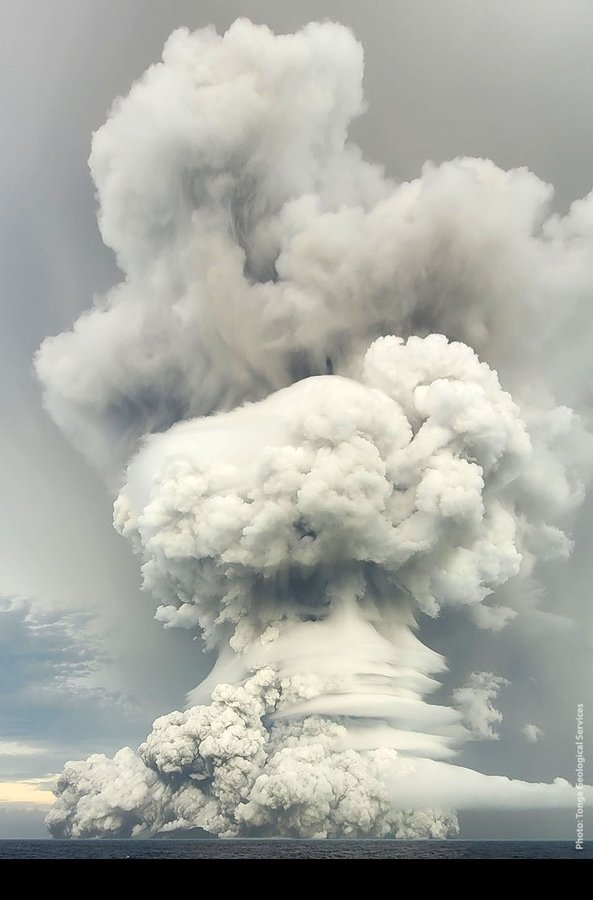
The utterly stunning eruption of the Hunga Ha'apai volcano on January 14, 2022.
Photo by Taniela Kula in Matangi Tonga Online.
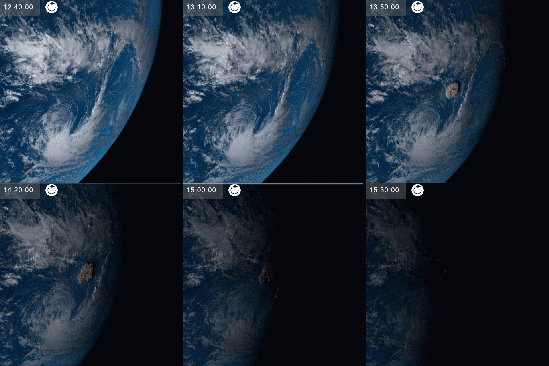
The shock wave from the eruption near Tonga, captured by the Japanese geostationary satellite "Himawari-8." Not only the eruption but also the shock wave is visible. On the other side of the terminator between daylight and night, the shock wave caught up with it. This means that the terminator travels faster than the speed of sound; in other words, Earth's surface rotational speed exceeds the speed of sound, and we are rotating at supersonic speed!
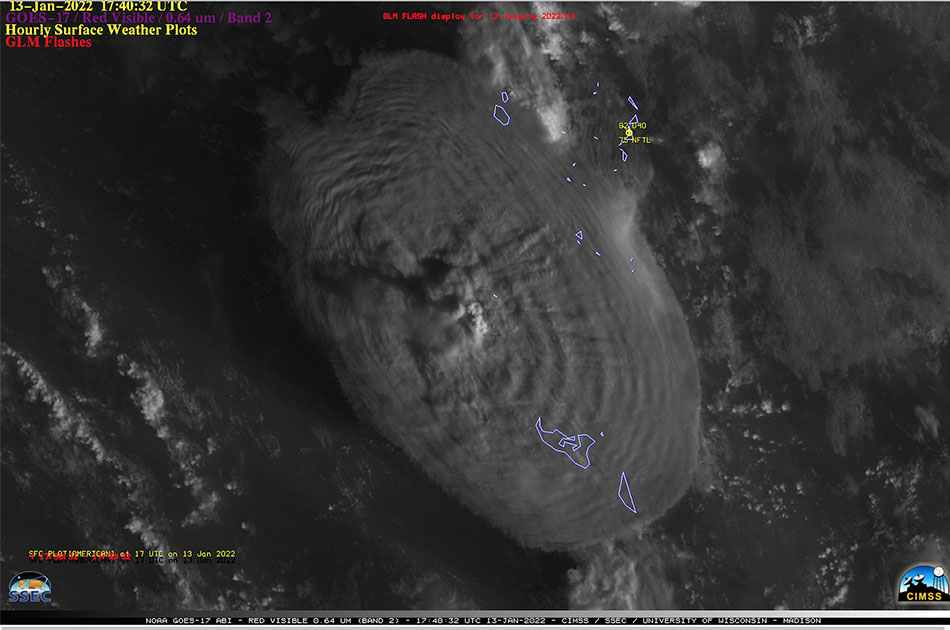
The eruption shown above, captured by the GOES-17 (NOAA) satellite at 6:40 a.m. local Tonga time on January 14, 2022, shows the scale of the explosion, which raised a plume more than 16 km above sea level. Tonga's coastline is outlined in blue.
Photographed from sea level yesterday afternoon by the Tonga Geological Service team, the volcano continued to demonstrate its immense power.
View east toward Hunga Ha'apai, with a 5-km-wide column of ash, steam, and gas rising more than 18 km above sea level. January 14, 2022, at 5:27 p.m. Photo: Taniela Kula/TGS.
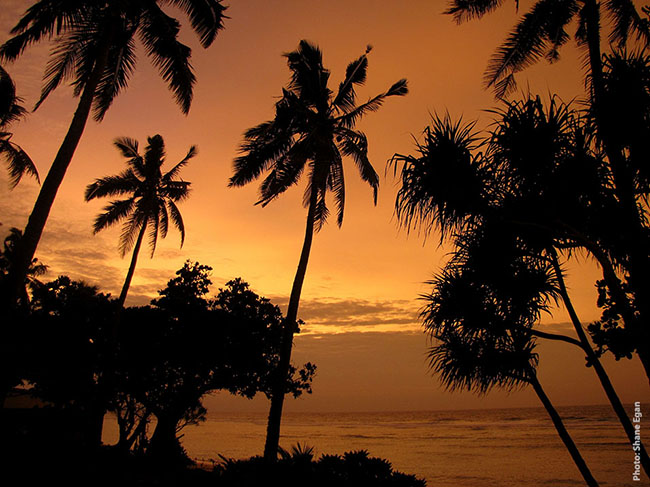
Orange light at sunset during the eruption of Hunga Volcano. Kanokupolu Beach, Tongatapu. January 14, 2022.
The planet is named after the ancient Roman god of commerce.
From bottom to top: the Moon, Venus, and Mercury. The photograph was taken at the Paranal Observatory, in the Atacama Desert, Chile.
Mercury in the solar system is—
the planet closest to the Sun;
the smallest planet;
the fastest planet;
the densest planet;
the planet with the smallest axial tilt, so it has no change of seasons;
the most difficult to observe because of its proximity to the Sun.
Mercury’s orbit precesses—its perihelion (the point in its orbit closest to the Sun) continuously shifts, returning to its original position after 260,000 years.
Mercury’s orbital precession parameters differ somewhat from those calculated according to the laws of Newtonian mechanics. Today, calculations based on GR (General Relativity) produce very similar results.
In the illustration, the precession rate has been increased for clarity compared with the actual rate.
Mercury’s surface looks similar to the Moon’s.
Comparison of the structures of Mercury and the other terrestrial planets
(Excerpt from Robert Svoboda’s book "The Greatness of Saturn")
Casting a gentle glance at his master, the pandit said:
— Great King! Mercury is even mightier, than Mars, for can bodily strength compare with the power of the mind? All true experts consider Mercury the brightest jewel in the crown of the Nine Planets, for his valor and courage are extraordinary. He — is the wisest among the planets, and removes all obstacles from the path of his servants. With all his might, he strives to protect people from misfortune and seeks to grant prosperity to everyone. Endowing all people with insight, he illuminates before them both paths — the worldly and the spiritual.
Mercury’s color — is green, like the greenery of the sacred durva grass. His body is well-formed and handsome, and his strength never diminishes. His speech is distinct, clear, and melodious, yet he also delights in ambiguities, all kinds of puns, and words with double meanings. Games delight his heart, as do jokes, and merriment of every kind. Ever benevolent, ever ingenious, he — is a Vaishya (merchant). Mercury’s wisdom is great, and he is extraordinarily skilled in mathematics and commerce. In the human body, he rules the skin, the intellect, and speech. His metal — is brass, and his gemstone — is the emerald. He has a mixed vata-pitta-kapha constitution,and enjoys all tastes.
Lord of the north, among the days of the week he rules Wednesday, and among the constellations — Virgo and Gemini. He is renowned by many names — Golden-Eyed, Enchanting, Gentle, Knowing and Awakening.
Mercury — is the son of the Moon.
The Story of Mercury
A young man named Ramu got married. After waiting the customary period following the wedding ceremony, he went to his father-in-law’s home to take his young wife from her family home to his father’s house. Ramu was received with great hospitality and warmth.
After spending several days with his wife’s parents, he asked permission to return home. However, his father-in-law said to him: “Today is Wednesday. Women are forbidden to travel on this day, especially on such an important occasion. Postpone your departure until tomorrow.” But Ramu was very stubborn. He ignored his father-in-law’s requests and pleas, and the newlyweds left the wife’s family home that very day.
Several hours into the journey, the young wife became thirsty and asked her husband for water. Ramu took a pot and went to the nearest well for water. But when he returned, he saw another man in the cart with his wife. The man looked exactly like Ramu and was wearing precisely the same clothes. Both men claimed to be Ramu, and a heated argument broke out. A crowd gathered around them. Everyone turned to the young wife and asked her to identify which of them was her real husband... However, the woman could not say which of the two Ramus was her spouse, because the two young men looked completely identical.
At that very moment, the king’s soldiers arrived at the scene. Unable to tell them apart either, they prepared to seize the real Ramu, who was still holding the water pot in his hands. Frightened in earnest, Ramu began to pray desperately to the god. Suddenly, a voice from heaven said: “All this is an illusion created by Mercury. The confusion arose because this man insisted on traveling with his wife specifically on Wednesday. Perform worship in honor of Mercury so that this obstacle may disappear.”
From then on, both Ramu and his wife always honored Wednesday as Mercury’s day.
Anyone who reads or hears this story need not fear difficulties when setting out on a journey on Wednesday.
NASA’s Scientific Visualization Studio created the “Moon Phases and Libration” tool, which shows the Moon’s phases in the highest resolution for a specific moment in time.
The visualization was created based on images from the LRO (Lunar Reconnaissance Orbiter), an automated NASA interplanetary station and artificial satellite of the Moon, launched in June 2009.
From images taken by the LRO mission.
The far side of the Moon.
Earth from the LRO satellite.
A young lunar crater.
“Lunokhod 1”
Ina formation.
Apollo 11 landing site (LM).
Tranquility Base, photographed by LRO at the end of 2011. Northwest of the descent stage is a television camera; to the south are a laser retroreflector (LRRR) and a seismometer (PSEP); to the east is Little West Crater. In addition to these objects, traces of moonwalking are visible.
Here is what Venus will look like through binoculars at dawn:
Venus (and Mercury) exhibit phases similar to those of the Moon.
Phases of Venus:
Phases of Mercury.
Venus is especially bright these days because it is at a point in its orbit very close to Earth — on January 9, it was aligned between Earth and the Sun.
Venus can also be seen during daylight.
Half an hour before sunrise, at sunrise, and for another half hour afterward.
The telescope’s deployment has been completed. Webb (or Webb) is now in orbit L2, 1.5 million km from Earth.
Continuous cooling is taking place, followed by the instrument’s activation, testing, and calibration. Alignment and calibration of the telescope’s mirrors will also begin once the temperature falls within the permissible range and the instruments are switched on.
The telescope and scientific instruments began cooling rapidly in the shade of the sunshield as soon as it was deployed, but they will need several weeks to cool completely to stable operating temperatures. This cooldown period will be carefully controlled using strategically placed heater strips. The remaining five months after commissioning will be devoted to adjusting the optics and calibrating the scientific instruments.
Saturn. (Saturday—the day of Saturn, deity: Shani)
A magnificent view of Saturn’s rings from the Cassini spacecraft, 2005.
Sunlit Tethys, an icy moon of Saturn, can be seen slightly left of and below the center. It offers a fantastic view of the Saturn system, its rings, and the shadows they cast. Tethys is about one thousand kilometers in diameter, and its orbit lies at a distance from the center of the giant gas planet roughly equal to five Saturn radii. At this distance—about 300,000 kilometers—it lies far beyond Saturn’s main bright rings.
The moons are located farther from the giant planet than its rings.
This is Janus, with a large crater visible on its surface. The image was taken in 2009:
Janus is one of the closest moons.
Enceladus is noticeably larger than Janus and is located farther from Saturn. It is covered in ice. Cassini took this image in October 2015 as it dove beneath Enceladus’s south pole.
Hyperion is one of Saturn’s distant moons, and Cassini visited it during one of the early stages of the mission, back in 2005. Hyperion is distinguished by its irregular shape and is riddled with deep craters:
Iapetus is the third-largest of Saturn’s moons. Just like the Moon in relation to Earth, Iapetus always faces its planet with the same side. But this is Iapetus’s far side. This image earned comparisons to the “yin-yang” symbol:
And, of course, the largest of Saturn’s moons is Titan. Here it is captured against the backdrop of Saturn itself:
In photographs of Titan from space, craters and other surface features cannot be distinguished as they can on Saturn’s other moons: they are hidden by this celestial body’s own dense atmosphere. However, Titan has oceans and areas of land, including sharp mountain peaks. To view them, Cassini sent the Huygens probe into the moon’s atmosphere; this is a panoramic image taken by it:
As of today, Saturn is known to have 82 natural satellites with confirmed orbits; this is the largest number of discovered moons of any planet in the Solar System;
The new sunspot AR2936 quickly became one of the largest active regions of Solar Cycle 25, growing fourfold in just 48 hours. This 2-day film from NASA’s Solar Dynamics Observatory shows the rapid development of the sunspot:
AR2936 has several dark cores larger than Earth, and the entire group stretches more than 100,000 km across the Sun’s surface.
Yesterday in Cannes, France, amateur astronomer François Rouvier “caught” the sunspot in the middle of a flare:
The sunspot is currently producing a C-class flare every 4–5 hours.
On February evenings—if the sky and weather permit—the beautiful constellation Orion is clearly visible, and to its left and below is the brightest star, Sirius (α of the constellation "Canis Major).
And lower down, very close to the horizon, is the second-brightest star, Canopus.
I write "apparent brightness" because a star (or galaxy, or comet...) may appear comparatively brighter or dimmer depending on the distance between us. Although it is not highly luminous, Sirius is bright precisely because it is close to us.
A comparison of the sizes of our Sun and Canopus, the second-brightest star in our night sky.
A comparison of the sizes of Sirius A and the Sun.
Sirius is a binary star consisting of a white giant (Sirius A) and a white dwarf (Sirius B), orbiting their common center of mass with a period of approximately 50 years. The average distance between these stars is about 20 AU, comparable to the distance from the Sun to Uranus. (AU—astronomical unit—the average distance from Earth to the Sun).
Sirius A (left) and Sirius B (the bluish-white star on the right).
Originally, the Sirius system consisted of two blue-white stars of spectral class B: Sirius A had a mass of 2 M☉ (M☉—the mass of the Sun), while Sirius B had a mass of 5 M☉. It is believed that about 120 million years ago, the more massive Sirius B exhausted its fuel and became a red giant, then shed its outer envelope and entered the white-dwarf stage, which it remains in to this day. Ancient texts contain references to a red Sirius.
At present, Sirius B has a mass of 1.02 M☉ and is one of the most massive known white dwarfs (the mass of typical white dwarfs is 0.5–0.6 M☉).
Sirius is a rainbow-colored star.
Although Sirius ranges in color from white to blue-white, it can be called a rainbow-colored star because it often twinkles in many colors. The twinkling colors are especially easy to notice when you see Sirius low in the sky.
No color enhancements were made to this image. (I saw Sirius this way; and the Moon also appears completely red when it is closer to the horizon).
In fact, these changes are simply what happens when a bright star such as Sirius shines through a layer of Earth's atmosphere. Differences in the density and temperature of Earth's air affect starlight, especially when we see the star low in the sky.
Its brightness, twinkling, and changes in color sometimes lead people to report Sirius as a UFO!
In India, Sirius is known as Svana, the dog of Prince Yudhishthira. The prince and his four brothers, together with Svana, set out on a long and difficult journey to find the Kingdom of Heaven. However, one by one, all the brothers abandoned the quest until only Yudhishthira and his dog Svana remained. Finally, they came to the gates of paradise. The gatekeeper Indra welcomed the prince but refused Svana entry. Yudhishthira was stunned and told Indra that he could not abandon his kind and loyal servant and friend. His brothers, Yudhishthira said, had abandoned the journey to heaven in order to follow the desires of their hearts. But Svana, who had willingly given his heart, chose to follow no one but Yudhishthira. The prince said that without his dog, he would leave even heaven behind. This was what Indra wanted to hear, and he then welcomed both the prince and the dog through the gates of paradise.
Sopdet, the ancient Egyptian personification of the star Sirius.
Thus, Sirius is the brightest star in the night sky as seen from Earth, and it is visible from both hemispheres. It is only 8.6 light-years away, in the constellation Canis Major. (1 light-year—the distance traveled by light in 1 year).
, I only learned today from your post that the star I dearly love is Sirius... How often I looked at it as a child, always finding it by Orion’s Belt, talking to it silently; we had a special connection. It seemed to me that this star was just as sad as I was, and that it understood me. How did I single it out from all the stars in the sky...?! I simply found it with my eyes one day and never lost it again. And I always knew it was a friend...(though I called it “Nia”). ,
873415, there are legends about aliens from Sirius.
The Dogon are one of the many tribes of West Africa, living in the valleys of the Niger River in what is now Mali. In terms of their level of development, they would seemingly differ little from neighboring tribes. But their extraordinary knowledge of astronomy is utterly incredible, particularly their knowledge of the Sirius star system, the structure of the Solar System, and the structure and formation of the Universe.
There are many interesting articles online with various theories about the Dogon’s origins. For example: The Dogon—primitive people or descendants of aliens from Sirius?
There are also books, for example:
Ladd Scranton — The Dogon Secret Knowledge of the Origins of Humanity.
Alexander Redko — Dogon Cosmology. Man — Earth — Universe.
I myself read about them in a book long ago, back when there were only books, magazines, and newspapers.
The video covers a 60-hour period, from February 2 to 5, 2022.
Chile, January 20, 2022.
The thin crescent of Venus (through a telescope) against the daytime summer sky and neighboring clouds. The sky is summery because Chile is in the Southern Hemisphere, where it is currently summer.
Tuesday, the day of Mars. Color: red. Deity: Angaraka, or Mangala (he has many names).
Mars grants protection, the ability to refuse, self-confidence, patience, the strength to act, and determination.
Vrata-katha for Mars. (Excerpt from Robert Svoboda's book "The Greatness of Saturn")
— O King! Mars is exceedingly cruel and sharp as a dagger's blade. He unleashes his wrath upon anyone who allows himself to be arrogant and presumptuous in serving him, destroying his entire family and possessions. But those who serve him meekly and humbly, following the prescribed rituals, he blesses with wealth and heals of illness. The vow dedicated to Mars removes obstacles and difficulties and frees one from illness, debt, and enemies. When performing the rite, dress in red garments and adorn yourself with red flowers, and eat only once that day, consuming food prepared from red-colored ingredients, such as ripe grains of wheat.
Short in stature, stocky and strong, broad-shouldered but narrow-waisted. Mars has the appearance of a young man. His face is ruddy, while his body is dark-complexioned. His bloodshot eyes burn with a fierce fire. Born from the womb of the earth, he is as beautiful as lightning and holds a spear in his hand. Bright as a flame, he is full of strength and passion, recklessly brave and wrathful, changeable yet generous. He is an accomplished orator and a kshatriya (warrior), kindling fires and inflicting wounds. Mars has a pitta constitution. His color is blood-red, and his power overflows. He is dressed in red garments and adorned with red garlands. In the human body, Mars governs the muscles and bone marrow. Of the cardinal directions, the south is subject to him; of the days of the week, Tuesday; and of the constellations, Scorpio and Aries. His metal is copper, and his gemstone is coral. He is called the Devourer of Disease, the Wound-Inflicter, the Windstorm-like, the Auspicious One, the Son of Earth, and the Cruel-Eyed, as well as the God with Red Hands and Feet. Because he shines like glowing coal, he is called Angaraka.
One day Daksha decided to perform an expiatory sacrifice. For the splendid festival held near the confluence of the Rangi and Yamuna rivers, Daksha (whose name means “learned” or “skilled”) invited all the supreme gods, demigods, and sages... all except his own son-in-law—the lord Shiva, embodiment of universal consciousness. Hearing about the impending ritual, Shiva's wife, Sati (“Truthful”), wished at all costs to attend the festival. Shiva tried to dissuade her, but Sati insisted. However, she came to regret her decision. Her father paid no attention to her, while he insulted her husband, the god Shiva, calling him unworthy of such refined company. Angrily, Sati said to her father: “I cannot bear the insult inflicted upon my husband, the Supreme Being of the Universe. If I were not your daughter, you would not dare treat me this way! I renounce my body. I do not wish to remain in this form for another moment, lest you defile me further with your boundless arrogance!”
Sati abandoned her body, immolating it with her inner fire. Later she was reborn as the goddess Parvati (“Daughter of the Mountain”) and, after undergoing severe trials, reunited with Shiva.
When he saw that his wife had taken her own life, Shiva, lord of all animals, froze in grief and sorrow. But soon rage began to boil within him, for this god was hot-tempered and volatile. A drop of boiling sweat appeared on his forehead, in the very place where the crescent Moon adorned him. And here is something worth considering, O King: the reckless curse Daksha had cast upon the Moon was the reason this drop grew so unbearably hot, and no one but the Moon turned Shiva's fiery rage toward the destruction of Daksha.
The moment it touched the ground, the drop transformed into a fiery spirit filled with boundless power. Burning its way through the earth and all the underworlds, this spirit dried up the seven seas. This divine entity, known as Virabhadra (“Blessed Warrior”), appeared as blazing fire with many heads and eyes, and tens of thousands of arms and legs. An embodied mass of power, Virabhadra stood before his creator with his hands respectfully folded.
“Command me,” he said.
“Go and destroy Daksha and everything he has prepared for the sacrifice,” commanded Lord Shiva.
At once Virabhadra gathered an entire army of spirits and set out to carry out his mission. Sati's death terrified everyone gathered at the sacrificial festival, and at the sight of many other ominous signs, the entire host of celestial beings froze in alarm. When Virabhadra suddenly appeared before them in all his majesty, the gods were overcome with confusion and, maddened with fear, scattered to save their lives. Virabhadra did not pursue them. Thinking only of his task, he first destroyed the offering prepared for the rite and then beheaded Daksha, despite the attempts of the rishi Bhrigu to protect the doomed progenitor. Victorious, Virabhadra returned to Shiva, lord of all animals, who said to him: “You have worked well, destroying Daksha's sacrifice, and you have burned enough already. Restore peace to the Universe, and you shall live in the heavens, where you will become the foremost of the planets, O son of Earth! You shall be called Angaraka.”
After these words, the wrath of the relentless Virabhadra subsided, and he was transformed into a planet equal to the great Kartikeya. Then Lord Shiva allowed the sacrificial rite begun by Daksha to be completed, and the former peace returned to the Universe. However, because the rite had been disrupted, many diseases entered the world. Those who fled in terror from the fiery spirit developed gulma (leprosyor a disease of the spleen). Of those who partook of the sacrificial food, some contracted leprosy, while others suffered damage to the pancreas. Fear, shock, and grief drove many mad. Those whose bodies were defiled by the impure touch of the spirit-warriors began to suffer seizures. Virabhadra himself appears on earth as fever and raksha pitta arising from the heat of fever. These ailments, which have now spread throughout the world, are seven of the eight principal diseases caused by greed, malice, and anger. The eighth is, of course, consumption, which arose when Daksha cursed the Moon.
— So it is Daksha, who brought forth countless forms of life, who is responsible for these painful diseases entering the world, — the king said thoughtfully. — Let this serve as a lesson to every ruler! Only one who has established a right relationship with true Reality is entitled to wield power! Now tell me what connection Mars has with Kartikeya. And the pandit continued:
— Some experts, O my lord, say that Mars is Kartikeya himself, the fearless warrior. Others maintain that Mars is the planet, while Kartikeya is a star possessing the same power. And since it is believed that those afflicted by Mars can ease their lot by worshipping Kartikeya, allow me to tell you about him.
Some experts, as is well known, claim that Kartikeya was born directly from the seed of Lord Shiva. When Shiva and Parvati first secluded themselves after their wedding, their lovemaking continued uninterrupted for one hundred million years. This union, truly inspiring sacred awe, was interrupted only because Shiva's attention was distracted by Agni, the god of fire. Losing control, Shiva allowed his seed to spill forth, and thus Kartikeya was born.
However, other sources, my lord, say that Kartikeya was born from the seed of Agni himself, who had fallen madly in love with Krittika (the stars forming the constellation of the Pleiades). For the name Kartikeya means “son of Krittika.” And the Pleiades were originally the wives of the Bears.
The Pleiades star cluster.
— Indeed, my lord. The Seven Bears. For in ancient times this was the name given to the Seven Sages, that is, the stars forming the Big Dipper, otherwise known as the Great Bear. Agni burned with desire for the wives of the Seven Sages, the great rishis whom he served, helping them perform a lengthy sacrificial rite. To touch the Pleiades, he entered the fire of their household hearths, but the rishis' wives did not succumb to temptation. This only inflamed his desire further, and Agni withdrew into the forest, vowing that if he could not restrain his lust, he would end his life because of this sinful passion.
It was there, in the forest, that Svaha found him. She was one of the daughters of the prolific Daksha and had long secretly yearned for Agni. Now she was able to tell him of her passion. When she saw that he did not respond favorably, Svaha assumed the form of one of the wives of the Seven Rishis and gave herself to him. Agni was, of course, delighted to unite with her, for he did not recognize her in this form and believed that his innermost desire had finally come true. Assuming the form of each of the Pleiades in turn, Svaha enjoyed union with Agni six times. She alone could not take the form of Arundhati, the wife of the great rishi Vashistha, because Arundhati was utterly devoted to her husband, chaste, and worthy of every praise.
Thus, Svaha united with Agni six times that day, then transformed into a bird and flew to the summit of a high white mountain. There she released Agni's seed into a securely concealed receptacle, so that the wives of the great rishis would not be accused of adultery with the god of fire. In this receptacle, Agni's mighty seed transformed of its own accord into a healthy, strong boy named Skanda. As soon as he appeared, he behaved like a true warrior. Desiring to test his strength against the mountains, he tormented and battered them until both the mountains and the earth itself acknowledged his superiority. The entire world bowed before Skanda, the Invincible, and the Universe rang with his praises.
As soon as the gods learned of his birth, rumors spread that his mothers were the six wives of the rishis. Believing the false rumor, the outraged rishis renounced their wives and drove them away, despite the fact that the rishi Vishvamitra, who knew the truth, tried to convince them that the Pleiades had not violated their marital fidelity. Vishvamitra knew this because he himself performed Skanda's initiation ceremony when the boy reached warriorhood.
The six wives of the rishis came to Skanda and, saying that their husbands had rejected them, begged him for help: they wanted to ascend to heaven but could not do so on their own. Heeding their pleas, the mighty Skanda brought them to heaven, where they found a dwelling place. Thus these six rejected women became the six Pleiades and were revered as Skanda's mothers. Only Arundhati, the sole wife whose form Svaha had been unable to assume, remained with her husband, becoming the star Alcor. After this, Svaha finally married Agni.
Indra, who feared Skanda, ordered the Seven Mothers, warrior goddesses, to kill the mighty child. However, they became so filled with love for him that milk began to flow from their breasts, and thus the Milky Way came into being. Skanda drank this milk, and the goddess Kali herself, called the Blood-Drinker, accepted him as her own son. Then Indra decided to kill Skanda in battle. But the boy quickly defeated all the gods, and when Indra pierced his side with lightning, another warrior emerged from the wound, armed with a mace—the glorious Vishakha. Finally acknowledging his defeat, Indra admitted Skanda into the assembly of the gods. Then the gods anointed him with celestial waters, just as in ancient times they had anointed Varuna, lord of the waters, and Skanda became commander of the celestial armies.
Such is Kartikeya, O King, and such is the planet whose deity he is—fiery Mars! I bow low before eternally youthful Mars.
A coronal mass ejection from the Sun (CME) struck Earth's magnetic field on February 9 at 21:00 GMT. So far, the impact has not caused a geomagnetic storm. However, storms often take hours or even more than a day to develop.
At present, up to 40 Starlink satellites belonging to SpaceX are falling from the sky—the unexpected result of a small geomagnetic storm on the Sun.
Statement from SpaceX:
"On Thursday, February 3, at 1:13 p.m. Eastern Time, Falcon 9 launched 49 Starlink satellites into low Earth orbit from Launch Complex 39A (LC-39A) at NASA's Kennedy Space Center in Florida. ... Unfortunately, the satellites deployed on Thursday were significantly affected by a geomagnetic storm on Friday [4 февраля]...
Geomagnetic storms heat Earth's upper atmosphere. Transparent swirls of warm air literally rose upward and grabbed the Starlink satellites. According to SpaceX, the onboard GPS devices detected a 50 percent increase in atmospheric drag compared with previous launches.
The Starlink team placed the satellites in safe mode, in which they would fly edge-on (like a sheet of paper) to minimize drag," SpaceX says. "Preliminary analysis shows that the increased drag at low altitudes prevented the satellites from exiting safe mode to begin orbit-raising maneuvers, and up to 40 satellites are reentering or have already entered Earth's atmosphere."
SpaceX says that the deorbiting satellites "pose zero collision risk to other satellites and are designed to burn up upon reentry, meaning that no orbital debris is created and no parts of the satellites fall to the ground."
It is worth watching the night sky this week—you may see a Starlink satellite burning overhead.
During these days, brilliant Venus and red Mars can also be seen with it in the east before dawn, weather permitting.
In general, Mercury is very difficult to observe because it is so close to the Sun—it bathes in its rays, which makes it difficult to see, appears very low above the horizon, and sets quickly. As it moves along its orbit, Mercury rises slightly higher or lower above the horizon—the higher it rises, the farther it is from the Sun. And then the chances of observing it are higher.
The greatest distance from the Sun at which Mercury can ever appear in the sky is about 28 degrees. The smallest distance is about 18 degrees. On February 16, 2022, Mercury will be 26 degrees from the Sun.
Mercury, Mars, and Venus on February 9, 2022. (Stellarium)
The volcano and the Sun.
The powerful Hunga Tonga–Hunga Ha'apai volcano, which erupted beneath the waters of the Pacific Ocean on January 15, released a huge amount of ash into Earth's stratosphere. This volcanic ash is still in the air and continues to color sunsets in some parts of the globe. It also creates other interesting celestial phenomena, such as the Bishop's Ring photographed by Peter Lowenstein in Mutare, Zimbabwe, on Saturday, February 12.
Mutare, Zimbabwe.
A volcanic-aerosol solar halo (also known as a Bishop's Ring), caused by particles ejected into the stratosphere by the giant eruption of Hunga Tonga on January 15.
The halo around the Sun appeared in the hazy blue sky after sunrise on Saturday (February 12). It reached maximum intensity just after 9:00 a.m. and lasted almost until sunset, after which a brightly colored volcanic-aerosol twilight arc appeared.
It appears that the concentration of volcanic aerosols in the stratosphere over eastern Zimbabwe is currently high enough to create optical effects around the Sun in broad daylight, in addition to the impressive twilight displays at sunrise and sunset observed over the past few days.
The photograph was taken using an electronic viewfinder to avoid the danger of looking directly at the Sun, which was so bright that it overloaded the camera sensor, requiring substantial post-processing to restore the image details.
A heart-shaped phenomenon created by twilight rays projected onto the glowing volcanic aerosols from the Tonga–Hunga Ha'apai volcano in the Tongan Islands.
February 8. Over Maun, Botswana, which is very close to the latitude of the eruption.
A coronal mass ejection that occurred on the Sun during the night of February 15–16, 2022, traveled millions of kilometers into space.
The ESA/NASA Solar Orbiter spacecraft captured the largest solar prominence eruption ever observed in a single image together with the entire solar disk. The spacecraft is currently located almost directly between the Sun and Earth.
Note that the height of the plasma eruption is nearly equal to the Sun’s diameter.
A composite of images from the ESA/NASA Solar Orbiter and SOHO spacecraft, which captured the giant solar eruption on February 15, 2022.
NASA’s Imaging X-Ray Polarimetry Explorer (IXPE) mission, launched on December 9, 2021, has provided its first imaging data after completing a month-long commissioning phase.
All instruments are functioning well aboard the observatory, which aims to study some of the most mysterious and extreme objects in the Universe.
IXPE focused its X-ray instruments on Cassiopeia A for the first time. This object consists of the remains of a star that exploded in the 17th century. Shock waves from the explosion swept through the surrounding gas, heating it to high temperatures and accelerating cosmic-ray particles, forming a cloud that glows in X-rays.
Other telescopes had already studied Cassiopeia A. The image combines data from the IXPE and Chandra space telescopes. The intensity of the purple color corresponds to the intensity of the X-ray emission recorded by IXPE; the blue color shows data from NASA’s Chandra X-ray Observatory.
This image of Cassiopeia A also combines data from these two observatories. The IXPE data were collected from January 11 to 18, 2022.
Colors ranging from cool purple and blue to red and hot white correspond to increasing X-ray brightness.
Chandra’s X-ray images first showed that a compact object lies at the center of the supernova remnant; it may be a black hole or a neutron star.
The nebula's outline resembles the symbol of a heart. Radiation from the most abundant element—hydrogen—creates the nebula's bright red glow. The red glow and the nebula's shape are caused by radiation from a small group of stars near the center of the nebula.
At the center of the Heart Nebula are young stars from the open cluster Melotte 15. Through their powerful radiation and winds, they form several picturesque pillars of dust. The open cluster contains several bright stars almost 50 times more massive than our Sun, as well as many faint stars with masses many times smaller than the Sun's. A microquasar also formed there; it was ejected from the cluster several million years ago.
The Heart Nebula is located about 7,500 light-years away in the constellation of the mythical queen of Ethiopia—Cassiopeia.
An asteroid with three asteroid moons.
Astronomers discovered three bodies orbiting the hat-shaped asteroid Elektra,, making it the first known quadruple asteroid system. Previously, they knew about two outer moons (shown with orange and green orbits). The fainter inner body (highlighted in blue) is the recently discovered fourth body. Image: ESO.
This image does not show the terminator—the line separating the bright daytime side from the dark nighttime side. This is because the picture was assembled from 29 strips capturing areas near the terminator. The longest and most prominent shadows are visible near the terminator; because of their length and contrast, the flat photograph appears three-dimensional. The original images and data were obtained near the Moon by NASA's Lunar Reconnaissance Orbiter spacecraft. Lunar craters stand out because of the shadows they cast to the right. The image clearly shows that the dark areas known as maria are not only darker than the rest of the Moon's surface, but also much smoother.
An astonishingly detailed image of the International Space Station (ISS) transiting the Moon!
France, the city of Bourges, January 18, 2022. Author: Thierry Legault.
Many spiral galaxies have a bar running through their centers. It is believed that our own Milky Way Galaxy also has a small central bar. In the spiral galaxy NGC 6217, the bar is clearly visible in this sharp image obtained in 2009 with the repaired Advanced Camera for Surveys aboard the Earth-orbiting Hubble Space Telescope.
The image shows dark, filamentary dust lanes, young clusters of bright blue stars, red emission nebulae made of glowing hydrogen, a long bar of stars crossing the center, and a bright active nucleus that probably contains a supermassive black hole. Light from NGC 6217 takes about 60 million years to reach us; this galaxy is approximately 30,000 light-years across and can be found in the constellation Ursa Minor.
Mars Day, Tuesday. The deity is Angaraka, Mangala, Kuja, Bhauma, Kartikeya, and others.
Mars, or Mangala, is considered one of the most active and aggressive planets. The lord of fire and the planet of warriors and protectors symbolizes courage, resilience, determination, and leadership. Along with explosive energy, speed, assertiveness, and endurance, the planet also brings excessive tension and a propensity for conflict, and governs accidents, crashes, injuries, and violence. Reading and listening to kathas dedicated to Mars on Tuesdays helps harmonize and maintain the planet’s energies in goodness. One of Mars’s lessons is patience, willpower, and humility in overcoming trials and difficulties, through which we purify ourselves.
The Vrat-katha of Mangaliya.
A woman who gave birth to her only son late in life named him Mangaliya because he was born on a Tuesday (Mangala is Mars, the lord of Tuesday). One day, Mars came to her in the guise of a poor beggar to test her. When he began asking for alms, the woman replied that she was ready to give him whatever he asked for. He asked, “Are you sure? For if I ask, you will have to do it.” The woman agreed.
Then Mars said, “Bring your son to me; I want to prepare food on his back.” The request stunned the woman, but she could no longer refuse. Beside herself with grief, she watchedhow Mars lays firewood on the boy’s back and lights a fire. When the food was ready, Mars asked the woman to call her son so that he could taste the food. She exclaimed: “What are you saying? Can such miracles really happen? Eat and leave.” To this the god replied: “Just call him.” And as soon as the woman said, “Mangaliya!” the boy got up and approached his mother, who was so astonished that she could not utter a word.
(Based on NASA materials)
A year has already passed on Mars with the Mars 2020 mission team.
NASA’s Perseverance rover took this selfie above a rock nicknamed “Rochette” on September 10, 2021, the mission’s 198th Martian day, or sol.
NASA’s Perseverance rover captured this view of a hill called “Santa Cruz” in Jezero Crater on Mars on April 29, 2021, the mission’s 68th Martian day, or sol.
The boulders in the foreground, averaging about 20 inches (50 centimeters) across, belong to a type of rock that the rover team named “Ch’ał” (a Navajo term meaning “frog,” pronounced like “chesh”).
The knowledge carried by Jupiter passes from one human life to another. When a person begins studying Vedic astrology, it comes easily and resonates in the heart, because this is knowledge not acquired in just one incarnation. The same applies to other professions, such as lawyer, doctor, and so on. When a person feels that something is their calling, their purpose in this incarnation, it is the result of work from past lives.
Vrat katha for Jupiter.
Golden barley and a golden basket.
The story dedicated to Thursday illustrates how important it is to follow the conditions of a vow if you want its observance to change your destiny.
Once upon a time, there lived a poor Brahmin. He was poor because his wife had a terrible habit: every morning, she would eat all the leftovers from the previous day's lunch before offering prayers to God and attending to the household chores. They had been childless for many years, but at last they had a wonderful daughter who, from early childhood, began worshipping Lord Vishnu every day and Jupiter every Thursday. As a reward for such devoted service, she was granted a gift: on her way to school, she scattered barley along the road; during the day, the barley turned to gold, and on her way home, the girl gathered it. One day, as she was sowing the barley grain, her father said to her, “You need a golden basket for the golden barley.” The following Thursday, the girl prayed to God: “If I am faithfully observing my vow, then give me a golden basket for the barley.” On her way home from school that day, she found such a basket along the road.
The next day, the son of the local king happened to pass by and saw her sowing barley from the golden basket. He was enchanted by her beauty, gentle nature, and gifts. He returned home and, pretending to be ill, took to his bed. When the queen learned that her son had fallen ill, she went to him to find out what medicine could cure him. The young prince replied: “There is no such medicine, except for one remedy—to marry the girl with the golden basket for the barley.” The king sent for the girl, and her father gave her in marriage to the prince.
After the daughter left her family home to live with her husband, the Brahmin became as poor as before, and every day turned into a torment for him. At last, swallowing his pride, he decided to ask his daughter for help. She replied: “My respected father, send my mother to me, and I will tell her what must be done to rid us of this misfortune.” The father sent the girl's mother to the palace, and the girl told her: “My respected mother, if you perform the worship ritual every morning and observe cleanliness with particular care, everything will be well.” But the mother did not heed her daughter's words and continued to eat the leftovers from the previous day's lunch first thing every morning.
Then the girl ordered that her mother be locked in a room overnight, and in the morning made her bathe and perform the worship ritual before she had a chance to eat. As a result of this ritual, the mother attained spiritual insight and from then on observed the vow dedicated to Jupiter every Thursday. Happiness and wealth returned to the Brahmin's family. He lived to an advanced age with his wife, and after their deaths they both ascended to heaven.
Solar halo.
A pollen corona at sunset in Istria, Croatia. Iridescent rings surrounding the setting Sun on February 22.
Every year, trees in northern forests release abundant clouds of pollen. The pollen grains of these tree species are usually very similar in size, making them ideally suited for forming a corona.
The Milky Way and Andromeda are approaching and merging. (Based on| EarthSky)
The Andromeda Galaxy (M31), the nearest spiral galaxy to our Milky Way, is not noticeable in our night sky unless you look for it. However, under a dark sky, you can see it without optical equipment as a barely perceptible, diffuse patch of light. But in the distant future, Andromeda will shine brightly in our sky, becoming larger and larger... as it gets closer and closer to us. And although the two galaxies are still 2.5 million light-years apart, the eventual merger of our two galaxies has effectively already begun.
This image shows what the night sky would really look like if the Andromeda Galaxy—our neighboring galaxy—were brighter.
A composite photograph—an original background image of the Moon (by Stephen Rahn) and an image of the Andromeda Galaxy from NASA.
As the merger of Andromeda and the Milky Way continues, the Andromeda Galaxy will appear larger and larger in our
sky.
According to new data, the sizes of these two galaxies are approximately equal, or Andromeda is slightly larger—previously, it was believed that its radius was twice that of our Galaxy. Andromeda contains several times more stars than the Milky Way.
The Andromeda Galaxy is currently speeding toward our Milky Way at about 70 miles (113 km) per second. With this in mind, our merger will occur in five billion years. But in August 2020, the peer-reviewed Astrophysical Journal published a new study showing that the collision between our galaxies is already taking place.
Our Milky Way and other galaxies are surrounded by a large shell called a galactic halo, consisting of gas, dust, and scattered stars. The halos of galaxies are faint—so faint, in fact, that detecting them is not easy.
This illustration shows what the gas halo of the Andromeda Galaxy might look like if it were visible to people on Earth. According to NASA, a halo three times the size of the Big Dipper could easily become the largest feature in the night sky.
Recent measurements of the halo show that it extends halfway to our Milky Way (1.3 million light-years) and even farther in other directions (up to 2 million light-years). And that the collision between the Milky Way and Andromeda galaxies has already begun.
NASA/ ESA/ J. DePasquale and E. Wheatley (STScI)/ Z. Levay.
Merger model
Will this be a completely head-on collision or more of a glancing blow that does not affect the final outcome? Astronomers lean toward the former.
The Milky Way and the Andromeda Galaxy will effectively merge, forming one large elliptical galaxy.
The video also shows the Triangulum Galaxy as a smaller object near the Andromeda and Milky Way galaxies. Although the Triangulum Galaxy will most likely not join the merger, it may nevertheless strike our Milky Way at some point, taking part in a great cosmic dance with the two larger galaxies.
What happens to stars and planets when galaxies merge?
Throughout the universe, galaxies collide with one another. Astronomers observe galactic collisions—or their aftermath—using powerful telescopes. In a sense, when a galactic merger occurs, the two galaxies are like ghosts; they simply pass through each other. This is because the stars within galaxies are separated by such vast distances. Thus, the stars themselves usually do not collide when galaxies merge.
Nevertheless, the merger will affect the stars in both the Andromeda Galaxy and our Milky Way. The Andromeda Galaxy contains about a trillion stars. Meanwhile, the Milky Way has about 300 billion stars. Stars from both galaxies will be ejected into new orbits around the newly merged galactic center.
According to scientists involved in the 2012 studies, it is quite likely that the Sun will be ejected into a new region of our Galaxy, but Earth and the Solar System are not in danger of being destroyed. (Or is that merely what they want us to believe??)
Will humanity see the Andromeda merger?
So, what about life on Earth? Will terrestrial life survive the merger? Well, the Sun will eventually become a red giant in about 7.5 billion years, when it expands in size and engulfs Earth. But even before then, the Sun's brightness, or intrinsic luminosity, will increase. Ultimately, this will happen in about four billion years.
As solar radiation reaching Earth increases, Earth's surface temperature will rise. We may experience a runaway greenhouse effect, similar to what is happening now on our neighboring planet, Venus. So there is a good chance that terrestrial life will no longer exist when the merger is complete.
But by then, perhaps some Earth inhabitants will become astronauts. Perhaps we will leave Earth and even our solar system. We may still see Andromeda crashing into the Milky Way, just from a slightly different vantage point.