The brave hero of the “Ramayana,” Hanuman—the embodiment of strength and selfless devotion
O Hanuman, son of the Wind God, mighty and powerful,
you dispel the darkness of ignorance! Grant us strength,
wisdom, and knowledge; turn troubles and misfortunes away from us.
Protect us from the influence of the Kali Age!
“Hanuman Chalisa”
Hanuman is one of the main characters in the epic poem “
Ramayana,” the great devotee of
Rama, and one of the
Chiranjivis. Hanuman is also mentioned in the “
Mahabharata,” the Puranas, and several later texts: “
Ramcharitmanas,” “
Hanuman Chalisa,” and “
Bajrang Baan.” Hanuman is the son of
Anjana and
Kesari, as well as the son of the wind god
Vayu. He embodies the manifestation of inner self-control, faith, and devoted service. Hanuman is revered in the traditions of Hinduism, Jainism, and Buddhism—Hanuman’s appearance in in East Asian Buddhist texts may be connected with the translation of the “Ramayana” into Chinese and Tibetan in the 6th century CE.
Hanuman, as a deity appearing in the form of a
monkey, is symbolically associated with the mind, since the monkey is a metaphor for the restless mind, constantly moving chaotically from one thought to another. Therefore, Hanuman also represents the mind brought under control and governed by the spirit.
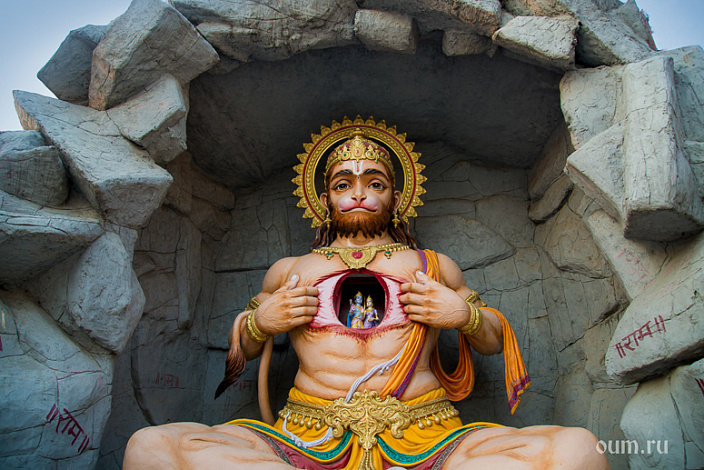
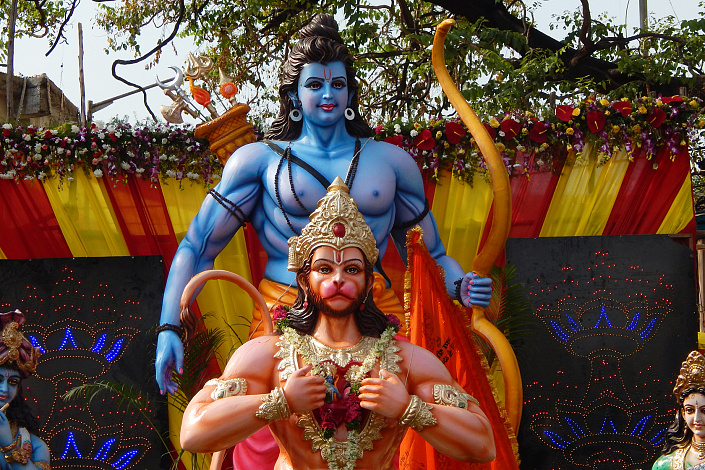
Hanuman, depicted as opening his heart, in which he keeps the images of Sita and Rama, also embodies all the features and qualities inherent in an open and harmoniously developed
Anahata Chakra—the energy center responsible for selfless service, bhakti, devotion, love, compassion, and an unfailing desire to come to the aid of others. Hanuman possesses siddhis,
supernatural abilities 
- the ability to assume a very small form
(anima)
- or, conversely, to attain incredible height and size
(mahima),
- to become weightless and capable of moving through the air—levitating
(laghima),
- to assume any desired form
(prakamaya),
- achieving everything desired and, by applying willpower, moving instantly from one place to another (prapti),
- gaining power over any beings
(vashitva),
- the ability to subjugate
(ishtapittva or aishvarya),
- experiencing pleasure without self-indulgence
(bhukti).
All these siddhis are manifestations of an opened and harmonious Anahata chakra. It is believed that through meditation on the spiritual heart, the Anahata chakra, the practitioner gains spiritual knowledge and the eight siddhis listed above. Thus, Hanuman represents an energy capable of transforming him into any form, enabling him to levitate and carry heavy objects through the air, as described in the pages of the great Ramayana. He defeats dark forces that greatly outnumber him. Hanuman embodies powerful, invincible strength, endurance, courage, and devotion.
There are asanas in hatha yoga named after this glorious hero of the Ramayana: —
Hanumanasana and Anjaneyasana (Anjana — “the name of Hanuman’s mother, the hero of the Ramayana epic”
). The name derives from the Sanskrit words
Hanuman and asana, meaning the giant leap made by Hanuman in order to reach the islands of Lanka. It is also called the “leap of love and devotion.”
Ardha Hanumanasana
Anjaneyasana
What does the name Hanuman mean?
There are several versions regarding the origin and meaning of the name “Hanuman” (Sanskrit: हनुमान्). It is likely that his name reflects the immeasurable power of knowledge and exalted wisdom possessed by this brave warrior; here he appears as one who fights with the grandeur of knowledge, or as a wise warrior: “
man”— ‘to think’;
“khan” — ‘to strike, overthrow, defeat’.
According to one version, the name consists of two words:
“hanu” — ‘
jaw’ and “mant” — ‘visible’, respectively, so the name can be interpreted as
“one who has a prominent jaw”. Another version is that his name derives from the words
“khan” — ‘destroyed, defeated’ and
“maana” — ‘
pride’,
thus meaning
“one who has destroyed pride within himself”.
The many names describing Hanuman’s principal traits and qualities are detailed in the “Hanuman Chalisa,” the most famous hymn glorifying the god Hanuman and describing his forms, deeds, and exploits, celebrated in the epic “Ramayana.”
In the Vedic pantheon, gods generally have many names, each embodying the essence of some noble trait or attribute, or symbolizing one of the deity’s deeds. Hanuman appears under various names, including:
Pavanasuta — son of the wind, or
Maruti — child of the wind;
Mangalamurti (the embodiment of Mars: “
Mangala” — the name of Mars in Vedic astrology;
“murti” — ‘form, image’).
Some names derive from the names of Hanuman’s parents:
Anjaneya — son of Mother Anjana;
Kesari Nandan — son of Father Kesari.
Panchamukha-Anjaneya — the five-faced Hanuman.
Under the name
Maruti, he appears as the son of the wind god.
Vajrang Bali — possessing indestructible strength, one who cannot be broken — is composed of the words: “
vajra” — ‘lightning, arrow, diamond, indestructible’;
“anga” — ‘body part, limb’;
“bala” — ‘strength, courage, power’.
The names
Vira,
Mahavira,
Mahabala and others, denoting this attribute inherent in him, embody Hanuman’s extraordinary strength and courage.
Chiranjeevi — ‘immortal’; various versions of the “Ramayana” state that Hanuman was blessed by Rama with immortality and will remain on earth as long as the memory of Rama’s glorious deeds lives on.
Kurupsundar — possessing an unattractive appearance but inner beauty:
“Kurup” means “ugly,” while
“sundar” means “beautiful.” Kamarupin (
“rupin” means “visible, in visible form”;
“kama” means “desire”) can change form at will, becoming as small as an atom or growing to unlimited proportions.
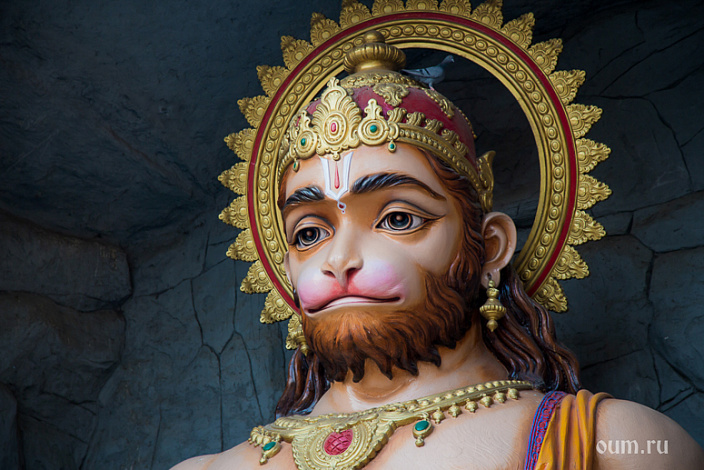
Image of Hanuman
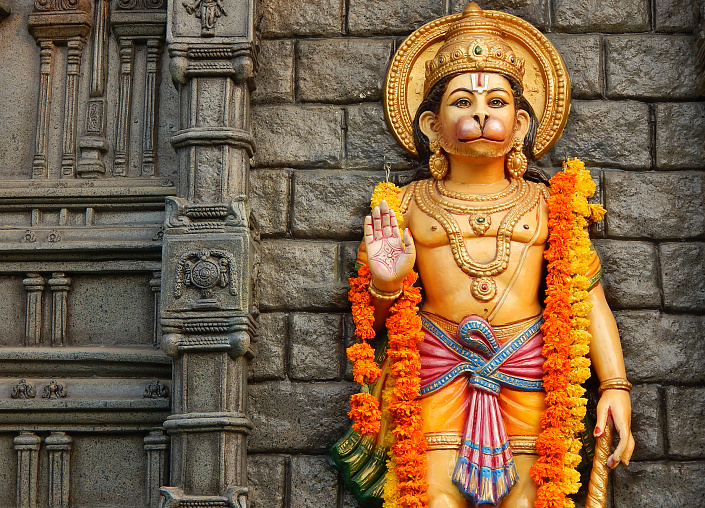
O Hanuman, you are clothed in splendid garments, your skin shines like gold, diamond earrings sparkle in your ears, and lush curls crown your forehead. You hold a mace in your hand, and across your shoulder is draped a pavitra, a symbol of connection with God—a thread woven from the rarest and most sacred herbs.
“Hanuman Chalisa”
He may be depicted with five heads, known as
Panchamukhi. In this form, he freed Rama and Lakshmana from Patala. His heads face in different directions and embody five distinct energies:
- the lion’s head—Narasimha—signifies victory over dark forces, courage, and overcoming fear;
- the head of Hanuman—symbolizes victory over enemies, the destruction of sins, and filling one’s life with pure thoughts and good deeds;
- the head of an eagle — Garuda — symbolizes victory over obstacles and protection from evil spirits;
- the head of a boar — Varaha — brings prosperity and abundance;
- the head of a horse — Hayagriva — bestows wisdom and knowledge.
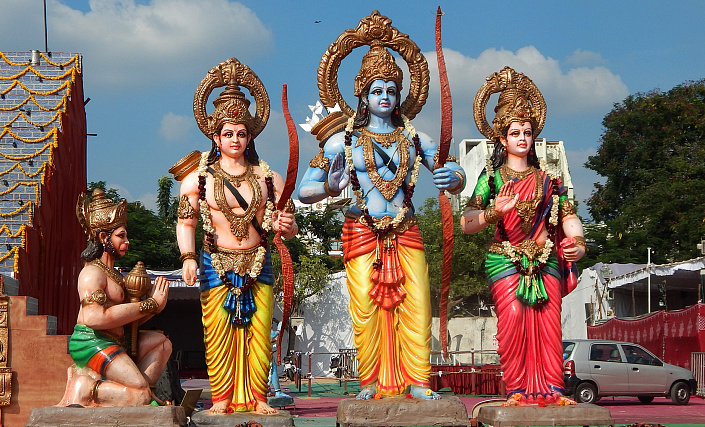
Hanuman may be depicted either together with the other central characters of
the Ramayana, or alone.
In images with Rama and Sita, he is generally positioned to Rama’s right, as a devotee bowing before him, with his hands folded in the “namaste” mudra.
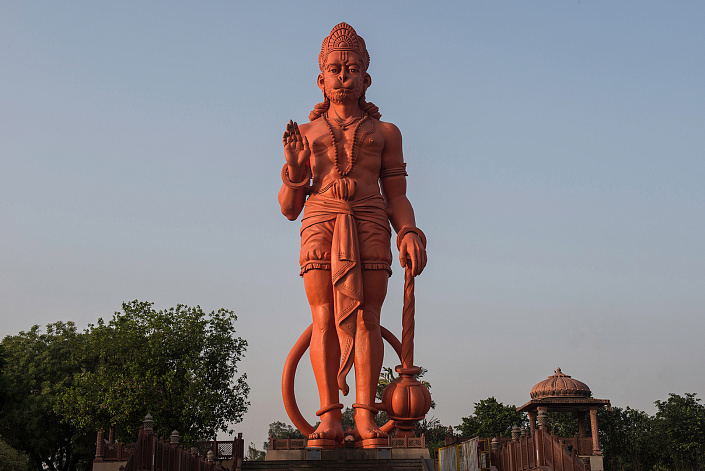
When alone, he always carries a weapon; one hand is raised in a gesture of protection, and he may be shown in one of the scenes depicting events from his life, for example, as the child Hanuman holding the Sun, or performing one of his feats by holding a mountain with medicinal herbs in his hand. Hanuman’s weapon is the
mace, with which he defeats the enemies of Dharma and destroys obstacles on the path of spiritual self-improvement. He may also hold
in his hands.Vajra.
He is most often depicted with Rama, Sita, and Lakshmana, usually opening his chest to symbolically show that he keeps their images in his heart.
God Hanuman
Hanuman is one of the central characters in the epic Ramayana; however, we have little evidence that Hanuman was worshipped as a deity in Vedic times. Some believe that Hanuman began to be endowed with divine essence approximately 1,000 years after the Ramayana was composed. In any case, the description of Hanuman in the epic as possessing incredible strength and extraordinary abilities indicates that Hanuman was an embodiment of divine essence on Earth. Hanuman is considered an avatar of Shiva. In this aspect, he is known as Rudra-Avatara.
In the modern era, his iconography and temples have become increasingly widespread. Hanuman embodies strength, courage, heroic self-sacrifice, and loving devotion to his god. In later literature, he appears as the patron god of martial arts, as well as meditation and diligent study. Hanuman is worshipped both independently and together with Rama and Sita. He is revered as a deity who triumphs over evil and provides protection.
Temples and Statues of Hanuman
There are numerous temples and statues dedicated to Hanuman throughout India. It is believed that the earliest statues of Hanuman appeared in the 8th century; images of him can be found in 10th-century temples in central and northern India. For example, stone carvings depicting the worship of Hanuman, as well as sculptures of Hanuman in the cave temples of the village of Undavalli (6th–13th centuries), near the city of Vijayawada (Andhra Pradesh), not far from the coast of the Bay of Bengal.
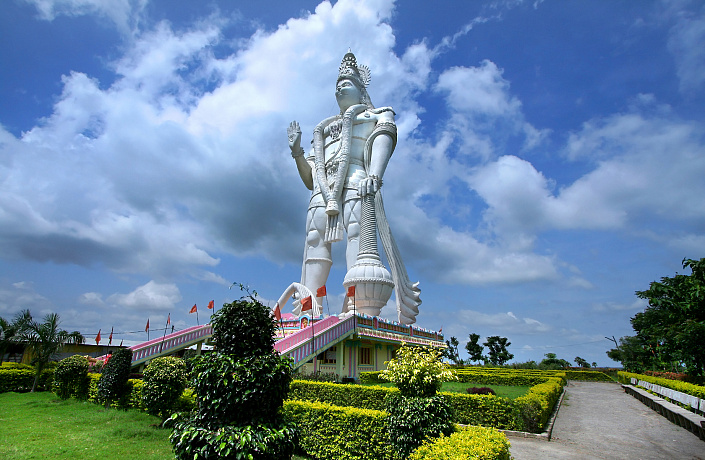
Of particular note is the temple statue installed in 2003 at the Paritala Anjaneya Temple—the world’s tallest sculpture dedicated to Hanuman, standing 41 meters high. It is located in the state of Andhra Pradesh, in the village of Paritala, near the city of Vijayawada.
In the ancient Indian village of
Khajuraho , southeast of Delhi, lies one of the oldest temple complexes. It is known that in ancient times there were more than 85 temples here, as established by the surviving foundations of these once-magnificent structures. Archaeological excavations have restored only some of them.
The eastern group of temples includes the
Temple of Hanuman (10th century), on the base of which an inscription dated to 922 CE has survived—the oldest written testimony among all the surviving inscriptions in
Khajuraho. There is also a 2.5-meter-high statue of Hanuman here.
On the grounds of the
Jakhu Temple in Shimla, the capital of
Himachal Pradesh, stands a 33-meter-high statue of Hanuman. According to legend, traces of the monkey god have also been preserved here; supposedly, he rested in this area while carrying a mountain of medicinal herbs from the Himalayas to Lanka.
The
Sankat Mochan Temple, or the
“Monkey” Temple, in
Varanasi in the state of Uttar Pradesh is dedicated to Hanuman. There is also a statue of Hanuman here. It is believed that a puja performed at this temple can bring relief from problems and the fulfillment of wishes. Pilgrims and devotees of Hanuman come to the temple every day.
In the city of
Chitrakoot, on the border between Madhya Pradesh and Uttar Pradesh, there is a forested hill with a shrine dedicated to Hanuman at its summit,
Hanuman Dhara, reached by 360 very impressive steps leading upward; it contains a small statue of Hanuman.
In the state of
Karnataka, in the village of Hanumanali, the Hanuman temple stands on Anjaneya Hill and contains a rock-carved likeness of the monkey chief.
Many other statues of Hanuman can be found throughout India. For example, a huge
orange statue of Vajrangabali, opening his chest, with Rama and Sita in the region of his heart, stands in
Shahjahanpur, Uttar Pradesh and is 125 feet tall. A huge statue of Hanuman equipped with a mechanical system depicting Hanuman opening his heart, where he keeps Sita and Rama, is located in New Delhi.
A marble sculpture of Hanuman holding a gada (mace), with his other hand folded in a gesture of protection, is located in Nandur, Maharashtra. The statue in the
village of Agarashtata, Karnataka is 31 meters tall. A thirty-meter sculpture distinguished by its realistic depiction stands in the
Shri Adya Katyayani Shakti Peeth Mandir—in the temple complex of Chhatarpur.
Festivals and holidays dedicated to Hanuman
Hanuman is one of the main characters in India’s annual
Ramlila celebrations, which present a dramatic reenactment of Rama’s life based on the events recounted in the epic “Ramayana” or in other works based on it, such as
“Ramcharitmanas.” These events are also the subject of dramatic plays and dance performances held during India’s annual autumn festival of
Navaratri. Here, Hanuman is portrayed as a hero who took part in the events of the legendary war between good and evil. The climax of the Vijayadashami celebrations is the burning, accompanied by fireworks, of a giant effigy representing the demon Ravana.
Hanuman’s birthday—Hanuman Jayanti—is observed during the traditional month of Chaitra in the lunisolar Vedic calendar (March–April). The festival celebrating the birth of Hanuman, the hero of the “Ramayana,” takes place in the month of Chaitra (usually on Chaitra Purnima) or in the month of Kartika. On this significant day, Hanuman’s devotees seek his protection and blessings, visit temples to worship him and make offerings, recite hymns in honor of Hanuman, particularly the “Hanuman Chalisa,” as well as ancient sacred scriptures such as the “Ramayana” and “Mahabharata”.
Hanuman — leader of the monkeys, references in ancient scriptures
Hail to you, great Hanuman, almighty lord of the monkeys!
Your valor is known in the three worlds; you are an unfathomable ocean of wisdom!
“Hanuman Chalisa,” verse 1
Hanuman is the god of the vanaras (half-monkeys, half-humans). The earliest reference to a monkey appearing in the form of a divine being to whom offerings are made is found in
the “Rigveda” (hymn 10.86). However, it cannot be stated with complete certainty that this hymn refers specifically to Hanuman. It presents a dialogue between Indra and his wife Indrani about how she noticed that some offerings of soma intended for Indra had been given to a monkey possessing immeasurable energy and inexhaustible strength, whose name was Vrishakapi. She regarded this as a sign that people were forgetting Indra. In response, the king of the gods, Indra, said that the living creature (the monkey) disturbing her should not be regarded as an enemy or rival; on the contrary, they should make an effort to coexist peacefully. At the end of the hymn, everyone reaches an agreement and shares the offerings equally among themselves.
Hanuman is mentioned in the epics—the “Ramayana” and the “Mahabharata.” He also appears in the Puranas: the “Mahabhagavata Purana” describes Hanuman as an inhabitant of the lands of Kimpurusha-varsha, where he and the residents of these landsworship Rama Chandra; he is also mentioned in the Brihad-dharma Purana, Skanda Purana, the dramatic work Mahanataka, and others.
The Hanuman Chalisa is a glorification of Hanuman in the form of hymns, traditionally attributed to the poet Tulsidas. He claimed to have had visions in which Hanuman appeared before him, after which he wrote his poetic version of the tale of Rama—
Ramacharitamanasa.
In the Ramayana, attributed to Valmiki, Hanuman is one of the central characters, appearing as the leader of the monkeys, and as Rama’s helper and messenger. Here, he embodies the ideal of true bhakti, a spiritually devoted follower who nevertheless courageously and selflessly upholds Dharma and the Path of Truth.
Texts such as the Bhagavata Purana, Ananda Ramayana, and Ramacharitamanasa portray him as wise, strong, brave, and wholeheartedly devoted to Rama.
The Story of Hanuman’s Birth
According to Vedic legends, Hanuman was born in the kingdom of
Kishkindha, which belonged to the vanaras, to
Anjana and his father,
Kesari. His father’s name means “brave as a lion.” According to one version, his mother Anjana, with pious reverently worshipped the god Shiva, and for her humble devotion, the god Shiva rewarded her with the birth of a son who became his incarnation on Earth. Hanuman is also called the son of the wind god Vayu, as recounted in the legends of Hanuman’s birth, also described in the “
Bhavartha Ramayana” by the poet Eknath (16th century CE), which states that when
King Dasharatha of Ayodhya performed, on the advice of Vasishtha, a yajna for the conception of a son, conducted by the sage Rishyasringa. Dasharatha’s wives were to taste the sacred drink
payasam (“bestowed by the gods”). However, an eagle carried away the cup of payasam intended for Sumitra. Flying over the village where Hanuman’s future parents lived, it dropped the cup, which was caught by the god Vayu and carried to the place where Anjana was performing her worship, and he placed it in her hands. After drinking from the cup, she soon conceived a son. As a result, Hanuman was born to her.
Legends of Hanuman. Childhood and Youth
Hanuman was a disciple of the solar god
Surya. “I will always stay by your side, never falling a step behind, and I will become your most diligent student,” Hanuman said
Surya, who transmitted all his knowledge to him in 60 hours. In gratitude for this
, Hanuman promised the god of sunlight and warmth that he would always support and protect his son
Surya—
Sugriva—whenever necessary. Thus, later,
Hanuman and Sugriva became loyal friends, and he helped
Sugriva and rescued him from trouble more than once.
As
Valmiki relates in the “Ramayana”, one day, even before the radiant
Surya became
Hanuman’s spiritual mentor, when Hanuman was still small but already possessed incredible strength and truly extraordinary and unique abilities, he caught sight of the bright red celestial body rising in the sky and mistook it for a fruit. Remembering his mother’s words that his food should consist of juicy, ripe fruits resembling the Sun, he flew toward the Sun, grabbed it by the side, and flew through the sky with it for a long time. This caused the Sun’s movement to slow, and chaos reigned on Earth: no one could tell where day ended and night began. Then the king of the gods
Indra, seeking to restore order, hurled a thunderbolt at Hanuman. It struck him on the jaw, and he fell to the ground lifeless. The god Vayu, overcome with grief at the loss of his son, left the earth, causing immense suffering for all living beings. In order to bring him back,
Shiva restored
Hanuman to life and granted him strength and power like Indra’s vajra. The other gods also bestowed gifts upon Hanuman:
Agni protected him from fire,
Varuna —from water, and
Vayu granted his son the ability to fly like the wind. The god
Brahma granted him the ability to travel anywhere, while no one would be able to stop him.
Vishnu presented him with a weapon—
gada (a mace).
Some time after this, Hanuman began using the divine abilities and powers he had received on innocent passers-by as mere pranks. One day, in the forest of
Kishkindha , he sneaked up on sages who were meditating and began tossing them into the air. One of them, the sage Matanga, became very angry and cast a curse uponHanuman’s curse resulted in him forgetting the vast majority of his superpowers. Later, when he would urgently need them, he would remember them only after someone nearby reminded him (this would be Jambavan11, who suggested that Hanuman leap across the ocean to reach Lanka and find Sita, who had been abducted by Ravana, and reminded him that he could cross this enormous distance over the ocean thanks to the divine superpowers with which he had been endowed).
Hanuman is one of the main heroes of the epic poem "Ramayana"
Hanuman appeared on Earth at the same time as Rama, the great ruler of the Solar Dynasty, who reigned for 11,000 years. His reign is known as
"Ramarajya" — the Golden Age. He strengthened the foundations of Dharma on Earth; righteousness, virtue, and piety among the kingdom’s subjects were the norm. His reign was not marred by suffering, grief, humiliation, or injustice. Every person embodied the brightest qualities; no one even contemplated doing anything wrong. There was clear and absolute adherence to the principles of "Yama" and "Niyama," which are familiar to us and sufficiently difficult for some to observe in our present age of Kali-yuga—truthfulness, non-violence, absence of greed and envy, and responsibility for one’s words, thoughts, and actions. The ruler was responsible for the prosperity of his people in every aspect.
On the pages of
the Ramayana, we see a description of a highly developed civilization that once existed on our planet. Rama incarnated on Earth in order to become an example of ideal conduct for his people and to demonstrate through his own example what qualities everyone should possess. For, as it is stated on the pages of the Ramayana, —
“As is the king, so are the subjects.”
He came to Earth with the aim of freeing people from suffering and granting them happiness, for whoever holds power bears enormous responsibility for their subjects.
His mission at the turning point between the ages (
Treta and Dvapara Yugas) was also to reveal to humanity, through the demon
Ravana— his antithesis — all the vices he possessed, whether lust, malice, desire, anger, or greed, and to show their utter meaninglessness and transience, as well as what they lead to. Ravana was to become the embodiment of those qualities that, through
Rama’s power of righteousness and fidelity to Dharma, were destroyed. Their confrontation led to the victory of the forces of light, which representsthe obviousness of the inevitable outcome of the age-old struggle between good and evil. Many gods also incarnated on Earth at that time, including
Hanuman, who manifested in this world in order to take part in these events and help Rama. Since the events of the “Ramayana” took place approximately
1,200–860 thousand years ago, the heroes’ appearance also differed greatly from the images our imagination forms in accordance with the modern era. The vanaras and bears of that time were not representatives of the animal kingdom. Unfortunately, we can now only speculate about what the members of this mysterious people, who disappeared from the face of the Earth long ago, looked like.
How It All Began
The first meeting of
Rama and
Hanuman took place when
Rama and
Lakshmana, searching for
Sita, were heading toward the temporary refuge of
Sugriva on
Rishyamukha Mountain. Seeing them, he suspected that they might be warriors of his brother
Vali, and asked
Hanuman to find out who they were. Thus,
Hanuman, disguised as a rishi, went to meet the brothers. When he learned that they were the princes of
Ayodhya, he bowed respectfully before
Ramachandra and, assuming his true form, told them about himself.
Rama embraced him and said that he was as dear to him as his brother
Lakshmana: “I pour out my love upon those who are devoted to me and see this as the supreme path to liberation.”
Hanuman told
Rama that
Sugriva could provide invaluable assistance in the search for
Sita, and that he was the king of the monkeys, but had to hide from persecution by his brother
Vali. When Rama learned that
Sugriva had suffered the same fate—that
Sugriva’s brother had stolen his wife—he helped him defeat his brother and gave
Sugriva the royal throne
Kishkindha. After
Sugriva gathered his vanara warriors to set out in search of
Sita.
The Giant Leap Across the Ocean to Lanka
Hanuman led the army of monkeys, and filled with devotion and self-sacrifice, he set out with the army to fulfill the sacred mission—he promised
Rama that he would find
Sita without fail. The eagle
Sampati (Jatayu’s brother) told them that the captive
Sita was on the island of Lanka, which stood on a three-peaked hill, in one of its flowering gardens—
Ashokavana—but they would have to discover exactly where for themselves, if they could cross the ocean by leaping one hundred yojanas and find her there. Who possessed the strength and agility to do this? Of course, the son of the wind god,
Hanuman, whose brilliant talents and abilities were matched by his boundless devotion
to Rama. Since the distance was great, the ocean god decided to help Hanuman and raised an underwater peak from its waters
Mainaka, so that Hanuman would have the opportunity to rest on him for a while, but the valiant
Hanuman merely touched him with his foot as a sign of gratitude, did not stop, and swiftly headed toward Lanka. However, an obstacle arose in his path—the serpent demon
Surasa and the giantess
Simhika. He defeated them both and soon found himself in Lanka.
The Search for Sita in Lanka
Hanuman possesses numerous siddhis, some of which he uses after entering Lanka in search of
Sita. Once in Lanka, in order to move unhindered through the domains of
Ravana, he assumed the form of a tiny, almost invisible monkey. At the city entrance, the rakshasi Lankini, who guarded the gates of the capital, noticed Hanuman and was about to swallow him, but he struck her so hard that she fell to the ground.
Hanuman entered the city while carrying out his divine mission—and this was a harbinger of the complete destruction of the rakshasas. In the capital, in a temple named “Hari,” amid a garden of Tulasi trees, he met a devotee of Rama
Vibhishana.
Hanuman was amazed that among the rakshasas he had the good fortune to meet a worthy and pure-hearted inhabitant, who turned out to be
Ravana’s brother. He told Hanuman how to find
Sita in the Ashoka grove, where
Hanuman immediately went. He appeared before
Sita, tossing her Rama’s golden ring so that she would recognize him as
Rama’s messenger, and told her that Rama would soon arrive in Lanka with his army of monkeys commanded by
Sugriva and bears led by
Jambavan, to fight the demons and rescue her. He also proved to her that he was fully capable of standing up to the rakshasas, assuming the gigantic form he took in battle, thereby convincing
Sita that such an army of
Rama could defeat the demons of Lanka.
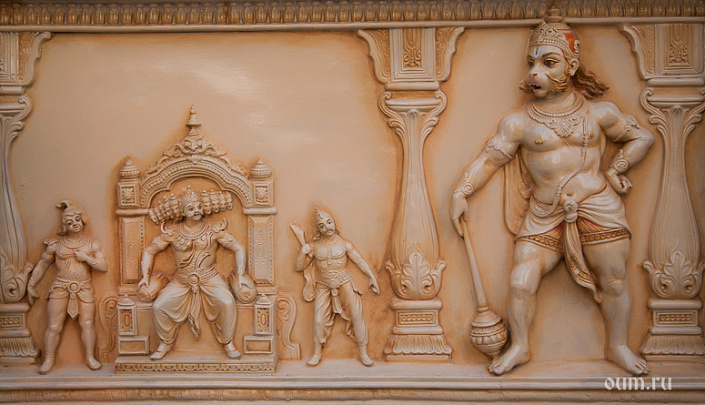
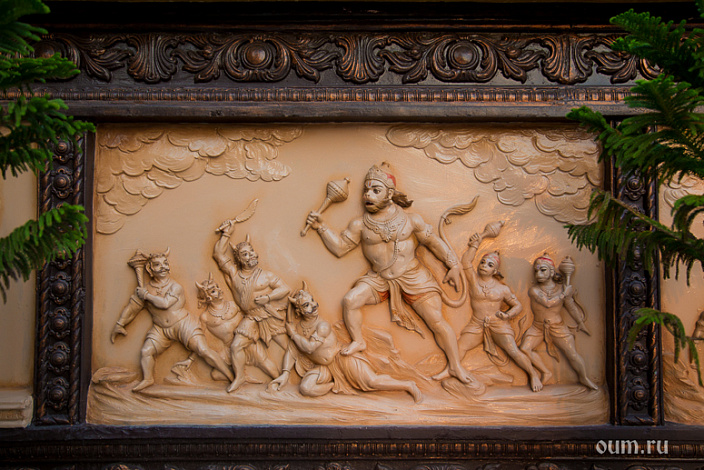
Hanuman fights the rakshasas
Hanuman appears as an invincible warrior possessing incredible strength, capable of single-handedly defeating an enemy army many times his size. After leaving
Sita,
Hanuman decided to have a snack of ripe fruit in the garden, but he was discovered by guards who were unable to deal with him. When the news reached
Ravana, he sent an entire army of rakshasas against Hanuman, but
Hanuman easily dealt with them using nothing but a small tree branch, and, with the mantra “
Ram…
Ram…” on his lips, slew all the demons who attacked him, including one of
Ravana’s sons —
Akshay Kumar. Following this,
Ravana sent another army under the command of his other son,
Meghanada, to destroy the uninvited intruder. But they were not destined to overcome
Hanuman here either. With a deafening roar, he tore a huge tree out by its roots and, swinging it, fended off the rain of arrows shot at him. However, it was only when
Meganada used the arrow
of Brahma,
Hanuman did not oppose the great divine weapon
Brahmastra and prostrated himself before it in reverence. He was then seized and brought before the ruler of Lanka.
Hanuman Burns Lanka
In this episode from the great epic, we see how
Hanuman faces very difficult circumstances that threaten his mission; however, he finds an incredible way to change the situation and turn it against the enemy.
To Ravana,
Hanuman explained that he had only wanted to eat in the garden and had been forced to confront an army of demons in order to preserve his life. He reminded
Ravana that he was the great-grandson of
Brahma,
the grandson of Pulastya and the son of Vishrava, and pointed out that he should renounce luxury and power and bow before
by Rama.
Ravana flew into a rage upon hearing such outrageous proposals and ordered
Hanuman to be killed.
Vibhishana intervened, saying that the punishment should not be so severe. The rakshasas came up with another idea: they decided to wrap
Hanuman's tail in oil-soaked cloths and set it on fire.
Hanuman met the scheme with laughter—as they poured on the oil, his tail grew longer and longer, and when they set it alight,
Hanuman began leaping from one rooftop to another, spreading fire behind him. The whole of Lanka was engulfed in flames within minutes. After that,
Hanuman, letting out a deafening roar that made all of Lanka tremble, leapt across the ocean and reached the opposite shore. These events marked the night of the full moon of the month of Kartika.
Crossing to Lanka over Rama's bridge. Hanuman carries a mountain of medicinal herbs to Lanka
And then Hanuman said to Rama: “You have chosen me as the weapon with which you accomplish your deeds. Nothing is impossible for one who has won your grace.”
“Ramayana.” A dialogue between Hanuman and Rama
Hanuman played a significant role in rescuing
Lakshmana, who had been wounded on the battlefield in the war against the demons. Rama's army crossed the ocean to Lanka over a huge bridge built in five days, one hundred yojanas long. According to legends about this crossing, the name of the god
Rama was inscribed on every stone, making them lighter than the wind. Hanuman is often depicted inscribing Rama's sacred name on stones for the future bridge to Lanka. Some believe that Rama's Bridge still connects India and Lanka today, formed by a chain of limestone boulders, mixed with sand and coral, measuring one and a half by two and a half meters. The construction of
Rama's Bridge (Setubanhanam—the sacred causeway) is described in Book VI of the Ramayana:
“During the first day, in an excess of zeal,
They swiftly built fourteen yojanas of the causeway.
And twenty more the monkey army raised the next day—
Such deeds are no marvel for those of mighty strength!
And twenty-one yojanas amid the watery depths
The giants completed by the evening of the third day.
And twenty-two yojanas they quickly finished by the end
Of the fourth day, accomplished by the monkey race.
On the fifth, they laid down twenty-three more, and brought
The length of the wondrous bridge to one hundred.”
“Ramayana,” Yuddha Kanda, “The Book of War”
Having crossed over to Lanka, they set up camp near Mount
Suvela. Soon, they began laying siege to the city’s four gates. When
Megananda attacked with the magical weapon
of Brahma—Shakti, which struck Lakshmana directly in the heart,
Hanuman carried him from the battlefield. To save
Lakshmana, a healing remedy was needed, which the healer
Sushena could identify. The valiant
Hanuman went to him: assuming a tiny form, he entered the fortress of Lanka, where Sushena was sleeping, and carried him to the camp. The healer named the medicinal plant that would help
Lakshmana return to life—it grew on Mount
Sanjivi.
Hanuman went to the mountain, but, unable to identify the necessary healing herb, he carried the entire hill to Lanka in his hands. The healer then found the required plants and, preparing a healing potion, restored
Lakshmana back to life. Thus, thanks to the brave and exceptionally strong
Hanuman, Rama’s brother
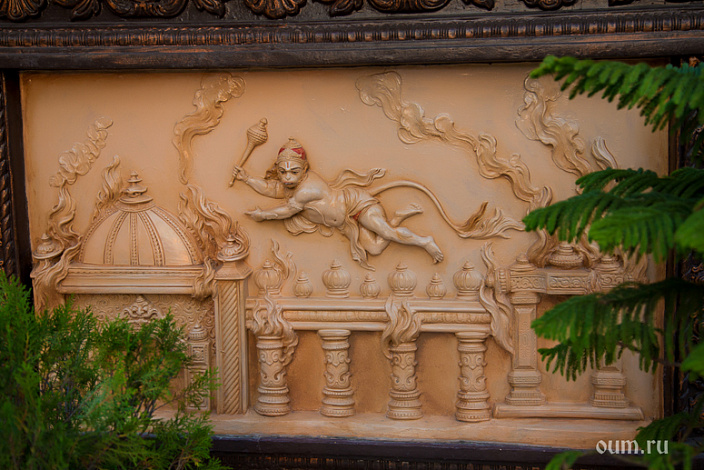
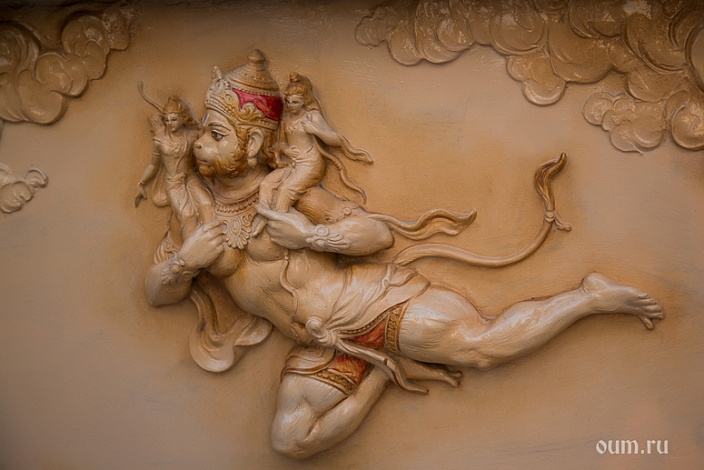
Lakshmana was saved. This story forms the basis for the widespread depiction of
Hanuman, shown flying while holding a mountain with medicinal plants in his palm.
Hanuman rescues Rama and Lakshmana from the underworld of Patala
When
Ravana lost his beloved
son Meghanada, he went to the temple of
Shiva, where another
son of his, Ahiravana, who dwelled in the underworld, appeared before him.
Ravana summoned him to his aid.
Ahiravana, having performed the necessary rituals, enveloped
Rama’s army camp in impenetrable darkness in order to capture
Rama and his brother.
Hanuman lengthened his tail and wrapped it around the camp in several coils, forming a high wall, and used his body to block the entrance to the “fortress” he had created. But
Ahiravana, having assumed the form of
Vibhishana, managed to get inside and put everyone to sleep with a mantra, then dragged
Rama and
Lakshmana away to the underworld of
Patala. When the real
Vibhishana realized who could have done this, he told
Hanuman, who set off for
Patala, hidden deep beneath the earth. There, he overheard two birds talking about how
Ahiravana was preparing to perform a sacrificial ritual involving
and
Lakshmana. At the gates of the underworld, he met
the guard Makaradhvaja, who was also a monkey. Therefore,
Hanuman quickly gained his trust, and Makaradhvaja told him where the captive brothers were being held. Hanuman managed to enter the city and, in the form of a molecule, infiltrated the garland intended for the sacrificial ritual, where he consumed all the offerings placed on the altar. When the princes were brought into the hall,
Hanuman assumed his gigantic, terrifying form and cut
Ahiravana into pieces, but he managed to reassemble himself. Then
Hanuman severed his head and threw it into the sacrificial fire, while placing the crown on the head of the guard
Makaradhwaja, proclaiming him ruler of Patala.
Hanuman seated
Rama and
Lakshmana on his shoulders and lifted them out from underground.
Hanuman in the “Mahabharata”
The ancient epic “Mahabharata” also tells of the glorious and valiant Hanuman, calling him the wisest Indra among monkeys. He is mentioned
in the third, forest book, “Aranyakaparva”. Here he is presented as
Bhima’s brother, whom Bhima accidentally encounters on his way to
Mount Gandhamadana. Hanuman lies on the ground, exhausted, and blocks
Bhima’s path with his body, yet offers to let him move his tail aside and pass.
Bhima, who possessed incredible strength, was unable to move
Hanuman’s tail from its place. He submitted and acknowledged Hanuman’s divine power. He then asked
Hanuman to assume his former appearance, which he had possessed during the Treta Yuga (when the events of the Ramayana took place).
Hanuman explained to
Bhimathat he now had a different appearance, since all beings correspond to the current age in each yuga; therefore, he no longer looked as he had before—“time is irreversible.” However,
Bhimasena insisted, and Hanuman assumed his former form, increasing substantially in size19. He told Bhima about the different yugas:
Krita, Treta, Dvapara and Kali, as well as the essence of Dharma. Hanuman prophesied to
Bhimathat he would soon take part in a great war, while Hanuman would sit atop
Vijaya’s banner, shouting a battle cry, striking the enemy with fear and terror and weakening their forces. However, after this mention of Hanuman, he does not appear again on the pages of the epic…
Hanuman Yantra
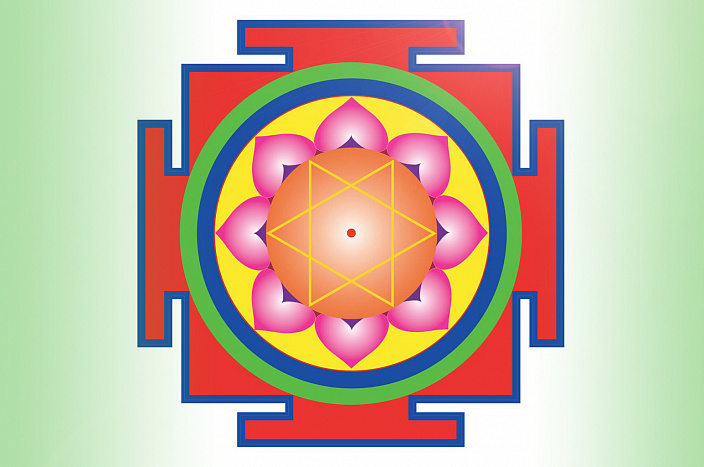
The Hanuman Yantra is a certain geometric design, a conduit for cosmic energy that harmonizes space and bestows particular qualities upon those who concentrate on it, while also transforming energy of lower vibrations and raising it to higher ones. It provides protection from misfortunes, gives strength and courage to overcome difficulties, instills bravery and boldness, and provides confidence in oneself and one’s abilities. The Hanuman Yantra is an image placed within the protective bhupur square, featuring a circle surrounded by lotus petals that symbolizes the power of absolute truth and the original, pure, divine nature. The yantra is placed in your home on a clean altar, facing north or east. Certain rules should be observed: do not allow anyone to touch the sacred image, do not let it become dusty or dirty, and keep the place where it stands clean at all times, as it will be charged with the energy radiated by the yantra. During meditation on the yantra, a mantra glorifying the deity is usually repeated, thereby invoking the energy of that deity. Meditation on the Hanuman Yantra will help you be more focused and concentrated in the present moment.
Mantras to Hanuman
In addition to the forty hymns from “
Hanuman Chalisa,” which possesses the power of a mantra glorifying the valiant and noble Hanuman, there are also short mantras praising the valiant Hanuman. They likewise radiate vibrations of pure bhakti energy, strength and courage, and the steadfast confidence so necessary on the Path of spiritual self-development. They enable us to overcome any difficulties and prevent us from straying from the righteous path leading to the higher realms of existence and raising us to higher levels of consciousness. It is believed that mantras glorifying the name of the brave devotee of Rama, Hanuman, activate prana—the life force—and that our consciousness awakens and is purified by the powerful energy of the Universe. Mantras to Hanuman are also used when it is necessary to free oneself from any addiction, attachment, or limitation.
1.
The Hanuman Gayatri Mantra, or “Hanuman Gayatri,” is a modification of the ancient and very powerful Gayatri Mantra20 from the Rigveda (III.62.10):
Om bhur bhuvah svaha
Tat savitur varenyam
Om Andjaneyaa Vidmahe
Vayuputraya Dhimahi
Thanno Hanuman Prachodayat
2.
Powerful mantra for achieving success:
3.
Mantra of strength through devotion:
4.
Mantra to great Hanuman—a variation of the traditional Mahavishnu mantra:
«Oṁnamobhagavatevāsudevāya»:
Om namo bhagavate andjaneyaa
Immersing ourselves in the reading of tales of the past and mythological stories, we admire the qualities once revealed in the forms of the gods and heroes of old. The “Ramayana” is an epic narrative of events that took place in ancient times, when the gods came to earth to guide humanity, entering a new age, through their example. Even today, these teachings and instructions are a priceless gift from the Vedic past, which we should treat with reverence and respect.
O Hanuman, son of Pavana, savior and embodiment of all blessings, dwell in my heart together with Rama, Sita, and Lakshmana! OM TAT SAT
“Hanuman Chalisa”



 I’ll listen to it


 I am endlessly grateful to Hanuman!


 . The series is beautiful and informative. Only afterward did I discover the Hanuman Chalisa in this wonderful performance. After watching the series, you understand the words you are reciting completely differently, thanks of course to the translation and animation—the graphics correspond to the text. The longest period I practiced was one month; since then I have returned to it periodically. I really like the performer’s voice—such calm confidence, capable of moving mountains