

- Joined
- Nov 21, 2019
- Messages
- 6,792
- Reaction score
- 124,300
- Points
- 11
- Age
- 55
- Location
- Орёл
- 💎VM
- 431,089.00
- New country
- 🌐Единия
- Enneatype
- 5 (?)
- Gender
- Male
- Ashram resident
- Yes
You have already read about Northern Mowgli here — Review — Reviews of my course — Primordial Island
The Book “Northern Mowgli”
An autobiographical book by Sergey Veretennikov.
Based on real events, as well as on the author’s practices from the “Your Yoga” website, woven into the book as Traces in the Snow.
The North was not cold to him.
Cold is when you are afraid. And he was not afraid.
Winter simply existed. Cold, polar, blizzard-ridden... And he did not even know that things could be different. After all, he was only five years old. And he had been born right here, among permafrost, tundra, crystal-clear lakes and rivers.
He lived in a settlement standing in the middle of the tundra, like some kind of space station on Mars beneath an invisible dome.
It also resembled a space station because whenever bad weather began, the settlement became completely cut off from the outside world: nothing flew or traveled here. The settlement was entirely left to itself in this incredible, almost fantastic world, where winter brought astonishing frosts of up to 70 degrees, while summer brought incredible heat of over 40 degrees. And instead of sandstorms, as on Mars, there were snowstorms made of sharp, needle-like snow, as if from shards, lasting for many days...
The wind flew low, almost along the ground, raising drifting snow, and the tundra roared as if someone were slowly turning over an enormous snow-white blanket.
Dogs lived here on their own. Three large gray dogs with intelligent eyes. They never barked when he approached. They simply ran up and walked beside him, as if it had been decided in advance.
They walked for a long time. Snow creaked beneath the felt boots his father had lined. The sky was low, and the stars hung so close that it seemed he really was walking on Mars, or some other planet almost devoid of atmosphere.
They went beyond the settlement, to where human tracks ended and virgin, untouched snow began in every direction.
He stopped. Not because he wanted to stop, but because he was listening to his body. The way animals do... And small children.
The frost cut away everything unnecessary. Thoughts here were always about something lofty, while the body was simple. Here, you could not want what everyone expected of you. Here, you lived as you felt. In such cold, it was impossible to lie. Neither to yourself nor to the world. Otherwise, you would not survive...
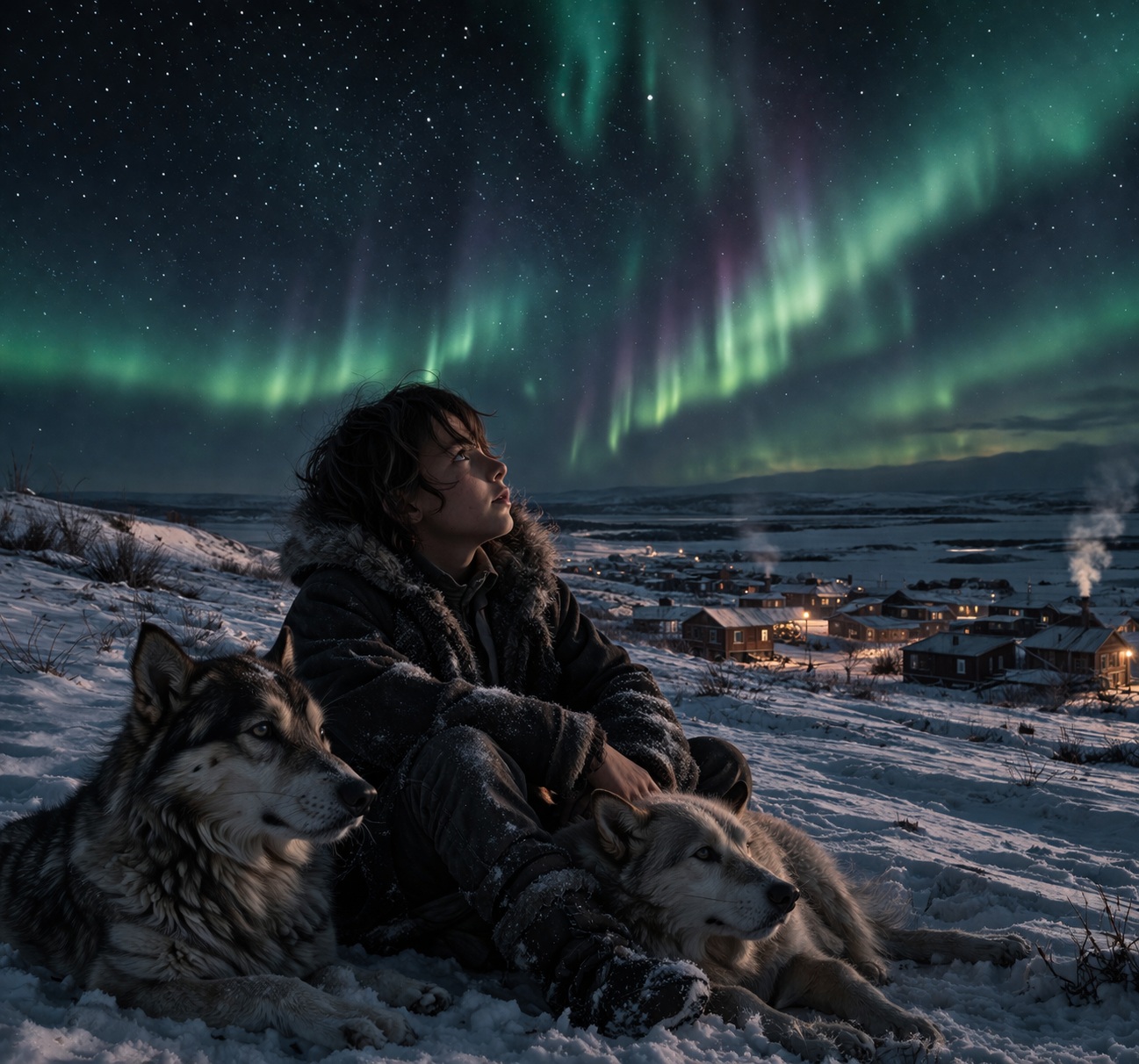
He lay on his back on the soft snow that had appeared after a long blizzard.
And the North accepted him.
The Earth was his mother. She held his body gently and sternly in the softest, purest snow, neither pressing him down nor letting him go.
It seemed she whispered: “He is mine. My Children always live this way...”
Above him, the northern lights slowly began to blaze.
The sky became the stage for a cosmic performance, a quiet concert of colors and electrical impulses.
Each wave of light was like a gesture, a sign, a silent language of the Universe. There was no chaos in these slow iridescent movements—only an ancient, inhuman harmony that had existed long before thoughts, words and names.
He felt that this was not a spectacle.
It was a meeting.
A meeting he had been waiting for a long time.
For five whole years.
That was how many years ago he had been somewhere else. Before this birth, before this world...
Nature, in whose bosom he lay, seemed to open even more deeply.
And from this very place, from this cosmic love, silence and tenderness, Nature lifted him as consciousness—and showed him to the sky.
As a mother lifts a child into her arms and says to his father: “Look. He is my son! And your son!”
And the Cosmos watched.
It did not judge.
It did not look down on him.
It did not search for flaws...
It loved.
The radiance descended lower and lower, as if the boundary between sky and earth were dissolving. Streams of light passed through him, sinking deeper and deeper—to where there were not yet any thoughts. Into a realm still untouched by the bustle and coarseness of the material world, which all adults had already thoroughly “fallen ill with.”
He lay there, watching what was happening in wonder.
And gradually, from above, knowledge descended.
Like a sudden awakening from sleep, like an astonishing clarity about life.
He understood what animals remained silent about.
Why they did not seek God.
Why they were not afraid of the Cosmos...
Because they were always in It.
And at that moment he ceased to be a small human being in the tundra.
He became the vast Cosmos in that small body.
The northern lights slowly dissolved. The sky returned to the stars.
Nature gently lowered him back into his body.
The dogs rose, as if they understood that it was time to return.
The dream ended.
And from that moment on, his entire life became not a search for truth,
but an attempt not to fall asleep again.
He told no one about it.
And not because he was afraid.
But because there were no words for what he had learned.
The words came much later...
CHAPTER ONE
After the Sky
After that sky, everything remained the same.
The house. The settlement. The people. The conversations.
And everything became different.
He ate, slept, ran and grew—like everyone else. But inside him was something that no longer fit into ordinary life. It did not interfere. It did not hurt. It simply did not coincide with it.
People spoke in words, thought in words, felt in words...
He saw adults living as if the sky were a ceiling.
As if the stars were merely dots.
As if the cold were an enemy, not a teacher.
And Nature were something one had to protect oneself from.
He did not argue.
He simply remembered.
But memory is a strange thing.
If you do not touch it, it begins to retreat deeper. It does not disappear—but hides.
The years passed.
The world grew louder.
Words grew heavier.
The body became less sensitive.
Sometimes, waking at night, he caught himself breathing too shallowly, as if afraid to take up too much space in this world. And then a vague feeling of loss arose within him. Not longing—but a sense that something did not fit.
He did not know exactly what he had lost.
But he knew that something had been there.
He tried to live like everyone else.
He studied. Worked. Listened. Spoke.
And yet, at certain moments—in the cold, in silence, in solitude—the body suddenly remembered.
It remembered how to live without tensing.
How simply to be who you are.
It lasted seconds. Sometimes minutes.
Then the noise returned.
He understood:
what had opened beneath the northern sky then
was not given forever.
It had to be held on to.
But not through effort.
Not through faith.
Not through struggle.
But through something he did not yet know.
He began to notice that whenever the body became simple, the world also became simpler. As if reality responded not to thoughts, but to a state of being.
He did not call these practices.
He did not call anything anything at all.
He simply did what kept him from falling completely asleep.
Later, people would ask him:
—How did you come to this?
—Where did you learn it?
—What system is it?
But he would remain silent in response.
Because there had been no system.
There had been a return.
And everything that follows in this book
—is not a teaching,
—is not a path,
—is not a method.
These are merely traces in the snow,
left by one
who had once seen the sky too closely
and could no longer pretend
that he did not remember.
FIRST TRACE
How the World Began to Speak
Fate chose the city of Oryol as Northern Mowgli’s place of further life. Named after the proud bird that flies alone, at the very heights of the sky...
When he found himself among people, he understood for the first time
that noise does not come only from a blizzard.
People talked constantly.
Even when they were silent.
Their looks spoke.
Their pauses spoke.
Their expectations spoke louder than words.
And often—even screamed!
And they even shouted and spoke in his direction:
—Be like this.
—No, do not be like this.
—Prove that you are right, not guilty.
—Explain why you are not like everyone else.
—Improve yourself; we are waiting for you to become like everyone else...
He saw how people spent years
proving that they were not the people
they were thought to be.
And the harder they tried,
the heavier life around them became.
In the tundra, everything was different.
There, no one was interested in
what you were supposed to be.
You were either awake—or not.
You either lived—or not.
Here, everyone seemed to carry a sack of other people’s thoughts on their back and consider it their fate.
He noticed that he himself sometimes began to act the same way.
He wanted people to understand him.
He did not want them to think badly of him.
And it was precisely at such moments
that he felt something inside him
contract.
The body became rigid.
Breathing became shallow.
The world became hostile...
He remembered the North.
There, no one explained
who he was.
The North did not care.
Not because it was indifferent, but because it saw straight through people.
When you are alone with primordial Nature, it cannot be otherwise. It reveals all of itself to you and makes you do the same, without concealing a single particle of yourself.
And one day, a strange,
almost audacious understanding came:
what if nothing were corrected?
What if you allowed the world
to think whatever it wanted about you—
at once, without resistance?
What if you did not defend yourself,
even mentally?
It was not resignation.
And not defeat.
It was like lying down in the snow
and allowing the Earth to hold you.
He felt that at this point
the tension that had held him for years
disappeared.
If you are already bad,
there is nothing to prove.
If you are already guilty of everything,
you are free from explanations.
There was something
northern,
honest,
pure about it.
And the world suddenly
became lighter...
Constantly maintaining a certain opinion of yourself was not only pointless. It was exhausting.
And very unlike the North.
There, he never explained to the sky who he was. He stood before it with nothing concealed.
One day he saw clearly:
a huge part of human life is spent not living,
but proving that you are not the person others think you are.
People live with this burden for years, as if carrying a fragile object on their backs—their image. They are afraid of dropping it. Afraid it will crack. Afraid someone will see them as they really are, rather than as they want to appear.
In every moment when tension had once arisen, he seemed to say to the world:
yes, let it be so.
If I am bad—then I am bad.
If I am guilty—then I am guilty.
And something strange happened.
The tension disappeared.
When there is nothing to defend, there is nothing to lose.
When the image is destroyed, only the living and real, the eternal, remains.
He suddenly felt as he had then, in the snow.
Without armor.
Without excuses.
Without trying to please anyone.
As if he had lain down in the snow in the tundra again,
and the Earth were holding him—
without asking whether he deserved it.
He understood:
the desire to be liked makes a person a slave.
And agreeing to be anything—sets one free.
The world had not changed.
People continued to think what they thought.
But inside, it became quiet.
_______________________________
Practice used: Your Yoga. Freedom from Opinions (or I Am Bad by Default).
SECOND TRACE
How People Give Themselves to Dead Things
When it became quiet inside,
he began to notice more.
Not because he had become more attentive.
But because the noise no longer obscured reality.
He saw what happened to people next.
The very same people
who worried so much about
what others would think of them
worried just as much about their bodies.
They seemed to look at the body as a stupid machine
that broke down for incomprehensible reasons.
And it could be repaired like a machine.
Fixed.
Handed over to a specialist.
They searched for a specialist
who could give them health.
Doctors.
Medicines.
Remedies.
And almost no one asked the simple question:
who actually lives inside this body?
He saw people say:
“The doctor cured me,”
“The pill helped,”
“I was lucky with the medicine.”
And sometimes they really did feel better—he knew that it was not caused by those pills and doctors.
Healing always took place where silence and peace appeared—inside the person themselves.
Everything else
merely allowed it to happen.
As if a person needed a reason
to allow Life
to flow through them again.
He saw
that some people allowed it—
and the body gradually healed.
While others continued searching outside,
changing remedies,
shifting responsibility—
and returned to the same place again.
When a person continually gives themselves over to external things—opinions, judgments, doctors, remedies—they lose connection with what truly sustains life.
Not because anyone is to blame.
But because their attention has gone elsewhere.
He remembered the North.
There, the body was not a soulless machine.
There was a body carrying billions of years of evolution...
Wise and strong.
There was no “treatment.”
Life was simply not halted by fear and delusion.
And it was the same here.
When a person stops considering themselves broken,
stops waging war on the body,
stops waiting for salvation from outside—
something inside begins to work on its own.
Quietly.
Without promises.
Without effects.
As if the inner Universe
simply returns
to its proper place.
He drew no conclusions from it.
He did not argue.
He did not try to convince anyone.
He simply saw.
_______________________________
Practice used: Your Yoga. Who Can Give You Health and Healing
The Book “Northern Mowgli”
An autobiographical book by Sergey Veretennikov.
Based on real events, as well as on the author’s practices from the “Your Yoga” website, woven into the book as Traces in the Snow.
INTRODUCTION
The North was not cold to him.
Cold is when you are afraid. And he was not afraid.
Winter simply existed. Cold, polar, blizzard-ridden... And he did not even know that things could be different. After all, he was only five years old. And he had been born right here, among permafrost, tundra, crystal-clear lakes and rivers.
He lived in a settlement standing in the middle of the tundra, like some kind of space station on Mars beneath an invisible dome.
It also resembled a space station because whenever bad weather began, the settlement became completely cut off from the outside world: nothing flew or traveled here. The settlement was entirely left to itself in this incredible, almost fantastic world, where winter brought astonishing frosts of up to 70 degrees, while summer brought incredible heat of over 40 degrees. And instead of sandstorms, as on Mars, there were snowstorms made of sharp, needle-like snow, as if from shards, lasting for many days...
The wind flew low, almost along the ground, raising drifting snow, and the tundra roared as if someone were slowly turning over an enormous snow-white blanket.
Dogs lived here on their own. Three large gray dogs with intelligent eyes. They never barked when he approached. They simply ran up and walked beside him, as if it had been decided in advance.
They walked for a long time. Snow creaked beneath the felt boots his father had lined. The sky was low, and the stars hung so close that it seemed he really was walking on Mars, or some other planet almost devoid of atmosphere.
They went beyond the settlement, to where human tracks ended and virgin, untouched snow began in every direction.
He stopped. Not because he wanted to stop, but because he was listening to his body. The way animals do... And small children.
The frost cut away everything unnecessary. Thoughts here were always about something lofty, while the body was simple. Here, you could not want what everyone expected of you. Here, you lived as you felt. In such cold, it was impossible to lie. Neither to yourself nor to the world. Otherwise, you would not survive...
He lay on his back on the soft snow that had appeared after a long blizzard.
And the North accepted him.
The Earth was his mother. She held his body gently and sternly in the softest, purest snow, neither pressing him down nor letting him go.
It seemed she whispered: “He is mine. My Children always live this way...”
Above him, the northern lights slowly began to blaze.
The sky became the stage for a cosmic performance, a quiet concert of colors and electrical impulses.
Each wave of light was like a gesture, a sign, a silent language of the Universe. There was no chaos in these slow iridescent movements—only an ancient, inhuman harmony that had existed long before thoughts, words and names.
He felt that this was not a spectacle.
It was a meeting.
A meeting he had been waiting for a long time.
For five whole years.
That was how many years ago he had been somewhere else. Before this birth, before this world...
Nature, in whose bosom he lay, seemed to open even more deeply.
And from this very place, from this cosmic love, silence and tenderness, Nature lifted him as consciousness—and showed him to the sky.
As a mother lifts a child into her arms and says to his father: “Look. He is my son! And your son!”
And the Cosmos watched.
It did not judge.
It did not look down on him.
It did not search for flaws...
It loved.
The radiance descended lower and lower, as if the boundary between sky and earth were dissolving. Streams of light passed through him, sinking deeper and deeper—to where there were not yet any thoughts. Into a realm still untouched by the bustle and coarseness of the material world, which all adults had already thoroughly “fallen ill with.”
He lay there, watching what was happening in wonder.
And gradually, from above, knowledge descended.
Like a sudden awakening from sleep, like an astonishing clarity about life.
He understood what animals remained silent about.
Why they did not seek God.
Why they were not afraid of the Cosmos...
Because they were always in It.
And at that moment he ceased to be a small human being in the tundra.
He became the vast Cosmos in that small body.
The northern lights slowly dissolved. The sky returned to the stars.
Nature gently lowered him back into his body.
The dogs rose, as if they understood that it was time to return.
The dream ended.
And from that moment on, his entire life became not a search for truth,
but an attempt not to fall asleep again.
He told no one about it.
And not because he was afraid.
But because there were no words for what he had learned.
The words came much later...
CHAPTER ONE
After the Sky
After that sky, everything remained the same.
The house. The settlement. The people. The conversations.
And everything became different.
He ate, slept, ran and grew—like everyone else. But inside him was something that no longer fit into ordinary life. It did not interfere. It did not hurt. It simply did not coincide with it.
People spoke in words, thought in words, felt in words...
He saw adults living as if the sky were a ceiling.
As if the stars were merely dots.
As if the cold were an enemy, not a teacher.
And Nature were something one had to protect oneself from.
He did not argue.
He simply remembered.
But memory is a strange thing.
If you do not touch it, it begins to retreat deeper. It does not disappear—but hides.
The years passed.
The world grew louder.
Words grew heavier.
The body became less sensitive.
Sometimes, waking at night, he caught himself breathing too shallowly, as if afraid to take up too much space in this world. And then a vague feeling of loss arose within him. Not longing—but a sense that something did not fit.
He did not know exactly what he had lost.
But he knew that something had been there.
He tried to live like everyone else.
He studied. Worked. Listened. Spoke.
And yet, at certain moments—in the cold, in silence, in solitude—the body suddenly remembered.
It remembered how to live without tensing.
How simply to be who you are.
It lasted seconds. Sometimes minutes.
Then the noise returned.
He understood:
what had opened beneath the northern sky then
was not given forever.
It had to be held on to.
But not through effort.
Not through faith.
Not through struggle.
But through something he did not yet know.
He began to notice that whenever the body became simple, the world also became simpler. As if reality responded not to thoughts, but to a state of being.
He did not call these practices.
He did not call anything anything at all.
He simply did what kept him from falling completely asleep.
Later, people would ask him:
—How did you come to this?
—Where did you learn it?
—What system is it?
But he would remain silent in response.
Because there had been no system.
There had been a return.
And everything that follows in this book
—is not a teaching,
—is not a path,
—is not a method.
These are merely traces in the snow,
left by one
who had once seen the sky too closely
and could no longer pretend
that he did not remember.
FIRST TRACE
How the World Began to Speak
Fate chose the city of Oryol as Northern Mowgli’s place of further life. Named after the proud bird that flies alone, at the very heights of the sky...
When he found himself among people, he understood for the first time
that noise does not come only from a blizzard.
People talked constantly.
Even when they were silent.
Their looks spoke.
Their pauses spoke.
Their expectations spoke louder than words.
And often—even screamed!
And they even shouted and spoke in his direction:
—Be like this.
—No, do not be like this.
—Prove that you are right, not guilty.
—Explain why you are not like everyone else.
—Improve yourself; we are waiting for you to become like everyone else...
He saw how people spent years
proving that they were not the people
they were thought to be.
And the harder they tried,
the heavier life around them became.
In the tundra, everything was different.
There, no one was interested in
what you were supposed to be.
You were either awake—or not.
You either lived—or not.
Here, everyone seemed to carry a sack of other people’s thoughts on their back and consider it their fate.
He noticed that he himself sometimes began to act the same way.
He wanted people to understand him.
He did not want them to think badly of him.
And it was precisely at such moments
that he felt something inside him
contract.
The body became rigid.
Breathing became shallow.
The world became hostile...
He remembered the North.
There, no one explained
who he was.
The North did not care.
Not because it was indifferent, but because it saw straight through people.
When you are alone with primordial Nature, it cannot be otherwise. It reveals all of itself to you and makes you do the same, without concealing a single particle of yourself.
And one day, a strange,
almost audacious understanding came:
what if nothing were corrected?
What if you allowed the world
to think whatever it wanted about you—
at once, without resistance?
What if you did not defend yourself,
even mentally?
It was not resignation.
And not defeat.
It was like lying down in the snow
and allowing the Earth to hold you.
He felt that at this point
the tension that had held him for years
disappeared.
If you are already bad,
there is nothing to prove.
If you are already guilty of everything,
you are free from explanations.
There was something
northern,
honest,
pure about it.
And the world suddenly
became lighter...
Constantly maintaining a certain opinion of yourself was not only pointless. It was exhausting.
And very unlike the North.
There, he never explained to the sky who he was. He stood before it with nothing concealed.
One day he saw clearly:
a huge part of human life is spent not living,
but proving that you are not the person others think you are.
People live with this burden for years, as if carrying a fragile object on their backs—their image. They are afraid of dropping it. Afraid it will crack. Afraid someone will see them as they really are, rather than as they want to appear.
In every moment when tension had once arisen, he seemed to say to the world:
yes, let it be so.
If I am bad—then I am bad.
If I am guilty—then I am guilty.
And something strange happened.
The tension disappeared.
When there is nothing to defend, there is nothing to lose.
When the image is destroyed, only the living and real, the eternal, remains.
He suddenly felt as he had then, in the snow.
Without armor.
Without excuses.
Without trying to please anyone.
As if he had lain down in the snow in the tundra again,
and the Earth were holding him—
without asking whether he deserved it.
He understood:
the desire to be liked makes a person a slave.
And agreeing to be anything—sets one free.
The world had not changed.
People continued to think what they thought.
But inside, it became quiet.
_______________________________
Practice used: Your Yoga. Freedom from Opinions (or I Am Bad by Default).
SECOND TRACE
How People Give Themselves to Dead Things
When it became quiet inside,
he began to notice more.
Not because he had become more attentive.
But because the noise no longer obscured reality.
He saw what happened to people next.
The very same people
who worried so much about
what others would think of them
worried just as much about their bodies.
They seemed to look at the body as a stupid machine
that broke down for incomprehensible reasons.
And it could be repaired like a machine.
Fixed.
Handed over to a specialist.
They searched for a specialist
who could give them health.
Doctors.
Medicines.
Remedies.
And almost no one asked the simple question:
who actually lives inside this body?
He saw people say:
“The doctor cured me,”
“The pill helped,”
“I was lucky with the medicine.”
And sometimes they really did feel better—he knew that it was not caused by those pills and doctors.
Healing always took place where silence and peace appeared—inside the person themselves.
Everything else
merely allowed it to happen.
As if a person needed a reason
to allow Life
to flow through them again.
He saw
that some people allowed it—
and the body gradually healed.
While others continued searching outside,
changing remedies,
shifting responsibility—
and returned to the same place again.
When a person continually gives themselves over to external things—opinions, judgments, doctors, remedies—they lose connection with what truly sustains life.
Not because anyone is to blame.
But because their attention has gone elsewhere.
He remembered the North.
There, the body was not a soulless machine.
There was a body carrying billions of years of evolution...
Wise and strong.
There was no “treatment.”
Life was simply not halted by fear and delusion.
And it was the same here.
When a person stops considering themselves broken,
stops waging war on the body,
stops waiting for salvation from outside—
something inside begins to work on its own.
Quietly.
Without promises.
Without effects.
As if the inner Universe
simply returns
to its proper place.
He drew no conclusions from it.
He did not argue.
He did not try to convince anyone.
He simply saw.
_______________________________
Practice used: Your Yoga. Who Can Give You Health and Healing


 Stop and simply look around with your heart, and everything—people, nature, the animal world—begins to interact actively with us, sending hints and simply filling us with wonder! “How wonderful that you exist!” I have often heard people say this lately in different circumstances, and I understand that these words are meant to remind me not to forget my “I AM.”
