Kali or Kshepana Mudra of Release: Free Yourself from Everything Unnecessary
In Sanskrit,
Kshepana means “to throw out,” “to let go,” “to pour out,” or “to release.” Kshepana Mudra is a mudra for getting rid of waste, known in Ayurveda as mala. This waste or mala may literally be physical waste, toxic relationships, negative thoughts, or old habits, samskaras (habits), and vasanas (tendencies from past lives) that no longer serve your higher Self.
Kshepana (Kali) Mudra
You can use this mudra when you feel heavy or overwhelmed, or when you are clinging tightly to expectations or the desire to keep everything under control. It is also helpful to practice this mudra when you feel angry, upset, or depressed. It is like a gentle cleansing for the soul.
Kshepana Mudra and Apana Vayu
Kshepana Mudra works with apana vayu, which represents the downward and outward flow of energy (prana) involved in elimination (defecation and urination), menstruation, and childbirth. In addition to elimination through the large intestine, Kshepana Mudra helps us remove mala through the skin’s surface via sweat and through the lungsthrough the exhalation (out-breath).
Kshepana Mudra: Elements and Chakras
Mudras are often associated with specific elements according to the Ayurvedic theory of the five elements (earth, water, fire, air, and ether). Kshepana Mudra is often associated with the air element and, consequently, with the heart chakra.
Performing this mudra is like an act of self-love—to say, “Enough, this does not serve me; I let it go.”
And after many years of practicing Kshepana Mudra, it begins to resonate with the second chakra and the water element. Many practitioners note that the image of water helps calm the nervous system and eliminate stagnation, stress, and so on. The second chakra is also closely associated with the energy of apana-vayu and the act of letting go.
Kali Mudra
In the tantric tradition, this same mudra is called Kali Mudra. In Sanskrit, Kali means “she who is black” or “she who is time.” The root word of Kali is Kala, meaning “black” or “time.” Kali is the embodiment of Shakti energy, which is also feminine power. In this context, this mudra is named after the goddess Durga, who transforms into Kali. The goddess Kali symbolizes destruction, transformation, and death (of everything unnecessary), removing darkness and making way for light.
The goddess Kali is often depicted as angry and destructive, but in fact she symbolizes the destruction of that which does not help sustain the universal Dharma (order).
In this context, in this mudra, the extended index fingers symbolize Durga’s sword, which kills Maya, meaning “illusion.” During this practice, blockages in our central energy channel, Sushumna Nadi, are removed.
Through this practice, the practitioner gains the opportunity to release or let go of what currently does not serve their highest interests. For this reason, many other yoga techniques also incorporate this practice.
Kshepana Mudra Practice
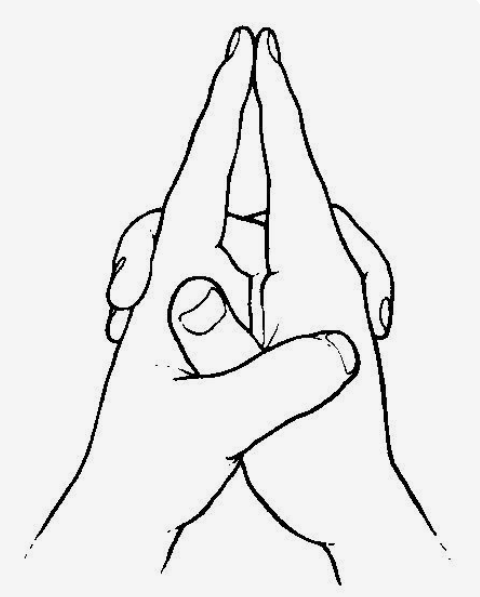
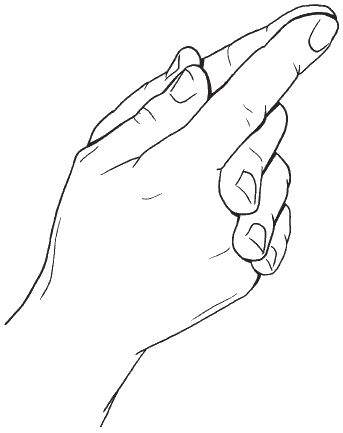
To perform Kshepana Mudra, interlace the fingers of both hands, then extend the index fingers.
The index fingers touch each other. The thumbs are crossed, and the pads of the thumbs rest on the crease between the thumb and index finger.
When sitting and practicing this mudra, the index fingers should point downward.
When performing this mudra while lying down, the index fingers should point toward the feet.
You can also practice this mudra during your asana practice. Here is a sequence that can be performed in a seated position.
- Begin with the mudra of the heart center. The index fingers point upward.
- As you inhale, turn the index fingers downward and slightly to the sides, extending your arms toward the floor.
- On the same inhalation, raise your arms upward.
- As you exhale, bring the index fingers to the crown of the head, the forehead, the nose, then the lips, and back to the heart.
- With each inhalation, imagine bright, luminous energy flowing into your body, and with each exhalation, release negativity in any of its forms.
- Practice for a total of seven times.
Benefits of Kshepana Mudra:
Kshepana Mudra helps get rid of negativity, disappointment, and suffering. Practicing the mudra, especially the one described above, creates a noticeable difference in our energy. Therefore, Kshepana Mudra can be called an “adjustment of state.”
Affirmations:
- “I release what no longer serves me.”
- “The spent energy in my body, mind, and soul flows away from me, and I gratefully accept everything that refreshes me,” from Gertrude Hirsch’s book *Mudras: Yoga in Your Hands*.
- “I surrender to the flow of the Universe.”
- “I easily embrace uncertainty.”
- “I don’t need to control everything.”
The Teacher has already spoken about it
HERE



 Веретенников Сергей
, thank you for this topic! Very interesting and useful material.

 4258
,
 7371
, thank you for your help. I added your additions to my posts about the specified mudras — Rare Mystical Mudras and Rare Mystical Mudras