- Joined
- Nov 21, 2019
- Messages
- 6,792
- Reaction score
- 124,314
- Points
- 11
- Age
- 55
- Location
- Орёл
- 💎VM
- 432,131.50
- New country
- 🌐Единия
- Enneatype
- 5 (?)
- Gender
- Male
- Ashram resident
- Yes
Tengri is an ancient word.
It consists of two words: Blue and Deity.
We know that the principal Vedic deities are also blue or dark blue.
Tengri also translates as blue sky.
It is a Turkic word and teaching.
Tengrism — Wikipedia
And it is not merely a word or a teaching—it is the Supreme God.
Important sources on medieval Tengrism include monuments of ancient Turkic runic script, especially “The Book of Divination,” as well as the epic “The Secret History of the Mongols.”
If you would like to explore this subject more deeply, read more at the Veretennikov School:
When we speak of ancient religions, we usually think of Egypt, India, Judea, China, Greece, Persia, and the Middle East. These spiritual traditions truly left an enormous mark on human history. But between them, in the very heart of Eurasia, lay a gigantic expanse of steppes, mountains, rivers, and nomadic routes.
There lived peoples whom chroniclers often called “unknown”: no one knew where they had come from, what tribe they belonged to, or what faith they followed. But this does not mean that they had no spiritual life. On the contrary, they had their own profound and ancient worldview—living, oral, and not tied to stone temples or weighty books.
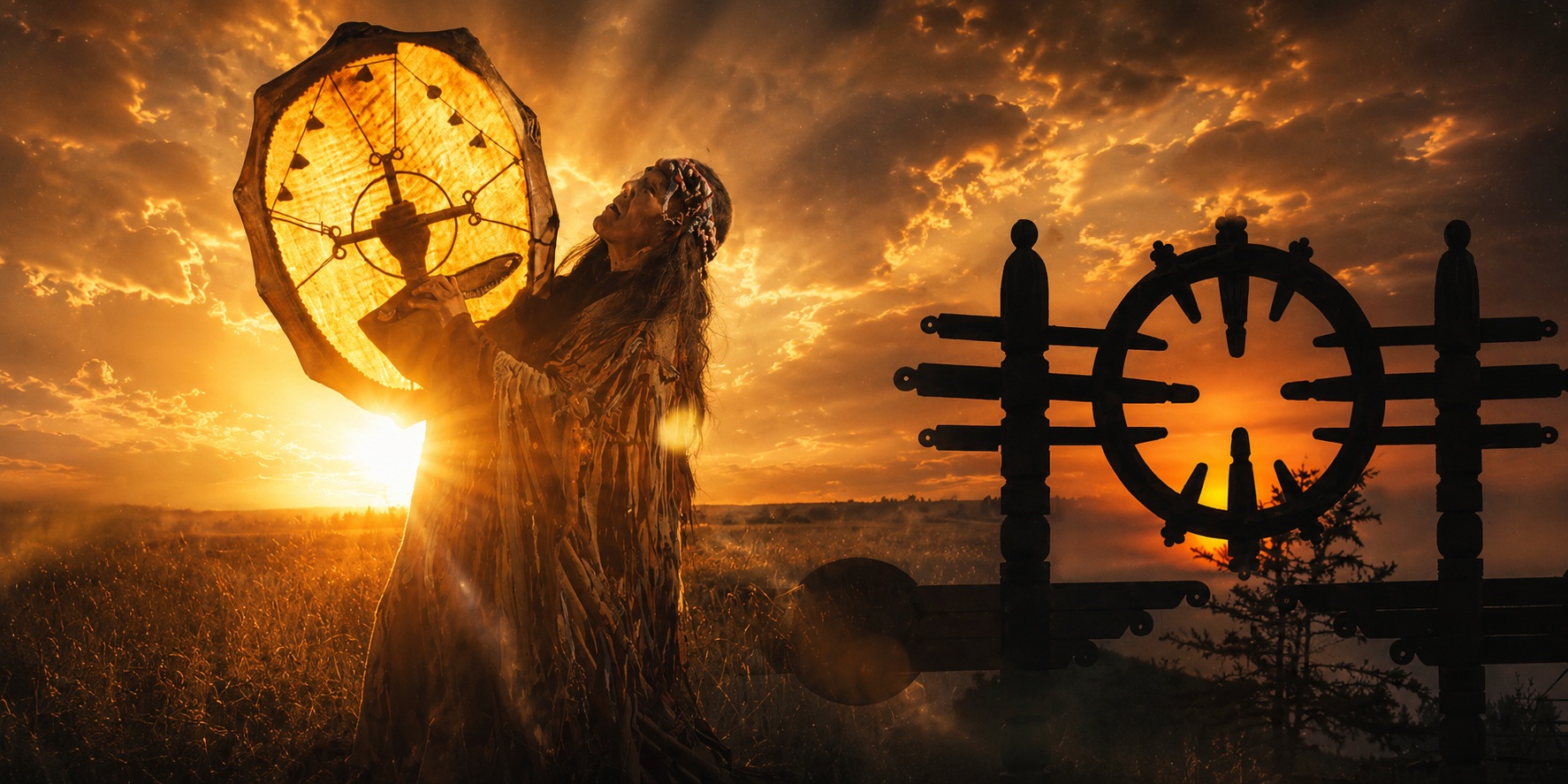
Tengrism remained almost invisible to the general public for a long time. Not because it did not exist, but because it lived differently. It was not the religion of city libraries and monastic archives. It was the religion of the steppe, wind, horse, fire, clan, mountain, and starry sky.
It was the faith of people who did not build a stationary civilization around a single city. They moved. And their memory moved with them.
Why Tengrism Has No Single Sacred Book
One frequently asked question is: if Tengrism has no single sacred book, can it be considered a true religion?
It can.
The oldest religions initially had no books. Not because they were “inferior,” but because writing appeared later. Before the book came tradition. Before the text came the voice. Before dogma came the memory of the clan. Before the library came the elder by the fire, the shaman beside the tree, and the mother telling her child about Heaven.
It is difficult for a nomadic people to carry heavy scrolls and libraries with them. Everything a nomad has must be necessary. The superfluous is discarded. The steppe quickly teaches minimalism: take only what horse, road, and fate can bear.
Therefore, sacred knowledge lived not so much on pages as in people. It was carried in memory, songs, rituals, signs, an attitude toward nature, and rules of honor.
As a wise man might say: I carry everything of my own with me.
And a steppe sage would add: and I do not hang anything unnecessary on the saddle.
Tengri as the Eternal Sky
The central idea of Tengrism is the existence of a supreme Heavenly principle. Tengri is not simply the “god of the sky” in the narrow sense. It is the supreme principle of the universe. It establishes order, grants destiny, watches over justice, and maintains the connection between worlds.
In the ancient consciousness, the Sky was not an abstraction. It was a living reality. A person could see it every day and every night. It was above everyone: above khan and beggar, warrior and child, human and beast.
The Sky cannot be bribed.
The Sky cannot be deceived.
The Sky cannot be forced to serve petty desires.
And this is the very powerful philosophy of Tengrism: a person does not live by themselves. There is a higher law above them. Not bureaucratic, not bookish, not invented by people, but cosmic.
When a person violates order, they do not merely break a custom. They fall out of harmony with the Sky.
The World as Order Emerging from Chaos
In Tengrism myths, as in many ancient traditions around the world, there was primordial chaos before creation—a boundless watery abyss, a state before form, before earth, before sky, before stable order.
Then light appears, a golden egg, the awakening of Tengri, and the division of the world into above and below, sky and earth. This image occurs in various ancient cultures because, wherever they lived, people intuitively felt that the world was not born as a mechanical accident, but as a transition from chaos to order.
Especially beautiful is the image of the world axis. Tengri sets a staff between heaven and earth, and space and time begin to revolve around this axis. In the sky, this axis becomes the North Star—a fixed point around which the entire celestial vault seems to move.
This is a very profound symbol.
Every world needs an axis.
Every person does too.
If a person has no North Star within, they are carried by the winds of circumstance. Today they believe one thing, tomorrow another, and the day after tomorrow a third. Today they serve the light, tomorrow profit, and later fear. Without an inner axis, a person becomes a tumbleweed.
Tengrism reminds us: find what is immovable within you. Find your inner Heavenly Pole. Find the vertical line between the earthly and the higher.
Three Worlds: Heaven, Earth, and the Lower World
In the Tengrism worldview, existence is divided into three levels.
The Upper World — the realm of Tengri, gods, and benevolent spirits.
The Middle World — the world of people, animals, nature, and earthly life.
The Lower World — the realm of dark spirits and chaotic, destructive forces.
This scheme is not merely mythology. It is spiritual psychology.
There are also three worlds within a person.
There is the upper world—their conscience, inspiration, prayer, and capacity for love, loyalty, heroism, and pure service.
There is the middle world—everyday life: work, family, food, the body, worries, relationships, and the path across the earth.
And there is the lower world—fears, envy, malice, greed, ignorance, and destructive desires.
A person lives on the boundary between these worlds. And every day they choose: what will rule within them? Heaven or chaos? A luminous vertical axis or underground shadows?
That is why ancient images should not be viewed merely as “the ancestors’ tales.” A map of the inner world is often hidden within a myth.
The World Tree and Sacred Mountain
In other traditions, the role of the world axis is played by the World Tree. Its roots descend into the lower world, its trunk stands in the world of people, and its crown rises toward the Sky. This tree connects everything that exists.
Alongside this image stands the sacred mountain—a high point where earth seems to draw close to heaven. In spiritual traditions, the mountain has always been a place of transition: a person ascends not only with their body, but also with their consciousness.
Mountains, solitary trees, and open spaces played an important role in Tengrism rituals. This is understandable: in steppe culture, the universe itself was the temple. The sky was the temple’s dome. Mountains and trees were its columns. The earth was its altar. The stars were its candles.
This is not the poverty of a religion. It is its grandeur.
When the entire world becomes a temple, a person can no longer say, “I am spiritual only here, in a special place.” No. They always stand beneath the Sky. Therefore, their responsibility is also constant.
Humans and Nature
One of Tengrism’s greatest strengths is its reverence for nature. But this is not primitive worship of a tree, stone, or river. It is the feeling that nature is alive and filled with forces, signs, and breath.
For modern people, nature has often become a “resource.” A forest is timber. A river is water. Land is an area. An animal is a product. The sky is weather. Everything is cut up into functions and prices.
For ancient people, nature was a mystery. And perhaps they were wiser than us in this respect.
Tengrism teaches us to see the world not as a warehouse of materials, but as a living sacred space. The sun, moon, stars, wind, mountain, tree, fire, and water are not merely the backdrop to human life. They are participants in the great existence.
Humans are not the masters of the universe. They are its children. Sometimes disobedient, noisy, and overconfident. But children nonetheless.
Destiny, Honor, and Responsibility
The idea of destiny occupies an important place in Tengrism. Tengri gives a person a soul and a path. But this does not mean complete predestination, in which a person decides nothing.
Rather, destiny is the field in which a person is to fulfill their potential. They are given life, but how they live it depends on their choices.
Here a moral law arises: a person must be honest, loyal, courageous, and just, and must respect their clan, ancestors, nature, and the higher order. After death, they face not mere disappearance, but the result of the path they have lived.
The righteous rise to the worlds of light. The evildoer ends up in a realm of darkness and disintegration.
This is a very important idea: life has consequences. Nothing disappears without a trace. Every action leaves a mark not only on society, but also on the person themselves, their soul, and their posthumous journey.
Modern people often want freedom without responsibility. Tengrism speaks more harshly: freedom exists, but the Sky sees everything.
Power Under the Sky
In the Tengrism tradition, a ruler’s power is also connected with the Sky. A khagan rules not simply because they are stronger than others, but because they have been granted heavenly sanction. Yet this is not a perpetual indulgence.
If a ruler violates the law of the Sky, becomes unjust, cruel, weak in spirit, or destructive to the people, they lose heavenly support. The wrath of the Sky may fall both on them and on the people bound to such a rule.
A serious political philosophy is embedded here: power is not absolute. Above power stands a higher moral law.
A ruler can deceive the people.
The people can deceive themselves.
But not the Sky.
The Wolf as a Symbol of Origin and Strength
In Tengrism and Turkic legends, the wolf occupies a special place. The heavenly wolf, the blue wolf, and the ancestral she-wolf are not merely animal characters. Here, the wolf symbolizes strength, survival, freedom, ancestral memory, and the ability to pass through destruction and be reborn.
The steppe is harsh. There, it is not the one who speaks beautifully who survives, but the one who senses the path, holds the pack together, knows the wind, and can be attentive and strong.
The wolf is an image not of savagery, but of primal truth. It does not live by falsehood. It does not construct ideologies. It senses.
This is also a lesson for modern people: do not lose your instinct for truth. Do not become decorative beings detached from the earth, body, nature, and clan.
The Philosophy of the Sky for Modern People
Modern people are greatly lacking in Sky.
They have screens, news, payments, arguments, purchases, opinions, endless bustle, and thousands of other people’s voices in their heads. But they often lack the main thing—the sense of a higher order.
Tengrism returns a simple and powerful thought: raise your head.
Look at the Sky.
Not as a tourist.
Not as a weather user.
But as a person who has remembered that infinity exists above them.
Look at a tree—not as an object, but as a living axis between earth and light.
Look at fire—not as a chemical reaction, but as an ancient sign of transformation.
Look at your life—not as a collection of random problems, but as a path where every action either brings you closer to the Sky or takes you farther from it.
In this sense, Tengrism can be important not only for Turkic peoples. It speaks in a language understandable to every soul: the language of Sky, Earth, wind, honor, and inner verticality.
In Conclusion
Tengrism is the religion of the Great Steppe, but at the same time it is a philosophy of open space. It has no confining walls. Its temple is immense. Its floor is the earth. Its dome is the starry sky. Its candles are the sun, moon, and fire. Its prayer is the breath of the wind. Its law is to live so that one need not be ashamed before the Sky.
And perhaps this is especially important today.
Because a person may lose books, cities, states, familiar forms, and names. But as long as they can raise their eyes to the Sky and ask themselves, “Is my path pure?”—the spiritual connection has not yet been broken.
And that means the world axis still passes through the heart.
It consists of two words: Blue and Deity.
We know that the principal Vedic deities are also blue or dark blue.
Tengri also translates as blue sky.
It is a Turkic word and teaching.
Tengrism — Wikipedia
And it is not merely a word or a teaching—it is the Supreme God.
Important sources on medieval Tengrism include monuments of ancient Turkic runic script, especially “The Book of Divination,” as well as the epic “The Secret History of the Mongols.”
If you would like to explore this subject more deeply, read more at the Veretennikov School:
- The Law of Protection [Магазин] (the entire topic)
- Goddesses
- The Book “Northern Mowgli”
When we speak of ancient religions, we usually think of Egypt, India, Judea, China, Greece, Persia, and the Middle East. These spiritual traditions truly left an enormous mark on human history. But between them, in the very heart of Eurasia, lay a gigantic expanse of steppes, mountains, rivers, and nomadic routes.
There lived peoples whom chroniclers often called “unknown”: no one knew where they had come from, what tribe they belonged to, or what faith they followed. But this does not mean that they had no spiritual life. On the contrary, they had their own profound and ancient worldview—living, oral, and not tied to stone temples or weighty books.
Tengrism remained almost invisible to the general public for a long time. Not because it did not exist, but because it lived differently. It was not the religion of city libraries and monastic archives. It was the religion of the steppe, wind, horse, fire, clan, mountain, and starry sky.
It was the faith of people who did not build a stationary civilization around a single city. They moved. And their memory moved with them.
Why Tengrism Has No Single Sacred Book
One frequently asked question is: if Tengrism has no single sacred book, can it be considered a true religion?
It can.
The oldest religions initially had no books. Not because they were “inferior,” but because writing appeared later. Before the book came tradition. Before the text came the voice. Before dogma came the memory of the clan. Before the library came the elder by the fire, the shaman beside the tree, and the mother telling her child about Heaven.
It is difficult for a nomadic people to carry heavy scrolls and libraries with them. Everything a nomad has must be necessary. The superfluous is discarded. The steppe quickly teaches minimalism: take only what horse, road, and fate can bear.
Therefore, sacred knowledge lived not so much on pages as in people. It was carried in memory, songs, rituals, signs, an attitude toward nature, and rules of honor.
As a wise man might say: I carry everything of my own with me.
And a steppe sage would add: and I do not hang anything unnecessary on the saddle.
Tengri as the Eternal Sky
The central idea of Tengrism is the existence of a supreme Heavenly principle. Tengri is not simply the “god of the sky” in the narrow sense. It is the supreme principle of the universe. It establishes order, grants destiny, watches over justice, and maintains the connection between worlds.
In the ancient consciousness, the Sky was not an abstraction. It was a living reality. A person could see it every day and every night. It was above everyone: above khan and beggar, warrior and child, human and beast.
The Sky cannot be bribed.
The Sky cannot be deceived.
The Sky cannot be forced to serve petty desires.
And this is the very powerful philosophy of Tengrism: a person does not live by themselves. There is a higher law above them. Not bureaucratic, not bookish, not invented by people, but cosmic.
When a person violates order, they do not merely break a custom. They fall out of harmony with the Sky.
The World as Order Emerging from Chaos
In Tengrism myths, as in many ancient traditions around the world, there was primordial chaos before creation—a boundless watery abyss, a state before form, before earth, before sky, before stable order.
Then light appears, a golden egg, the awakening of Tengri, and the division of the world into above and below, sky and earth. This image occurs in various ancient cultures because, wherever they lived, people intuitively felt that the world was not born as a mechanical accident, but as a transition from chaos to order.
Especially beautiful is the image of the world axis. Tengri sets a staff between heaven and earth, and space and time begin to revolve around this axis. In the sky, this axis becomes the North Star—a fixed point around which the entire celestial vault seems to move.
This is a very profound symbol.
Every world needs an axis.
Every person does too.
If a person has no North Star within, they are carried by the winds of circumstance. Today they believe one thing, tomorrow another, and the day after tomorrow a third. Today they serve the light, tomorrow profit, and later fear. Without an inner axis, a person becomes a tumbleweed.
Tengrism reminds us: find what is immovable within you. Find your inner Heavenly Pole. Find the vertical line between the earthly and the higher.
Three Worlds: Heaven, Earth, and the Lower World
In the Tengrism worldview, existence is divided into three levels.
The Upper World — the realm of Tengri, gods, and benevolent spirits.
The Middle World — the world of people, animals, nature, and earthly life.
The Lower World — the realm of dark spirits and chaotic, destructive forces.
This scheme is not merely mythology. It is spiritual psychology.
There are also three worlds within a person.
There is the upper world—their conscience, inspiration, prayer, and capacity for love, loyalty, heroism, and pure service.
There is the middle world—everyday life: work, family, food, the body, worries, relationships, and the path across the earth.
And there is the lower world—fears, envy, malice, greed, ignorance, and destructive desires.
A person lives on the boundary between these worlds. And every day they choose: what will rule within them? Heaven or chaos? A luminous vertical axis or underground shadows?
That is why ancient images should not be viewed merely as “the ancestors’ tales.” A map of the inner world is often hidden within a myth.
The World Tree and Sacred Mountain
In other traditions, the role of the world axis is played by the World Tree. Its roots descend into the lower world, its trunk stands in the world of people, and its crown rises toward the Sky. This tree connects everything that exists.
Alongside this image stands the sacred mountain—a high point where earth seems to draw close to heaven. In spiritual traditions, the mountain has always been a place of transition: a person ascends not only with their body, but also with their consciousness.
Mountains, solitary trees, and open spaces played an important role in Tengrism rituals. This is understandable: in steppe culture, the universe itself was the temple. The sky was the temple’s dome. Mountains and trees were its columns. The earth was its altar. The stars were its candles.
This is not the poverty of a religion. It is its grandeur.
When the entire world becomes a temple, a person can no longer say, “I am spiritual only here, in a special place.” No. They always stand beneath the Sky. Therefore, their responsibility is also constant.
Humans and Nature
One of Tengrism’s greatest strengths is its reverence for nature. But this is not primitive worship of a tree, stone, or river. It is the feeling that nature is alive and filled with forces, signs, and breath.
For modern people, nature has often become a “resource.” A forest is timber. A river is water. Land is an area. An animal is a product. The sky is weather. Everything is cut up into functions and prices.
For ancient people, nature was a mystery. And perhaps they were wiser than us in this respect.
Tengrism teaches us to see the world not as a warehouse of materials, but as a living sacred space. The sun, moon, stars, wind, mountain, tree, fire, and water are not merely the backdrop to human life. They are participants in the great existence.
Humans are not the masters of the universe. They are its children. Sometimes disobedient, noisy, and overconfident. But children nonetheless.
Destiny, Honor, and Responsibility
The idea of destiny occupies an important place in Tengrism. Tengri gives a person a soul and a path. But this does not mean complete predestination, in which a person decides nothing.
Rather, destiny is the field in which a person is to fulfill their potential. They are given life, but how they live it depends on their choices.
Here a moral law arises: a person must be honest, loyal, courageous, and just, and must respect their clan, ancestors, nature, and the higher order. After death, they face not mere disappearance, but the result of the path they have lived.
The righteous rise to the worlds of light. The evildoer ends up in a realm of darkness and disintegration.
This is a very important idea: life has consequences. Nothing disappears without a trace. Every action leaves a mark not only on society, but also on the person themselves, their soul, and their posthumous journey.
Modern people often want freedom without responsibility. Tengrism speaks more harshly: freedom exists, but the Sky sees everything.
Power Under the Sky
In the Tengrism tradition, a ruler’s power is also connected with the Sky. A khagan rules not simply because they are stronger than others, but because they have been granted heavenly sanction. Yet this is not a perpetual indulgence.
If a ruler violates the law of the Sky, becomes unjust, cruel, weak in spirit, or destructive to the people, they lose heavenly support. The wrath of the Sky may fall both on them and on the people bound to such a rule.
A serious political philosophy is embedded here: power is not absolute. Above power stands a higher moral law.
A ruler can deceive the people.
The people can deceive themselves.
But not the Sky.
The Wolf as a Symbol of Origin and Strength
In Tengrism and Turkic legends, the wolf occupies a special place. The heavenly wolf, the blue wolf, and the ancestral she-wolf are not merely animal characters. Here, the wolf symbolizes strength, survival, freedom, ancestral memory, and the ability to pass through destruction and be reborn.
The steppe is harsh. There, it is not the one who speaks beautifully who survives, but the one who senses the path, holds the pack together, knows the wind, and can be attentive and strong.
The wolf is an image not of savagery, but of primal truth. It does not live by falsehood. It does not construct ideologies. It senses.
This is also a lesson for modern people: do not lose your instinct for truth. Do not become decorative beings detached from the earth, body, nature, and clan.
The Philosophy of the Sky for Modern People
Modern people are greatly lacking in Sky.
They have screens, news, payments, arguments, purchases, opinions, endless bustle, and thousands of other people’s voices in their heads. But they often lack the main thing—the sense of a higher order.
Tengrism returns a simple and powerful thought: raise your head.
Look at the Sky.
Not as a tourist.
Not as a weather user.
But as a person who has remembered that infinity exists above them.
Look at a tree—not as an object, but as a living axis between earth and light.
Look at fire—not as a chemical reaction, but as an ancient sign of transformation.
Look at your life—not as a collection of random problems, but as a path where every action either brings you closer to the Sky or takes you farther from it.
In this sense, Tengrism can be important not only for Turkic peoples. It speaks in a language understandable to every soul: the language of Sky, Earth, wind, honor, and inner verticality.
In Conclusion
Tengrism is the religion of the Great Steppe, but at the same time it is a philosophy of open space. It has no confining walls. Its temple is immense. Its floor is the earth. Its dome is the starry sky. Its candles are the sun, moon, and fire. Its prayer is the breath of the wind. Its law is to live so that one need not be ashamed before the Sky.
And perhaps this is especially important today.
Because a person may lose books, cities, states, familiar forms, and names. But as long as they can raise their eyes to the Sky and ask themselves, “Is my path pure?”—the spiritual connection has not yet been broken.
And that means the world axis still passes through the heart.