
Intensive "Family • Parents • Relationships"
- Thread starter ИНТЕНСИВ
- Start date


- Joined
- Sep 7, 2020
- Messages
- 266
- Reaction score
- 4,716
- Points
- 29
- Age
- 59
- Location
- Сакартвело Тбилиси
- 💎VM
- 280.50
- New country
- 🌐Единия
- Gender
- Female
- Ashram resident
- Yes
- Academy training
- KEY
Task 2:
Arcana 9
Arcana 9


Intensive, day 1
I would like to rate my relationship with my lineage at 10, since I previously worked on it at the OM School, Shanti.
But still, I think I’ll give it an 8, as not everything has been worked through.
My parents are the same as in the first point: no, no, and then something comes up—either my mother has unresolved issues or my father does. I give it an 8.
Relationships—I give them a 5, because everything has completely fallen apart, and I can’t seem to put it back together))). Of course, everything is wonderful with the people close to me, but beyond that, I’m stuck.
Day two. Card No. 9
I would like to rate my relationship with my lineage at 10, since I previously worked on it at the OM School, Shanti.
But still, I think I’ll give it an 8, as not everything has been worked through.
My parents are the same as in the first point: no, no, and then something comes up—either my mother has unresolved issues or my father does. I give it an 8.
Relationships—I give them a 5, because everything has completely fallen apart, and I can’t seem to put it back together))). Of course, everything is wonderful with the people close to me, but beyond that, I’m stuck.
Day two. Card No. 9


Interpretation for the cards for Day 2 “Ancestral Diagnostics”
 If you have not chosen a card yet, it is important to choose one first via the link.
 Only after that should you read the description of the card you selected.
You can view the spread photo and the interpretation for the required card by clicking the Spoiler button with the corresponding label. After viewing the interpretation, share what resonated with you and what insights came to you. Write directly here in this thread. The more thoroughly you record your insights, the more clarity you will gain by the end of the Intensive!

The interpretations and photos of the cards were personally created by OM Shanti.
Each Card does not show a “guilty ancestor” or a proven fact from the past, but a possible theme of a family script that a person is invited to explore within themselves now.
If you have not chosen a card yet, it is important to choose one first via the link.Only after that should you read the description of the card you selected.You can view the spread photo and the interpretation for the required card by clicking the Spoiler button with the corresponding label.
After viewing the interpretation, share what resonated with you and what insights came to you. Write directly here in this thread. The more thoroughly you record your insights, the more clarity you will gain by the end of the Intensive!The interpretations and photos of the cards were personally created by OM Shanti.
Photos of all the cards:
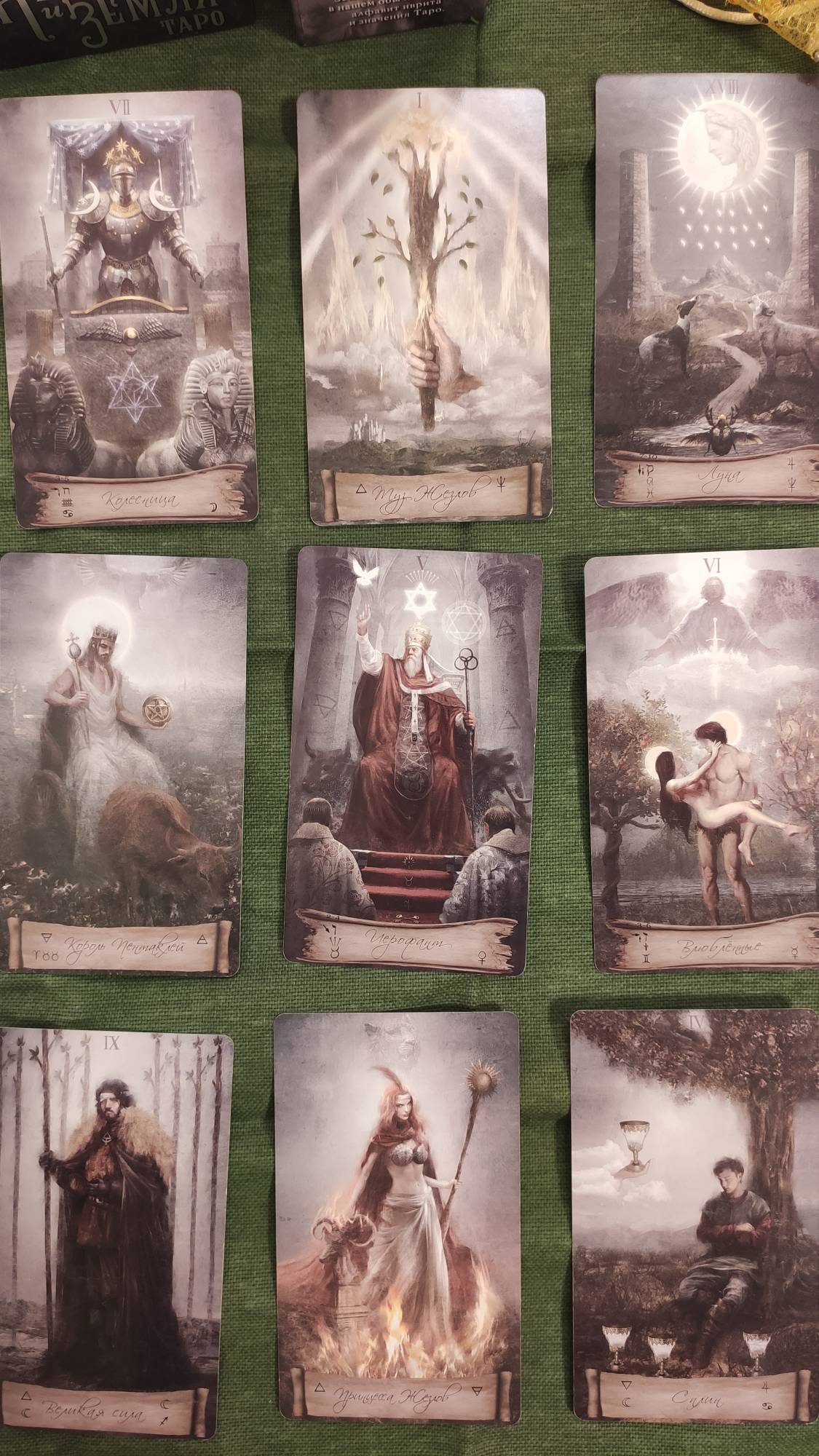
1. VII — The Chariot
If you chose The Chariot, the block may lie in the area of the direction of your path and the inner conflict between different ways of moving through life.
In the course, The Chariot is not simply about moving forward. Its most important theme is which path a person follows and whether that path is in accordance with their conscience. The white and black sphinxes point to different directions: a more difficult but honest path, and a path that may seem easier but contradict one’s inner principles.
In a family-line context, this can be read as a recurring pattern: moving in the direction one is “supposed” to take, choosing a convenient or familiar route even when one inwardly desires something else. There is another possible interpretation—the different parts of a person seem to pull them in different directions: the desire to live according to one’s own values collides with inherited ideas about the right way to live.
What to work on: examine where your life decisions are truly your own and where they are governed by a familiar family pattern. A useful question is: “In what direction do I continue moving only because that is what is customary, even though I inwardly feel that another path is right?”
If you chose The Chariot, the block may lie in the area of the direction of your path and the inner conflict between different ways of moving through life.
In the course, The Chariot is not simply about moving forward. Its most important theme is which path a person follows and whether that path is in accordance with their conscience. The white and black sphinxes point to different directions: a more difficult but honest path, and a path that may seem easier but contradict one’s inner principles.
In a family-line context, this can be read as a recurring pattern: moving in the direction one is “supposed” to take, choosing a convenient or familiar route even when one inwardly desires something else. There is another possible interpretation—the different parts of a person seem to pull them in different directions: the desire to live according to one’s own values collides with inherited ideas about the right way to live.
What to work on: examine where your life decisions are truly your own and where they are governed by a familiar family pattern. A useful question is: “In what direction do I continue moving only because that is what is customary, even though I inwardly feel that another path is right?”
2. I — Ace of Wands
If Ace of Wands is chosen, the theme of the block is connected with the right to begin something new, take the initiative, and set one’s own energy in motion.
In the course, this represents change, a creative undertaking, inner growth, and the youthful impulse to act. Aceshows a possibility that has only just emerged: the energy is already there, but it still needs to develop.
In relation to your request, this may point to a family pattern that makes it difficult to begin something new: “don’t stand out,” “don’t take risks,” “do things as usual,” “initiative is dangerous.” In that case, the energy is present, but instead of moving forward, a person stops it right at the start.
The work here is not so much with the past as with giving yourself permission to begin your own cycle, without requiring a complete guarantee of the result in advance.
What to work on: notice your own desires and the first impulses that you are used to suppressing. Ask yourself: “What have I wanted to start for a long time, but still don’t allow myself to take the first step toward?”
If Ace of Wands is chosen, the theme of the block is connected with the right to begin something new, take the initiative, and set one’s own energy in motion.
In the course, this represents change, a creative undertaking, inner growth, and the youthful impulse to act. Aceshows a possibility that has only just emerged: the energy is already there, but it still needs to develop.
In relation to your request, this may point to a family pattern that makes it difficult to begin something new: “don’t stand out,” “don’t take risks,” “do things as usual,” “initiative is dangerous.” In that case, the energy is present, but instead of moving forward, a person stops it right at the start.
The work here is not so much with the past as with giving yourself permission to begin your own cycle, without requiring a complete guarantee of the result in advance.
What to work on: notice your own desires and the first impulses that you are used to suppressing. Ask yourself: “What have I wanted to start for a long time, but still don’t allow myself to take the first step toward?”
3. XVIII — The Moon
If the Moon was chosen, the blockage should be sought in the area of fears, uncertainty, family fantasies, and ideas that are perceived as truth even though they may not be.
In the course system, the Moon is associated with the subconscious, instincts, insecurity, illusions, and self-deception. Its developmental task is to see where facts end and fears, expectations, and fantasies begin.
In the family lineage In this topic, it may manifest as unclear family prohibitions: “We don’t do that in our family,” “This always happens in our family,” “All the men/women in our family have to…”. Such beliefs can be passed down without being questioned and become a person’s inner reality.
The card does not say that there is necessarily a hidden secret, betrayal, or deception in the family. Rather, it invites you to explore what remains unclear.
What to work on: separating actual family facts from assumptions, fears, and inherited interpretations. A useful question is: “What do I believe about my family simply because it has been repeated many times?”
If the Moon was chosen, the blockage should be sought in the area of fears, uncertainty, family fantasies, and ideas that are perceived as truth even though they may not be.
In the course system, the Moon is associated with the subconscious, instincts, insecurity, illusions, and self-deception. Its developmental task is to see where facts end and fears, expectations, and fantasies begin.
In the family lineage In this topic, it may manifest as unclear family prohibitions: “We don’t do that in our family,” “This always happens in our family,” “All the men/women in our family have to…”. Such beliefs can be passed down without being questioned and become a person’s inner reality.
The card does not say that there is necessarily a hidden secret, betrayal, or deception in the family. Rather, it invites you to explore what remains unclear.
What to work on: separating actual family facts from assumptions, fears, and inherited interpretations. A useful question is: “What do I believe about my family simply because it has been repeated many times?”
4. King of Pentacles
If the King of Pentacles was selected, the topic concerns material stability, ownership of resources, responsibility, and the right to manage what has been achieved.
The King represents maximum maturity and independence. Pentacles represent Earth: material realization, resources, work, and stability. In the course, the King of Pentacles itself is associated with peacefulness, persistence, practicality, and insight.
In a family-line reading, a possible block is the attitudeto money, property, stability, social status, or financial independence. For example, a person may be capable of creating resources but not feel internally entitled to own them; or stability may become so important that any change is perceived as a threat.
This is not necessarily the story of a specific “wealthy man of the family.” In this system, a Court Card may describe the principle itself and the degree of maturity, rather than a real person.
What to work on: the right to be financially independent and to manage resources wisely. Question: “Which family beliefs about money, property, and success do I continue to regard as obligatory?”
If the King of Pentacles was selected, the topic concerns material stability, ownership of resources, responsibility, and the right to manage what has been achieved.
The King represents maximum maturity and independence. Pentacles represent Earth: material realization, resources, work, and stability. In the course, the King of Pentacles itself is associated with peacefulness, persistence, practicality, and insight.
In a family-line reading, a possible block is the attitudeto money, property, stability, social status, or financial independence. For example, a person may be capable of creating resources but not feel internally entitled to own them; or stability may become so important that any change is perceived as a threat.
This is not necessarily the story of a specific “wealthy man of the family.” In this system, a Court Card may describe the principle itself and the degree of maturity, rather than a real person.
What to work on: the right to be financially independent and to manage resources wisely. Question: “Which family beliefs about money, property, and success do I continue to regard as obligatory?”
5. V — The Hierophant
If The Hierophant is selected, the block is connected with tradition, rules, conscience, and an inherited system of values.
This is one of the spiritual Major Arcana. In the course, it represents the Teacher, a moral and spiritual tradition, knowledge, fidelity to principles, and the desire to reconcile the material with the spiritual.
In your inquiry, this directly leads to the topic of family rules: what is considered “right” in the family, “respectable,” “worthy,” “genuine.” The mere existence of tradition is not a problem. A blockage can arise when a person follows the form while losing an understanding of its meaning, or rebels against their entire ancestral heritage without distinguishing between its living values and outdated restrictions.
What to work on: rather than simply rejecting family norms, conduct a review of your heritage: which parts of it truly align with my conscience, and which do I follow only out of fear of breaking a rule?
The Hierophant’s task is to restore a living connection with values, rather than to get rid of traditions.
If The Hierophant is selected, the block is connected with tradition, rules, conscience, and an inherited system of values.
This is one of the spiritual Major Arcana. In the course, it represents the Teacher, a moral and spiritual tradition, knowledge, fidelity to principles, and the desire to reconcile the material with the spiritual.
In your inquiry, this directly leads to the topic of family rules: what is considered “right” in the family, “respectable,” “worthy,” “genuine.” The mere existence of tradition is not a problem. A blockage can arise when a person follows the form while losing an understanding of its meaning, or rebels against their entire ancestral heritage without distinguishing between its living values and outdated restrictions.
What to work on: rather than simply rejecting family norms, conduct a review of your heritage: which parts of it truly align with my conscience, and which do I follow only out of fear of breaking a rule?
The Hierophant’s task is to restore a living connection with values, rather than to get rid of traditions.
6. VI — The Lovers
If The Lovers are selected, the blockage concerns the choice between what is familiar and what is new.
In the course, the main meaning of this Arcana is not romance, but a situation in which the previous state is still comfortable and familiar, yet has stopped fostering growth, while the new path is both attractive and frightening. The transition is often connected with interaction with another person, a partner, or a system.
In the context of ancestral patterns, this can be a very recognizable point: loyalty to the family versus personal development. Sometimes a person unconsciously perceives choosing a different life as a betrayal of their parents or family lineage: living more abundantly, freely, and happily; building different relationships; choosing another profession.
The work is not about rejecting one’s lineage, but about allowing oneself to continue developing.
What to work on: granting oneself inner permission to choose something new while preserving respect for the past. Question: “Where am I afraid to choose my own life because I fear no longer belonging to my family?”
If The Lovers are selected, the blockage concerns the choice between what is familiar and what is new.
In the course, the main meaning of this Arcana is not romance, but a situation in which the previous state is still comfortable and familiar, yet has stopped fostering growth, while the new path is both attractive and frightening. The transition is often connected with interaction with another person, a partner, or a system.
In the context of ancestral patterns, this can be a very recognizable point: loyalty to the family versus personal development. Sometimes a person unconsciously perceives choosing a different life as a betrayal of their parents or family lineage: living more abundantly, freely, and happily; building different relationships; choosing another profession.
The work is not about rejecting one’s lineage, but about allowing oneself to continue developing.
What to work on: granting oneself inner permission to choose something new while preserving respect for the past. Question: “Where am I afraid to choose my own life because I fear no longer belonging to my family?”
7. Great Power
If Strength is selected, the block is related to the theme of one’s relationship with their own power, feelings, and strong inner impulses.
In the course, Strength does not mean suppressing emotions or winning through force. On the contrary, it is the ability to manage one’s power through wisdom, calmness, love, and gentleness; to acknowledge fears and weaknesses rather than run away from them.
In the context of the family lineage, there may be a pattern in which strength was understood only as toughness: “endure,” “don’t show your feelings,” “be strong,” “never ask for help.” The opposite extreme is also possible—a fear of one’s own energy, anger, desire, and ability to influence.
Then the task is not to become even tougher, but to learn to wield your power without waging war against yourself.
What to work on: notice which feelings were considered unacceptable in your family and which of your own expressions you therefore suppress. Question: “What part of my own power am I still afraid to acknowledge?
If Strength is selected, the block is related to the theme of one’s relationship with their own power, feelings, and strong inner impulses.
In the course, Strength does not mean suppressing emotions or winning through force. On the contrary, it is the ability to manage one’s power through wisdom, calmness, love, and gentleness; to acknowledge fears and weaknesses rather than run away from them.
In the context of the family lineage, there may be a pattern in which strength was understood only as toughness: “endure,” “don’t show your feelings,” “be strong,” “never ask for help.” The opposite extreme is also possible—a fear of one’s own energy, anger, desire, and ability to influence.
Then the task is not to become even tougher, but to learn to wield your power without waging war against yourself.
What to work on: notice which feelings were considered unacceptable in your family and which of your own expressions you therefore suppress. Question: “What part of my own power am I still afraid to acknowledge?
8. Page of Wands
If Page of Wands is selected, the theme of the block is unexpressed initiative and young potential that was not given enough space to develop.
The Page represents an early stage: great potential combined with a lack of experience and independence. Wands represent Fire—that is, desire, energy, and action. The card’s direct meaning in the course is energy, resourcefulness, and initiative. The elemental formula is “fire of earth.”
In a family-line context, this may point to a family pattern in which an enterprising child or young person was accustomed to being directed too forcefully: what to choose, what to become, how to behave, and where to express themselves. Then the adult part already exists, while inwardly the person is still waiting for permission to begin.
This may also be the theme of of an unrecognized talent: the energy was there, but it was perceived as frivolity, restlessness, or overly great ambitions.
What to work on: reclaiming the right to try and learn through experience. Question: “Where am I still waiting for someone older or more senior to give me permission to express myself?”
If Page of Wands is selected, the theme of the block is unexpressed initiative and young potential that was not given enough space to develop.
The Page represents an early stage: great potential combined with a lack of experience and independence. Wands represent Fire—that is, desire, energy, and action. The card’s direct meaning in the course is energy, resourcefulness, and initiative. The elemental formula is “fire of earth.”
In a family-line context, this may point to a family pattern in which an enterprising child or young person was accustomed to being directed too forcefully: what to choose, what to become, how to behave, and where to express themselves. Then the adult part already exists, while inwardly the person is still waiting for permission to begin.
This may also be the theme of of an unrecognized talent: the energy was there, but it was perceived as frivolity, restlessness, or overly great ambitions.
What to work on: reclaiming the right to try and learn through experience. Question: “Where am I still waiting for someone older or more senior to give me permission to express myself?”
9. IV of Cups — Four of Cups
If the Four of Cups is selected, the block is connected with emotional stagnation, being sated, and closed-mindedness toward new feelings.
In the course, the card signifies being sated, dissatisfaction, resentment, suppressed self-esteem, withdrawal, and at the same time a need for something new. The Four represents a state that has already become established and habitual.
In a family-line context, this may be an emotional pattern such as: not showing one’s needs, holding on to resentment for a long time, becoming accustomed to dissatisfaction, and gradually regarding it as normal. A person may live with the inner feeling that “nothing will change anyway,” even though the need for renewal is already present.
Here, the “block” is rather not an absence of feelings, but the fact that the feelings are stuck in a persistent state.
What to work on: acknowledge your own emotional dissatisfaction and understand what you are truly lacking. Question: “What feeling or old grievance has become so familiar to me that I have stopped noticing how it blocks the way to something new?”
If the Four of Cups is selected, the block is connected with emotional stagnation, being sated, and closed-mindedness toward new feelings.
In the course, the card signifies being sated, dissatisfaction, resentment, suppressed self-esteem, withdrawal, and at the same time a need for something new. The Four represents a state that has already become established and habitual.
In a family-line context, this may be an emotional pattern such as: not showing one’s needs, holding on to resentment for a long time, becoming accustomed to dissatisfaction, and gradually regarding it as normal. A person may live with the inner feeling that “nothing will change anyway,” even though the need for renewal is already present.
Here, the “block” is rather not an absence of feelings, but the fact that the feelings are stuck in a persistent state.
What to work on: acknowledge your own emotional dissatisfaction and understand what you are truly lacking. Question: “What feeling or old grievance has become so familiar to me that I have stopped noticing how it blocks the way to something new?”
Each Card does not show a “guilty ancestor” or a proven fact from the past, but a possible theme of a family script that a person is invited to explore within themselves now.
 Day 3: Diagnosis — Me and My ParentsIt is recommended that you complete Day 1's assignment before proceeding to the readings in this Intensive.
 The photo of the cards for this diagnosis was personally taken by OM Shanti just now specifically for our Intensive.
And the interpretation of the reading will also be prepared personally by OM Shanti — with an interpretation of each card drawn specifically in the context of your inquiry about your parents.

 Task:
Task: . Before you are several cards lying face down. Look at them and intuitively choose the one card that attracts you more than the others right now.
Focus on the following inquiry:
“Where is the block in my relationship with my parents that I am currently advised to work on in order to strengthen the flow of my parents’ blessing energy?”
 . Write the number of the card you chose here in this thread and also record it in your notebook.
Count the numbers from left to right: the first row is 1, 2, 3; the second row is 4, 5, 6; and the third row is 7, 8, 9.
 . The interpretation of the selected card will be posted tomorrow evening in this same thread.
 Who has already read the transcript for Day 2? I’d love to hear how the card resonated with you and what insights you gained.
 Hello! Day – 1. Lineage – 4. Parents – 5. Relationships – 7. I assigned the scores intuitively. I don’t yet know what to base the scores on. I think I’ll understand as I go. There are certain difficulties in all areas that I want to work through 

- Joined
- Nov 28, 2025
- Messages
- 45
- Reaction score
- 350
- Points
- 11
- Age
- 66
- Location
- РФ Липецкая обл.
- 💎VM
- 607.50
- New country
- 🌐Единия
- Enneatype
- 9 (?)
- Gender
- Female
- Ashram resident
- Yes
I’m joining the intensive.
Day 1: Ancestry (ancestors in another world; I try to remember everyone together with their descendants. We look through albums and prepare memorial meals with blini and kutia) – 5
Parents – 10: I have always loved them and am grateful to them for life in a valuable human body. I am proud of them.
Relationship with descendants – 9. I accept them with love and gratitude.
Day 2 – 2
Day 2 card – 2: Ace of Wands: the right to begin something new, take initiative, and set one’s own energy in motion.
That is exactly what is happening.
Day 3 – 5 card
Day 2 card – 2: Ace of Wands: the right to begin something new, take initiative, and set one’s own energy in motion.
That is exactly what is happening. Ideas in my head turn into projects and are brought to fruition.
Day 3 – 5 card
Day 1: Ancestry (ancestors in another world; I try to remember everyone together with their descendants. We look through albums and prepare memorial meals with blini and kutia) – 5
Parents – 10: I have always loved them and am grateful to them for life in a valuable human body. I am proud of them.
Relationship with descendants – 9. I accept them with love and gratitude.
Day 2 – 2
Post automatically merged:
Day 2 card – 2: Ace of Wands: the right to begin something new, take initiative, and set one’s own energy in motion.
That is exactly what is happening.
Day 3 – 5 card
Post automatically merged:
Day 2 card – 2: Ace of Wands: the right to begin something new, take initiative, and set one’s own energy in motion.
That is exactly what is happening. Ideas in my head turn into projects and are brought to fruition.
Day 3 – 5 card
Last edited:
-
 @
ИНТЕНСИВ:
Размещена расшифровка карт для первого расклада "Диагностика Рода": Интенсив "Род • Родители • Отношения"
@
ИНТЕНСИВ:
Размещена расшифровка карт для первого расклада "Диагностика Рода": Интенсив "Род • Родители • Отношения" -
@
ИНТЕНСИВ:
Расшифровка выполнена лично ОМ Шанти