A Little Astronomy and Astrology

  • Thread starter Удалённый пользователь 19
  • Start date
У

Удалённый пользователь 19

Гость
Sunday is Surya’s day. Golden, yellow clothing.

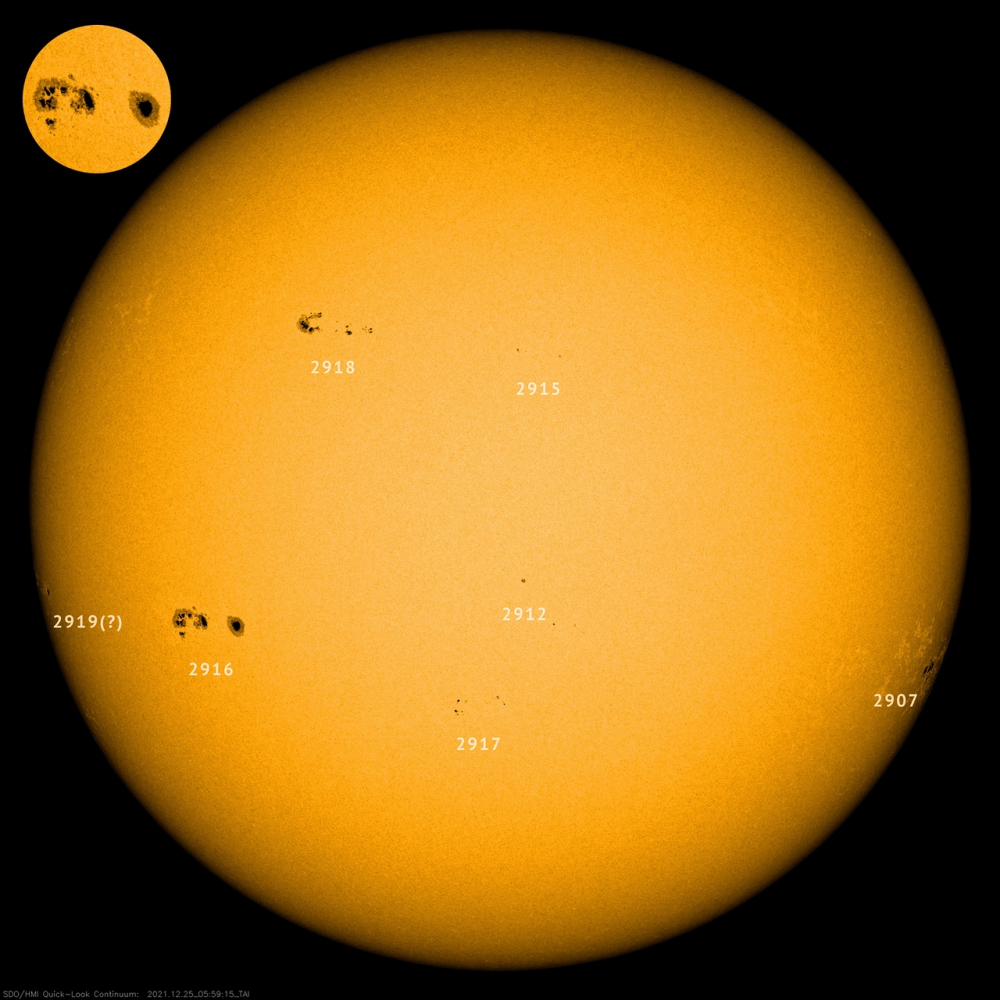
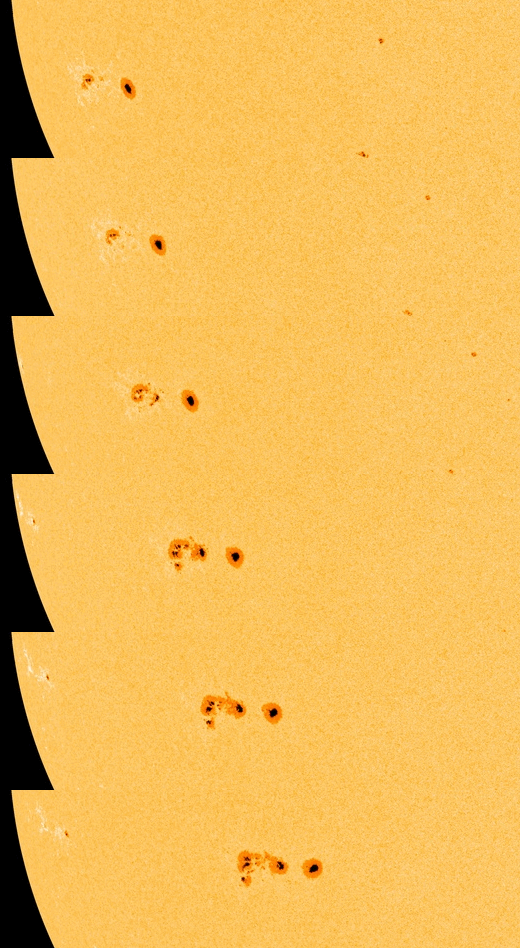
On December 22, a large, elongated sunspot group (No. 2916) could be observed on the Sun.

1640507527366.png


This weekend, another sunspot, AR2916, grew fourfold, becoming one of the largest sunspots of Solar Cycle 25 (the Sun is currently in this cycle, which began at the end of 2019). This 48-hour film from NASA’s Solar Dynamics Observatory shows the active region growing and rotating toward Earth:

26.12.21.gif


The Christmas comet.

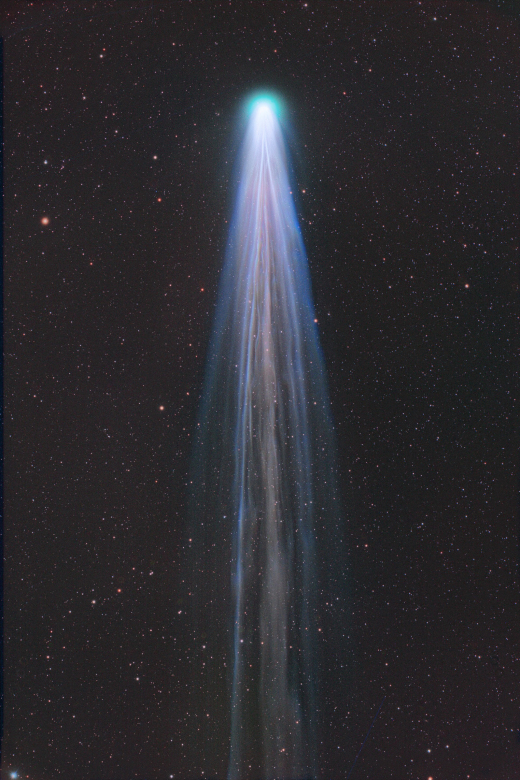
Comet Leonard (C/2021 A1) has turned into a real gift. “What is happening today is simply breathtaking,” reports Michael Jaeger, who photographed the comet using an 8-inch telescope in Namibia:

1640505263955.png


Comet Leonard’s magnificent tail is intertwined with numerous strands of gas and dust. They were created by a series of outbursts that began on December 15. Two, or perhaps even three, explosions in the comet’s nucleus sent streams of debris down the tail.
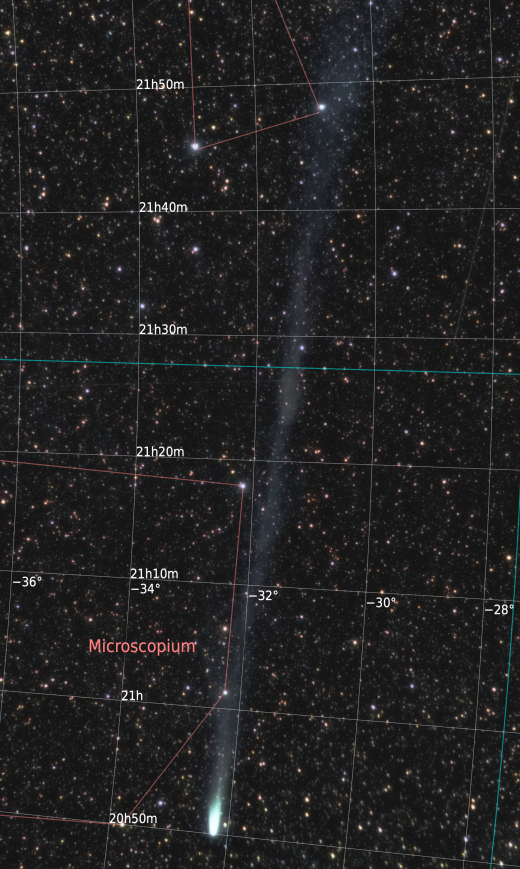
The same outbursts increased the comet’s brightness. It is now shining like a fourth-magnitude star in the constellation Microscopium in the Southern Hemisphere, visible through a small telescope.
More outbursts are expected soon. The comet is heading toward its closest approach to the Sun on January 3. The increasing heat may release new jets of gas and dust and perhaps even blow off huge chunks of ice and rock.

“Comet Leonard has a tail at least twenty degrees long,” reports Daniele Gasparri, who is sending this photograph from Chile’s Atacama Desert:

1640506937090.png
 

1114

З.Клуб
О.Клуб
Рег.
ДП-3
ОТГ-1
ОТГ-2
ОТГ-4
Ра-1
Ра-2
Ра-3
Ра-4
Ра-5
Joined
Sep 5, 2020
Messages
28
Reaction score
262
Points
10
Location
РФ
💎VM
4,707.00
Gender
Male
“Mars is clearly visible without a telescope. Mars has two moons—Phobos (“fear” in Greek) and Deimos (“terror”).”

021047, thank you for the topic. I haven’t really read everything, and understood even less.
I really liked the legend of King Vikrama.
I was surprised that Mars’s moons, Phobos and Deimos, are Fear and Terror.
A phobia is indeed a persistent fear in psychology, while demons are probably such frightening creatures.

This thought about words occurred to me:
Saturn and Uranus seem to be words with the same root. Saturn was probably SatUran. Saturn resembles Holy Uranus. (?)
There was simply Uranus, and there was SatUran, Saturn.
There is a similar modern word, saturation, meaning fullness (of the blood with oxygen).
There are similar words: damage, dropped, urn, urine, lesson, tract of wild land, thug, snatched away.
There is a radioactive element, Uranium-235, which is capable of harming one’s health.
The word Uranus probably implies possible great damage, some threat of dropping something, “I’ll ruin everyone.”
Heavenly Uranus supposedly inflicted earthly damage (to health); this damage (rubbish, ashes) was then dropped into an urn…
 
Last edited:
У

Удалённый пользователь 19

Гость
1 1114 , interesting thoughts.

There is such a tradition that the planets were named after ancient Greek and Roman gods.
Saturn has been known since ancient times because it was visible to the naked eye. It is the slowest planet in the solar system. Its original name was Cronus, after the ancient Greek god of time. However, in Roman mythology, Saturn, the god of agriculture, became Cronus’s counterpart. Galileo Galilei first observed it through a telescope in 1610.
Uranus was discovered as a planet in 1781. Herschel named it Georgium Sidus in honor of King George III, but eventually the planet was named Uranus after Cronus’s father, the Greek god of the sky, Uranus.
 
У

Удалённый пользователь 19

Гость
Successor to the Hubble Space Telescope.
(according to NASA publications)

On December 25, the James Webb Space Telescope, which had been under development for about 30 years, was successfully launched.

After launch, the telescope will need about a month to reach the L2 point, the so-called second Lagrange point, which is advantageous for space probes. This point is located approximately four times farther away than the distance from Earth to the Moon.

1640620544540.png


Image by ESA (the European Space Agency).

Unlike the Hubble Space Telescope and thousands of other satellites, Webb will not orbit Earth but the Sun.
The L2 point is located where, in the Earth–Sun system, gravitational forces and the orbital motion of an object balance each other. Thus, a spacecraft can relatively easily “hover” at L2. It can remain near Earth while Earth and the spacecraft orbit the Sun.


Starting several days after launch, the telescope will slowly deploy its largest feature—a tennis-court-sized sunshield. The sunshield is designed to reduce the Sun’s heat by more than a million times, down to -220 degrees Celsius. Webb’s mirror and instruments must be kept cold in order to detect signals from deep space: the faint infrared radiation for which the telescope was designed.
After the primary mirror unfolds, Webb’s instruments will be slowly switched on, and firings of its engines will place the observatory into its designated orbit.
Once in orbit, after the telescope has cooled and stabilized at its low operating temperature, the mission team on Earth will spend several months aligning its optics and calibrating its scientific instruments. Webb will then begin studying space in infrared light using its dazzling golden mirror.
One of Webb’s most important and recognizable features is its 21-foot-wide (6.5-meter) primary mirror. The primary mirror of a reflecting telescope determines how much light it can collect and, consequently, how deeply it can see into the universe. Webb’s mirror is almost three times wider than Hubble’s primary mirror.

1640623283917.png


Comparison of the primary mirrors of Hubble (2.4 m) and Webb (6.5 m). The human figure is included for scale.

Webb’s mirror consists of 18 separate hexagonal segments made of extremely strong, ultralightweight beryllium, which will unfold after launch. Each of the telescope’s mirror segments is coated with a microscopically thin layer of gold. This gold coating optimizes the mirror segments for reflecting infrared light, the primary wavelength being observed.

1640629847976.png


The James Webb Space Telescope, costing $9.7 billion, was developed over decades—and finally began operating.
 
У

Удалённый пользователь 19

Гость
Comet Leonard continues to amaze.

1640684574074.png


An astonishing disconnection event in the gas tail of comet C/2021 A1 (Leonard).
Photographed on the night of December 25–26, 2021, in Namibia.

1640696926780.png


Approximately halfway down the image, a gap appears. This is a disconnection event: a piece of Comet Leonard’s tail was pinched off and carried away by the solar wind.

Coronal mass ejections (CMEs) of charged particles striking comets can cause magnetic reconnection in their tails, sometimes tearing them off completely. At least two high-speed streams have slammed into the comet in recent weeks.-

This photograph, taken by Jan Hattenbach on December 26, shows Comet Leonard’s tail sweeping across the sky above La Palma in the Canary Islands:

1640696086778.png


Comet Leonard flared up three times starting on December 15—a possible sign of fragmentation of the comet’s nucleus. The comet will reach its closest point to the Sun on January 3. Increasing heat and proximity to solar storms could trigger further flares and disconnections. Astronomers in the Southern Hemisphere are monitoring the events.
 
Last edited by a moderator:

2909

З.Клуб
О.Клуб
Рег.
ООН-1
Joined
Nov 19, 2020
Messages
200
Reaction score
2,788
Points
29
💎VM
480.50
New country
🌐Единия
Gender
Female
Ashram resident
Yes
Thank you! Such wonderful photographs—I realized that I’m just a grain of sand in the Universe!
 

55555

З.Клуб
О.Клуб
Рег.
ДП-1
ДП-2
ДП-3
ОТГ-1
ОТГ-4
Ра-1
Ра-2
Ра-3
Ра-4
Ра-5
ООН-1
КЭЙ
ФАН
Joined
Sep 6, 2020
Messages
267
Reaction score
2,552
Points
13
Age
46
Location
Россия
💎VM
340.50
Gender
Female
Academy training
M-SNOV
021047, thank you so much for enlightening us and telling us about and showing us such fascinating things.
 
У

Удалённый пользователь 19

Гость
Today is Wednesday, Mercury’s day. The color is green.

Several photos of the northern lights from 2021.
(After all, the auroras are also mostly green!)

1640782239686.png


Alexey R. took this photograph in February in Teriberka, in the Kola District of Murmansk Oblast.
The perfect conditions came together: frost, ice, a full moon, a clear night, and no wind. The temperature was -34 degrees.


1640782719005.png


Mark Adamus took this photograph of the aurora in Alaska in the last light of twilight.
Mark said: “Wandering through these frost-covered forests is one of the most magical experiences, but also one of the most difficult to photograph. The temperature often reaches minus 30 degrees, and making your way through easily broken, crust-covered snow creates major difficulties.”


1640783201116.png


Marybeth Kiczenski took this photograph of the aurora from Bayfield, Wisconsin, in early November 2021.
“The aurora that flared up that night was caused by a combination of M-class solar flares and a CME; individually, they were not particularly numerous, but together they definitely packed a punch. I have never seen so much turquoise and purple. The whole night felt like a dream.”


1640783589542.png


Giulio Cobianchi took this photograph of the aurora in the Lofoten Islands, Norway.
“It was one of the most beautiful green nights I have experienced since living in Lofoten. It was only the beginning of a long night spent chasing the aurora until sunrise. I have visited this hidden cave in every season, as I enjoy exploring locations and finding new compositions that have never been seen before. It is never easy to photograph inside caves; during the shoot, you have to use more techniques.”


1640783858130.png


Joshua Snow took this powerful image of the aurora in Tombstone Territorial Park, Yukon, Canada.
“What a sight! The incredible grandeur of the northern lights. Lights that move and dance through space. Fleeting moments of vibration and shimmering glow. Life is almost the same experience, if you allow it to be. Learn to enjoy the small, fleeting moments. Learn to ebb and flow with space and time and shine when inspiration arrives. Wait for no one. Never stop. Shine, dance, and glow with all your heart, because you have only one life.”


1640785487525.png


Olli Sorvari from Levi, Finland, captured this view of the northern lights.
“I know that the journey is often more important and memorable than the results, and after taking this photograph, I think it was an unforgettable trip.”


1640785788519.png


Stefan Liebermann shared this photograph of the aurora, which he took in 2021.
“The full spectrum of the northern lights over Iceland’s iconic Vestrahorn. What a magical experience! A G3 (strong) geomagnetic storm struck Earth on October 31, 2021, producing these remarkable colors.”
 
Last edited by a moderator:

7371

З.Клуб
О.Клуб
Рег.
ДП-3
ОТГ-1
ОТГ-4
Ра-1
Ра-2
Ра-3
Ра-4
Ра-5
ООН-1
Род-1
КЭЙ
ДЭ
Joined
Sep 7, 2020
Messages
294
Reaction score
4,975
Points
29
Age
59
Location
Сакартвело Тбилиси
💎VM
181.90
New country
🌐Единия
Gender
Female
Ashram resident
Yes
Academy training
KEY
@021047,Thank you for sharing such beauty! Magical, wonderful, enchantingly beautiful!
 

8030

З.Клуб
О.Клуб
Рег.
ОТГ-1
ОТГ-2
ОТГ-3
ОТГ-4
Ра-1
Ра-2
Ра-3
Ра-4
Ра-5
ООН-1
КЭЙ-М
КЭЙ
ДЭ
М-СНОВ
Joined
Sep 8, 2020
Messages
523
Reaction score
7,379
Points
29
Age
43
Location
Россия, Москва
💎VM
799.90
Enneatype
5 (?)
Gender
Female
Ashram resident
No
What wonderful photos and explanations!!!😍😍😍 It’s a shame that you can’t give more than one like—such beauty!!! , I sincerely thank you for generously sharing your discoveries of the beauty in the world!🙏🙏🙏
 
У

Удалённый пользователь 19

Гость
Thursday is Jupiter’s day.

Huge hurricanes and high clouds on Jupiter.

1640885845969.png


Rotating storm clouds on Jupiter, captured last month by NASA’s Juno spacecraft. The image was processed to enhance the colors and contrast.

Usually, higher clouds appear lighter, and the lightest clouds in this picture are relatively small clouds scattered across the lower oval. However, these light clouds are not actually that small— they are about 50 kilometers across. They are located so high that they cast shadows on the rotating oval below. Large ovals are high-pressure regions; they can exceed a thousand kilometers in size and exist for several years. The largest oval on Jupiter is the Great Red Spot, which has existed for at least several hundred years.

1640887277167.png


Taken by Juno in April 2018.

The Great Red Spot is the largest storm in the Solar System, measuring 24,000–40,000 km in length and 12,000–14,000 km in width (substantially larger than Earth). It constantly changes in hue and size and tends to shrink. The nature of its color is still unclear.
Wind speeds inside the spot exceed 500 km/h.

1640888221037.png


Taken by Juno in July 2017.

(NASA/Jet Propulsion Laboratory–Caltech/Southwest Research Institute/Malin Space Science Systems)
 
У

Удалённый пользователь 19

Гость
Friday. Venus’s day.

Vrata-katha for Venus (conclusion).
(An excerpt from the book “The Greatness of Saturn”)


Here is how Venus became the son of Lord Shiva: One day, Parvati playfully covered Shiva’s eyes with her palm, and at that very moment the Universe was plunged into darkness. Quickly removing her hand from Shiva’s eyes, Parvati restored light to the world and saw, that a little boy was standing before her. “Where did he come from?” — Parvati asked in amazement, and Shiva laughed and replied: “You created him, by creating darkness, O goddess! He — is your son. Let us name him Andhaka (“Darkness”).” But Parvati refused to acknowledge the child. And then Lord Shiva gave him to the asura Hiranyaksha as an adopted son. The boy grew quickly and, soon turning into a gigantic demon, began mercilessly tormenting the gods. But during the war with the gods, Andhaka’s army was destroyed by the celestial forces, and, fleeing the battlefield, he took refuge with his teacher Venus, who comforted and supported him and revived his asura warriors.

Angered by this, Lord Shiva caught Venus and swallowed him, and fortune turned away from the asuras. Venus spent one hundred divine years inside Shiva’s body and saw many different worlds there, as well as all the gods, and asuras, and even the war between them. In the end, finding no other way, Venus left Shiva's body through his sexual organ, and then, without delay, bowed reverently before the great god. Impressed by such skill and resourcefulness, Lord Shiva gave him the name Shukra (which simultaneously means “white,” “the planet Venus,” and “semen”) and acknowledged him as his son, thus fulfilling, his promise,.

And I bow reverently before Venus, Shiva's son, who possesses the secret knowledge of Sanjivana-vidya.

1640932238793.png


17.03.21. The image shows a view from Venera 13, an automated Soviet spacecraft that landed in March 1982 using a parachute and aerodynamic braking in Venus’s dense atmosphere. Before it stretched a desert landscape with flat rocks, a broad plain, and evenly illuminated skies. The landing site was located in the Phoebe region near the equator of Venus. At the bottom left, the penetrometer, used for scientific measurements, can be seen, while the light-colored object on the right is part of the discarded camera lens cover.
On the surface of Venus, the temperature reaches 450 degrees Celsius, and the pressure is 75 times higher than on Earth’s surface. Under such conditions, the Venera 13 spacecraft, equipped with a sturdy airtight корпус, was able to operate for about two hours. Data from Venera 13 was transmitted through the inner regions of the Solar System almost 40 years ago, but digital processing of the unusual images of Venus continues today. A recent analysis of infrared measurements made by the ESA’s Venus Express orbiter showed that active volcanoes may currently exist on Venus.

1640934944732.png


Venus rotates very slowly on its axis: it takes the planet about 243 Earth days to complete one rotation. A Venusian day is longer than a Venusian year because Venus completes a full orbit around the Sun in 225 Earth days.

1640935706667.png

Friday is Venus’s day, when it is important for every woman to remember herself and her ability to bring beauty into the world. ​
 
У

Удалённый пользователь 19

Гость
Om Suryaya Namaha​
Sunday, the day of the Sun; colors: gold and yellow.

Just as the Sun is the center of the Solar System, in astrology the Sun symbolizes the subject’s psychic center, their “core,” “heart,” inner “Self,” and perception and understanding of the world.
In astrology, the Sun represents our third chakra, Manipura, the solar plexus. It gives us willpower, personality, vitality, immunity, and metabolism.

The Sun is a masculine, fiery planet.
The Sun has symbolized kings since ancient times. A solar eclipse—the eclipse of the king—was considered the worst possible omen for a king. Fear of eclipses was so great that in Babylon, for a period surrounding the eclipse (before and after the event), the king was temporarily replaced by a stand-in, while the actual ruler hid under names such as “Lord Little Man,” “Lord Farmer,” and so on.

1641117526446.png

A solar halo in Sweden.


Sometimes it seems as though we are looking at the Sun through a large lens. In the case shown here, there were actually millions of lenses—ice crystals.
When water freezes in the upper layers of the atmosphere, small, flat, hexagonal ice crystals can form. When these crystals fall, their flat surfaces are parallel to the ground most of the time. Near sunrise or sunset, an observer may be in the same plane as most of the falling ice crystals. At that moment, each crystal acts as a miniature lens: the sunlight refracted by them is directed toward the observer, producing a phenomenon known as parhelion—the technical term for “mock suns.” This video was filmed in late 2017 on a ski slope at the Vemdalen ski resort in central Sweden. The Sun is visible in the center, while two bright mock suns shine to its right and left. The bright 22-degree halo is clearly visible, as well as the rarer and fainter 46-degree halo. They are created by sunlight reflected by atmospheric ice crystals.
 
Last edited by a moderator:
У

Удалённый пользователь 19

Гость
Om Chandraya Namaha
​
Monday, the Moon, or Chandra, or Soma. Colors: silvery, light gray, blue, white.
Actually, the Moon has at least 08 names, such as Shrimat (Glorious), Taradhisha (Lord of the Stars), Nishakara (Creator of the Night), Satpatha (The True Path) and so on.

1641224111856.png
Vrat-katha for the Moon.
(From R. Svoboda's book "The Greatness of Saturn")


The law of karma, O king, is inexorable. The millstones of Nature grind slowly, but with great care, and no living creature is free from karma. Yes indeed, not one, not even one as exalted, as the lord Moon himself.
Having reached maturity, the Moon conquered the three worlds and performed the rajasuya sacrifice"rajasuya", which grants the authority of a ruler. Nine goddesses served him: Sinivali and Kuhu (goddesses of the two phases of the New Moon), Vapus ("Beautiful Body"), Pushti ("Nourishing One"), Prabha ("Radiance"), Vasu ("Excellent One"), Kirti ("Glory"), Dhriti ("Steadfastness") and Lakshmi ("Prosperity"). But having attained a degree of fame, rarely granted to anyone, he became extraordinarily arrogant and crossed the bounds of decent behavior.
The Moon was Jupiter's chief disciple, the guru of the celestial beings. Jupiter's wife, Tara ("Star"), was very fond of the lord Moon: everything about him attracted her — his character, his temperament, and his beauty. And one day, while Jupiter was away, carrying out an assignment for the gods, Tara and the Moon eloped. Some say, they fell in love with each other, others — that Tara persuaded the Moon, afraid of missing the moment, when she could become pregnant by him, and still others — that the Moon abducted her by force.
How exactly and why they fled, O my lord, is unknown to us, but we do know, what happened afterward: Jupiter, returning home and discovering, that his wife had vanished, quickly understood, what had happened. Several times he sent messages to the Moon asking him to return Tara. However, he repeatedly refused to comply with these requests, insisting that Tara had left with him willingly and would leave him only when she had had enough of him, insisting that Tara had left with him willingly and would leave him only when she had grown tired of him, when she had had enough of him, when she became tired of him. These words angered Jupiter so much, that he repeated them to his disciple Indra, who, in turn, demanded that the Moon return Jupiter's wife to him.

The Moon refused again, and then Indra went to war against him. In this war, the lord Venus (Shukracharya), who had long hated Jupiter, and the asuras, demon-like celestial beings, eternally at war with the gods, sided with the Moon. Rudra, the all-powerful lord Shiva, sided with the gods out of love for his teacher Angiras, a rishi, who was Jupiter's father.

The war dragged on for a long time, and the great rishis began to fear, that the end of the world was approaching. Therefore, Angiras asked Brahma to reprimand the Moon and order him to return Tara. And the lord Moon was forced to obey, but by then Tara was already pregnant by him. Upon learning this, Jupiter flew into a rage. "You, weak-willed woman! — he said to Tara. —Expel this fruit, planted by another, from your womb, from this field, where only I have the right to plow! I swear, I would reduce you to ashes for this fall, if I did not myself wish to sow my seed in you!"
And Tara, ashamed, expelled the fetus from her womb. It was a boy, shining, like gold. Seeing his radiance and beauty, Jupiter and the Moon fell in love with him and began to dispute over him, demanding that Tara reveal the father's true identity. Overcome with embarrassment, Tara could not utter a word, and then the newborn child angrily exclaimed: "Why try to hide your sin behind false modesty? Speak!" Finally, when Brahma questioned her in private, she admitted, that the Moon was the father of the wonderful child. And this boy was the planet Mercury.
(to be continued)​
1641224782769.png

Lunar halos.

1641225104633.png


Sometimes falling ice crystals turn the atmosphere into a gigantic lens, and arcs and halos appear around the Sun or Moon. That is exactly what happened one Saturday night in 2012 near Madrid, Spain. A bright Moon and four rare lunar halos were visible in the winter sky. The brightest object near the upper edge of the picture is the Moon. Moonlight is refracted by falling hexagonal ice crystals, creating a 22-degree halo around the Moon.
In the horizontal direction, tangent arcs adjoin the 22-degree halo; they form in crystals shaped like columns. Quite rarely, moonlight is refracted in more distant falling ice crystals, creating a third, rainbow-like arc 46 degrees from the Moon. Here it is visible directly above the picturesque winter landscape. In addition, part of the complete 46-degree circular halo is visible, which is very rare, especially for the Moon. Thus, what was actually captured was a quadruple halo. The snow-covered trees in the foreground grow along the Puerto de Navacerrada road in the Sierra de Guadarrama mountains near Madrid. In the background is the familiar winter sky, featuring Sirius, Orion's Belt, and Betelgeuse, all located between the inner and outer arcs. Halos and arcs are usually visible for anywhere from a few minutes to several hours.

1641226155495.png


The photograph was taken by Jean Hettel, Calamba, Laguna, Philippines, on September 26, 2020.
Below and to the right of the Moon is Saturn; farther down and to the right is Jupiter, brighter than Saturn.


Индия, 19.05.21.jpg


India, May 19, 2021.

The full moons of 2021.

1641227933943.png


This picture shows the full Moon by month in 2021. The composite image captured the side of the Moon facing Earth during each of its brightest lunar phases. The full moons for each month are shown as strips arranged from top to bottom. These strips are portions of full-moon images obtained with the same camera and lens, shown at the same scale. The strips may seem to be arranged incorrectly, but this demonstrates the change in the angular size of the full Moon over the course of the year, caused by changes in its distance from Kolkata, India, on planet Earth. The caption beside each strip gives the month, the full moon's name, its distance from the Moon in kilometers, and its angular size. Angular size is given in arcminutes; one minute is 1/60 of a degree. The largest full Moon was visible in May, when it was near perigee—the point in the lunar orbit closest to Earth. The most distant and smallest full Moon was in December, when it was near apogee. Of course, the full moons in May and November passed through Earth's shadow during the two lunar eclipses of 2021.
 
У

Удалённый пользователь 19

Гость
Today is Jupiter’s day, Brihaspati, the Guru of the Gods.
Om Gurave Namaha

1641489156577.png

Jupiter’s auroras.

Bright auroras occur—or rather, constantly “hang”—around both of Jupiter’s poles. Unlike auroras on Earth, which occur only during periods of heightened solar activity, Jupiter’s auroras are permanent, although their intensity varies from day to day. They consist of three main components:
the main ovals,
bright, relatively narrow (less than 1,000 km wide), circular formations,
polar spots caused by the planet’s natural satellites.

1641480288319.png


Aurora around Jupiter’s north pole, Hubble Telescope.
Image: NASA/ESA/John Clarke (University of Michigan)/SwRI.

1641485139052.png

Io, Ganymede, and Europa—the large moons of Jupiter.

Auroras form when high-energy electrons stream along the planet’s magnetic field and enter the upper atmosphere, exciting atmospheric gases and making them glow. The same thing happens on Earth.

Both Jupiter and Earth have magnetic fields that protect them from the solar wind. The stronger the magnetic field, the larger the magnetosphere. Jupiter’s magnetic field is 20,000 times stronger than Earth’s, creating a magnetosphere so large that it begins deflecting the solar wind 2–4 million miles before it reaches Jupiter.

1641483625114.png


Jupiter’s magnetosphere.


1641485665349.png


The solar wind flowing around Earth’s magnetosphere. Look how small Earth is compared with its magnetic field! The same applies to Jupiter.

The Juno spacecraft (in orbit around Jupiter) recently recorded newly discovered auroras which, unlike the rest of Jupiter’s auroras, are thought to originate near the edge of the planet’s magnetosphere, where the magnetosphere meets the solar wind—a flow of supersonic charged particles from the Sun. When they reach Jupiter, they interact with its magnetosphere in a way that is still not sufficiently understood.
Scientists have called this type of aurora faint ring-shaped auroras that rapidly expand over time.
The expanding rings are about 1,200 miles (2,000 km) across and rush outward at approximately 3 miles (5 km) per second.

1641490662566.png


In ultraviolet light. NASA/JPL-Caltech/SwRI.


A bright aurora on Jupiter. Hubble Space Telescope.
 
У

Удалённый пользователь 19

Гость
Final assembly of the James Webb Space Telescope .
(For more about the telescope, see above – A little astronomy and astrology).

The broadcast of the final assembly process of the Webb space telescope in space is taking place right now on many channels. The website displays the time in Eastern U.S. Time (ET). The broadcast began at 14:00 UTC (17:00 Moscow time, 9:00 a.m. ET).
I watched it on NASA TV – | NASA
I watched, with breaks, as the left section of the gold mirror (the three left segments) was attached. It is fascinating to observe the ground team’s calm, coordinated work.

The giant sunshield was successfully opened and “tensioned” during the first days after launch.
On January 5, 2022, Webb successfully deployed its secondary mirror. This is a small, round, convex mirror (29 inches, or 0.74 meters, in diameter) located at the end of long booms. This stage of Webb’s deployment caused the mission scientists the greatest concern.
Webb’s primary mirror is taking its final shape.
Today, the first of the two primary mirror wings, or side panels, was deployed and successfully secured. Each side panel contains three primary mirror segments, designed to fold back to reduce Webb’s overall profile during flight.

The deployment of the port-side mirror wing began at approximately 8:36 a.m. Eastern Time. At approximately 2:11 p.m. Eastern Time, engineers confirmed that the panel was fully secured and latched in place, and deployment was complete.

Now that the port-side wing panel is secured in place, ground teams will prepare to deploy and latch the starboard-side panel (the right side) tomorrow. Once complete, Webb will have finished its primary deployment sequence.

The light path through the telescope.

 
Last edited by a moderator:
У

Удалённый пользователь 19

Гость
Vrata-katha for the Moon (continued; the beginning is above in A Little Astronomy and Astrology).

(From R. Svoboda's book "The Greatness of Saturn")


The Moon —is the mind of all that exists, the lord of feelings and sensations, and the person, who tirelessly offers prayers to him, is freed from all ailments and attains happiness. Among the lunar constellations of the Vedic zodiac, called nakshatras, the Moon —is a god, embodied in lunar form, and his great dignity is enhanced by Shiva himself, the lord of Mount Kailash, whose forehead is crowned with the crescent of the young moon. That is why it is said, that the Moon — the eighth part of the incarnation of the noble god Shiva.

The Lord of the Night, the Moon — the overseer of rituals and refuge for the ancestors. Whoever, faithfully serves the gods, honors the ancestors, and drinks the sacred Soma beverage during sacrificial rites in honor of Soma, will most certainly reach the Moon, after leaving this world. The Vedas state, that the Moon is none other, than “the royal Soma — the food of the gods.” The spirit of the sacrifice, offered to Soma, rises upward, to the Moon. As the god of plants and growth, the Moon pours Soma nectar over all the plants in the world, nourishing them, so that they, in turn, become food for others. The Moon — is the ruler of all the world's waters and governs the salty taste. It rules the tides, preserves, accumulates and pours down the rains.

The Moon shines with the dazzling whiteness of yogurt, a mother-of-pearl shell or dew, and all food grows thanks to this light. He is fair-haired, young and fortunate; fluid, like water, he waxes in the body, then wanes. Peaceful and pleasant in appearance and temperament, he has a slender, though rounded physique. His hands and feet are graceful, his eyes are lovely. He is wise, and his words are intelligent, gentle, and melodious. The Moon has a mixed kapha-vata constitution. Unstable, he wanders constantly, never staying anywhere for long. By nature, he is a vaishya. In the human body, he governs the blood; possessing the nature of semen, he is full of passion. Those, who seek amorous pleasures, should worship the Moon.

The Moon — ruler of the northwest, is associated with Monday and the constellation of Cancer in the solar zodiac. He is called the Shimmering Drop of Gold in the sky {Indu"),the Radiant One (Chandra),the Creator of the Night, the Luminary with Cool Rays. the Creator of Snow. the Foremost among Brahmins. the Bearer of the Hare Mark. Soma, the Spouse of the Nakshatras and the Deer-Eyed One. Inspiring Love in All, he is called the Friend of the World. The Sun's Ray, called Sushumna, causes the Moon to wax day by day for two weeks, until the Full Moon arrives. The Sun's rays scorch, while moonlight brings peace and coolness and nourishes the body. Beginning on the day of the Full Moon, the gods drink Soma from the lunar cup on every day of the month's second half, until they drain it to the very bottom; our ancestors drink it on the day of the New Moon. The Moon possesses the nature of Soma. He was born from tears of joy, which flowed from the eyes of the rishi Atri, the son of Brahma, born from his mind.

— Be so kind, tell us about the birth of the lord of the Moon, — the king politely asked.

— It happened thanks to Anasuya (“the Kind-hearted One”), the wonderful wife of the rishi Atri. One day, the supreme gods of the Universe decided to test her chastity. Appearing at her home as guests, they shamelessly demanded, that she serve them food and wait on them naked. In response, this wise woman transformed the mighty gods into tiny infants and, having cast off her garments, fed the guests milk from her breast, and then made them adults again. Amazed by Anasuya’s wisdom and highly pleased with the way she had acted,, the gods blessed her, promising, that her children would have no equals. With Shiva’s blessing, the hot-tempered rishi Durvasa was born. At Vishnu’s word, Dattatreya was born—an immortal, who became the world’s first aghori.

Brahma’s boon was the birth of the Moon. And this is how it happened: the rishi Atri stood with his arms raised upward, motionless and without even blinking, for three thousand years. During that time, his body became so saturated with Soma, that he himself had transformed into Soma and risen into the sky. Soma’s juice overflowed from him and seeped from his eyes, filling the heavens with a wondrous radiance. The goddesses of the ten directions gathered together, to collect this juice in their shared womb, but they were unable to contain it for long. It fell to the earth and took the form of the Moon, after which Brahma placed it in a chariot. And all the celestials began to worship him. Later, he took all twenty-seven nakshatras as his wives, beginning with Krittika, and this nearly destroyed him, — the pandit concluded pensively.

— Explain, what you mean! — the king said impatiently, and the storyteller continued:

— The Moon was married to twenty-seven sister nakshatras, but favored only one — Rohini. He always remained in her house. And everyone, whoever turned their gaze to the heavens in those days, always saw the Moon full and motionless in the constellation of Rohini.

The other twenty-six wives, of course, were dissatisfied: each of them wanted to enjoy the company of her husband. They begged him to visit them too. But the Moon, madly in love with Rohini, paid no attention to their pleas. Then the nakshatras tearfully turned to their father, Daksha, the head of the lineage. Utterly outraged, Daksha demanded that his son-in-law behave as befitted him. This happened twice.

The third complaint from his daughters drove him into a rage, and Daksha cursed the Moon, afflicting him with consumption. Day by day, he grew weaker and waned, losing his radiance and essence. No sacrifices could heal him. All the plants in the world withered, and soon all living things began to languish, deprived of nourishment. The celestial beings, alarmed by the fact, that life on earth was declining, decided to intercede on the Moon’s behalf, and Daksha relented, heeding their pleas.
He promised, that he would free the already considerably diminished lunar disk from the affliction for half a month— but on the condition, that the Moon behaved properly. Since then, the Moon has borne this punishment, waxing, and waning, and spending one day and one night each month with each of his wives.

— And we, the inhabitants of Earth, O King, — the pandit continued, delighted by the opportunity to deliver a moral lesson, — should not forget what happened to the lord of the Moon, what befell the lord of the Moon. By choosing favorites among those, whom we promised to treat equally, we risk bringing a curse upon ourselves. And those, who indulge excessively in amorous pleasures, may expose themselves to a terrible wasting disease— consumption, that same affliction, which entered the world with Daksha’s curse.

— But is it not also true, — King Vikrama interrupted him, — that the forefather Daksha, grandfather of the twelve Adityas, suffered himself because of his reckless curse?

— Precisely so, O King, — the sage replied. — Every action provokes a reaction, and this is no less true, than the fact, that night follows day. When Daksha dared to insult another of his sons-in-law, the almighty god Shiva, he paid for it with his life and was reborn only through the intervention of the Lord of the Moon.

Countless kings and valiant warriors trace their lineage from the Moon through Mercury, including the greatest of them all — the god in human form. Embodied Perfection (Purnatmaka Purushottama), Protector of Cows and Beloved of the Cowherd Girls — Lord Krishna himself, the eighth incarnation of the god Vishnu.
Lord Krishna — the true descendant of the Lunar Dynasty: to everyone, who remembers him, he grants immeasurable bliss.

I bow reverently before Lord Moon, who, like this most glorious of his descendants, pours coolness and peace over the world and gives rise to supreme delight.

1641830319881.png

1641832813198.png
 
У

Удалённый пользователь 19

Гость
Wednesday—the day of Mercury, Budhi.

1642004472271.png

Green is Budhi’s symbolic color. He is depicted traveling on a lion with an elephant’s trunk, showing Mercury’s dual nature. The lion symbolizes strength, while the elephant represents wisdom and memory. In his hands, Mercury holds a bow and arrow to strike his target, Vishnu’s Sudarshana Chakra for protection, and a conch shell for liberation.

1642005801183.png


1642006005365.png
Comet Leonard wags its tail.


This video shows how the ion tail of comet C/2021 A1 (Leonard) changed over ten days at the beginning of last month. The images were obtained by NASA’s Solar Terrestrial Relations Observatory (STEREO-A), a spacecraft orbiting the Sun at approximately the same distance as Earth.
Each 29-degree-wide field image was subtracted from the subsequent image to emphasize the differences between them. The video clearly shows how Comet Leonard’s long ion tail lengthens, wags, and breaks off under the influence of the solar wind. After this video was recorded, Comet Leonard continued flying toward the Sun, reached the closest point to the Sun in its orbit between the orbits of Mercury and Venus, and survived this close approach without disintegrating,

What does Comet Leonard now look like from close up?

1642002646392.png


This image was taken on January 2 from the Siding Spring Observatory in Australia. Comet Leonard is now best observed from Earth’s Southern Hemisphere. It rounded the Sun, and now its brightness is fading as it leaves our Solar System.
 
У

Удалённый пользователь 19

Гость
Today is Friday, the day of Venus, Shukracharya—the mentor of the asuras, the demons.

1642173264217.png

​
Venusian clouds.

1642173920599.png


Cloud formations (in enhanced color) visible on Venus from a spacecraft of the European Space Agency (ESA). The image was taken from a distance of 30,000 km on December 8, 2011.

1642175200748.png​

Several days ago, I saw a note about Jupiter’s Great Red Spot on the Astronet website. I wanted to post it here yesterday, on Jupiter’s day, but the article disappeared for the entire day. Today it appeared again.

1642173096790.png


What will happen to Jupiter’s Great Red Spot? The gas giant Jupiter is the largest world in the Solar System; its mass is 320 times greater than that of Earth. Jupiter is home to one of the largest and longest-lived storms ever known—the Great Red Spot, visible on the left in this photograph.
The Great Red Spot is so large that it could swallow Earth, yet it is shrinking. Comparisons with historical records show that the storm’s area is now only one-third of its size 150 years ago. This image was obtained by the Hubble Space Telescope as part of the OPAL program in 2016. The image of Jupiter was processed to make the red tones more saturated. Recent data show that the storm’s area continues to decrease. The future of the Great Red Spot remains unknown; if the shrinking continues, it may meet the fate of the smaller spots on Jupiter—complete disappearance.

And this is a powerful solar flare from January 12, 2022.


​
 
У

Удалённый пользователь 19

Гость
Sunday, the Sun — Surya, as well as Aditya, Ravi, Savitri, Marichi, Pushpa, Mitra and others.

In Vedic Jyotish astrology, Surya is revered as Ravi (the root of the word “ravivara” — ‘Sunday,’ the day dedicated to the Sun). Surya rules one of the nine celestial houses (“Navagraha”). Navagraha comprises nine planets (the Sun, Moon, Mars, Mercury, Jupiter, Venus, Saturn, Rahu and Ketu), or rather astrological forces existing in physical, material, manifest form as celestial bodies or lunar nodes (in the case of Rahu and Ketu). The Sun is given a special place because Surya embodies the human soul and its inner world (the Karaka of the soul; “karaka” — ‘that which carries the corresponding qualities and properties’) and indicates the level of spiritual development a person has attained, which in turn is determined by the ability to accept Dharma and comprehend truth.

In Ancient Egypt, the sun god Ra was the supreme deity.​
The sun god in Ancient Greece was Helios.​
In Ancient Rome, the god Sol corresponded to Helios..​
Among the ancient Eastern Slavs, the sun god is represented by Dazhdbog (Kupala), Khors (Kolyada), Yarilo, Svarog (Svetovit). The Your Yoga website features a number of interesting articles, for example, Your Yoga. Slavic-Aryan Vedas. Source of Life.​
In Germanic-Scandinavian mythology, the Sun was personified by a female deity — Sol (or Sunna). Her brother is Mani — the divine embodiment of the Moon.​
Native Americans:​
Tonatiuh — the sun god of the Aztecs.​
Kinich Ahau — the sun god of the Maya.​
Inti — the sun god of the Incas.​
​
1642341343564.png

Sunrise by month in 2021.

1642336923340.png


Does the Sun always rise in the same place? No.
The image shows the sunrise each month of 2021 from the city of Edmonton in the province of Alberta, Canada. The camera lens was pointed east; north is on the left in the image, and south is on the right.


This video shows that the upper image was taken in December 2020, while the lower one was taken in December 2021; there are 13 photographs in total. In general, it can be said that the Sun always rises in the east, but on the day of the December solstice, the sunrise point shifts farthest south, while on the day of the June solstice, it shifts farthest north. In many countries, the December solstice is considered the official day marking the change of seasons—for example, the first day of winter in the Northern Hemisphere.

1642342865024.png​

1642336302889.png


What is that strange, frightening cloud? It is a retreating cumulonimbus cloud, more commonly called a thunderstorm cloud, somewhat unusual because it contains an unusual lumpiness at its near end while simultaneously producing falling rain at its far end.
The photograph was taken in mid-2013 in southern Alberta, Canada. The cloud is moving eastward into the distance as the Sun sets in the west behind the camera. In the image, the graphic colors of the sunset spread across the sky, giving the already photogenic clouds vivid orange and pink hues. The darkening blue sky forms the background. Farther in the distance, at the extreme right, a rising, waxing gibbous Moon is visible (the image must be enlarged to see it).
 
Shoutbox
  1. No shouts have been posted yet.
Top Bottom